 Arabic Learning Resources
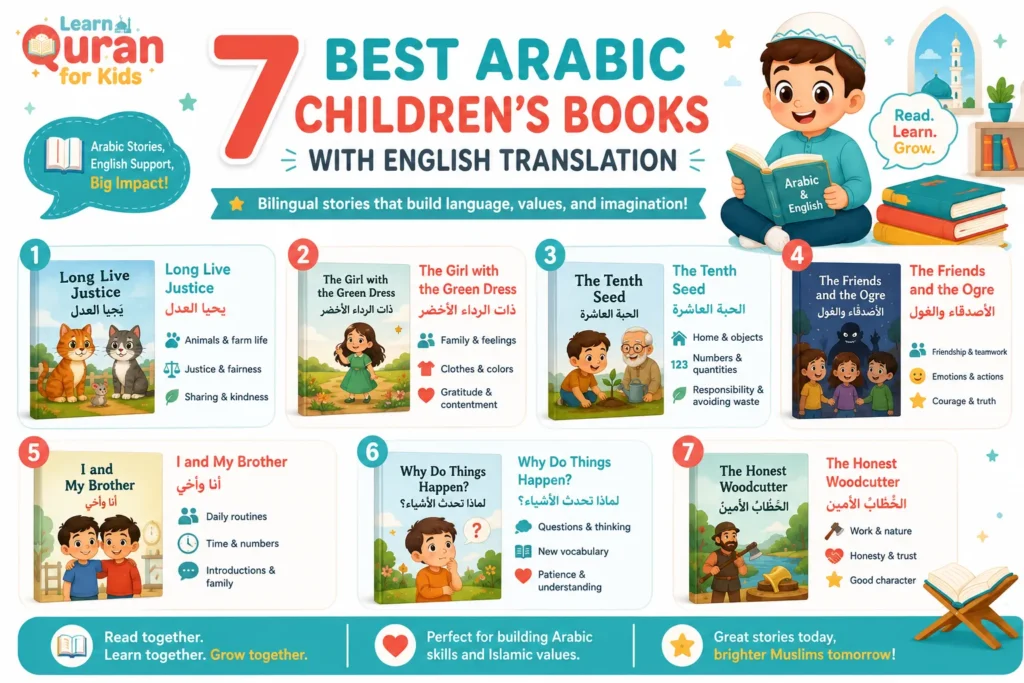
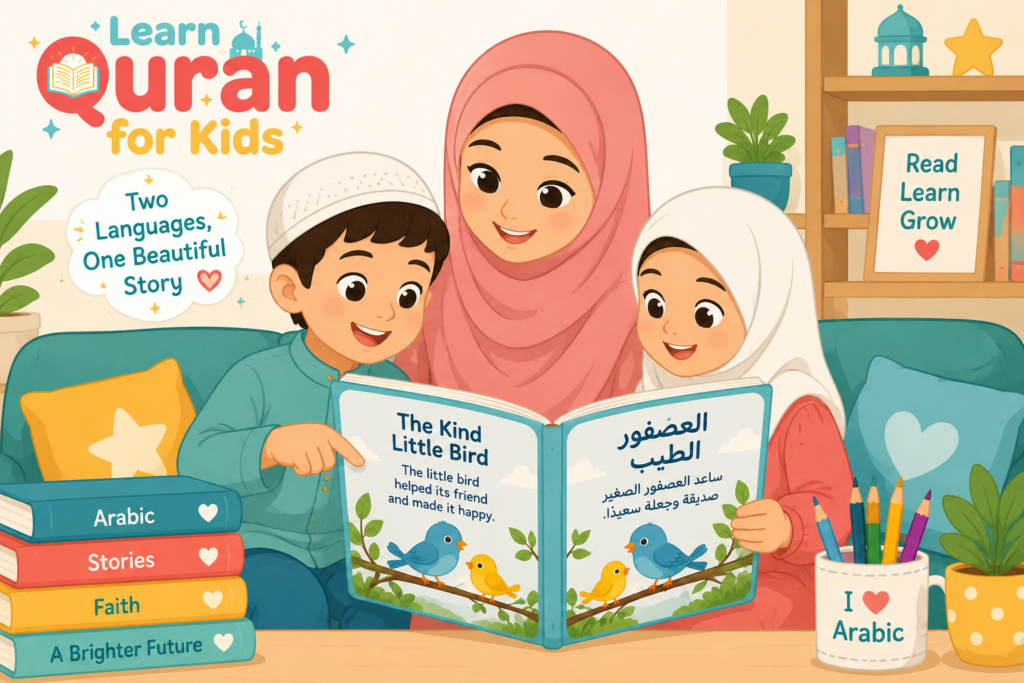
Arabic children’s books with English translation make learning Arabic easier and more enjoyable for young learners. They allow children to read simple Arabic while using English whenever they need help understanding the meaning. Through engaging stories, children encounter new words naturally instead of memorizing isolated vocabulary.
Regular story reading can improve Arabic reading, vocabulary, and comprehension at the same time. Illustrations also help beginners connect Arabic words with characters, objects, and actions. Many Arabic children’s stories go beyond language learning by teaching values such as honesty, patience, courage, gratitude, and justice.
This makes bilingual stories useful for both language development and character building. In this guide, parents will discover some of the best Arabic children’s books with English translation, including free options. You will also learn what each book teaches and which Arabic skills and vocabulary it can help children develop.
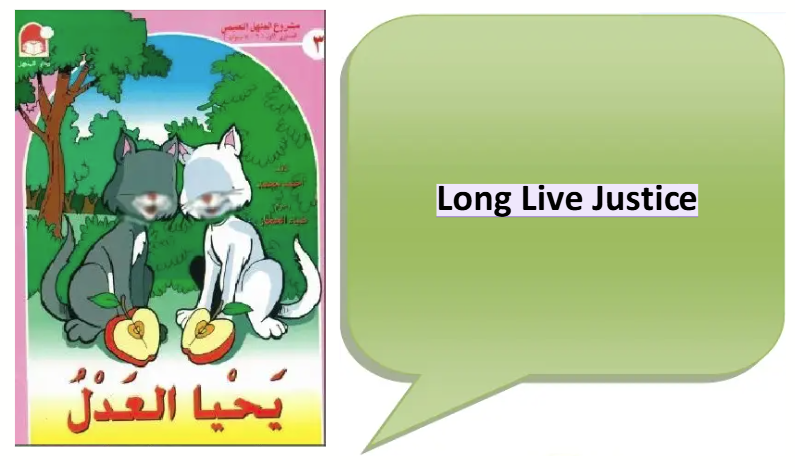
1. Long Live Justice – يحيا العدل
Long Live Justice follows two cats, Qattutah and Fattutah, who live on a large farm with Farfur, a mischievous mouse. Through the farm setting and the characters’ problem and eventual resolution, children encounter simple Arabic related to animals, colors, farm life, descriptive words, and basic sentence structures.
The story also introduces important values in an easy-to-understand way, teaching children about justice, fairness, sharing, and resolving disagreements peacefully.
Read also: Arabic Books for Kids
Read also: Best 10 Apps to Learn Arabic for Kids
Read also: The Best Islamic Gifts for Kids – 6 Types
2. The Girl With the Green Dress – ذات الرداء الأخضر
The Girl With the Green Dress follows a young girl whose mother asks her to take lunch to her father, while she feels unhappy about repeatedly wearing the same green dress. As the story unfolds, she experiences events that help her appreciate what she has.
Children can learn useful Arabic related to family, clothing, colors, feelings, and everyday verbs, while the story teaches important values such as obedience to parents, gratitude, contentment, and appreciation for what we already have.
Read also: Best 6 Islamic Ebooks for Kids
3. The Tenth Seed – الحبة العاشرة
The Tenth Seed follows Ahmad and his grandfather as Ahmad learns why seemingly small things, such as a lost pencil or a dripping water tap, should not be ignored. His grandfather uses everyday examples to teach him responsibility and the importance of avoiding waste. Through the story, children learn practical Arabic for everyday objects, home vocabulary, numbers, quantities, common actions, and simple dialogue, while discovering that small actions can have significant consequences and that time, effort, and resources should be valued.
Read also: Islamic Story Books for Kids
4. The Friends and the Ogre – الأصدقاء والغول
The Friends and the Ogre follows Ahmad and his friends when the electricity suddenly goes out, and a mysterious light makes them fear that an ogre is nearby. As they overcome their fear and search for the truth, children learn useful Arabic related to friendship, the home and surroundings, emotions, action verbs, and simple dialogue. The story also teaches valuable lessons about courage, patience, curiosity, and seeking the truth before making assumptions.
5. I and My Brother – أنا وأخي
I and My Brother introduces Waleed and Sa’eed through familiar situations such as greetings, introductions, talking about their ages, morning routines, and everyday family life. Children can practice useful Arabic for introducing themselves, numbers and ages, telling time, family members, and daily activities. The book is especially suitable for beginners because it uses short sentences, practical everyday vocabulary, familiar situations, and helpful visual support that make Arabic easier to understand and remember.
Read also: Islamic Manners for Kids
See Our Classes in Action!
Wondering what a typical lesson looks like? Take a peek inside our virtual classrooms below to see how our patient teachers keep students smiling, engaged, and learning every step of the way.
Start Your Child’s Quran Learning Journey Today!
Join Kids Learning Quran Academy and help your child read the Quran with confidence through fun and guided lessons.
Book a Free Trial Class6. The Small Spider and the Four Seasons – العنكبوت الصغير والفصول الأربعة
The Small Spider and the Four Seasons follows a determined little spider trying to reach the rooftop while facing a different challenge during winter, spring, summer, and autumn.
Through its repeated attempts, children learn Arabic vocabulary related to the four seasons, weather, nature, common verbs, and repeated sentence patterns.
It is particularly useful for beginners because it combines simple Arabic with English translation, pronunciation/transcription support, helpful illustrations, and free PDF availability, making the story easy to follow while encouraging persistence and language practice.
Read also: Seasons in Arabic for Kids
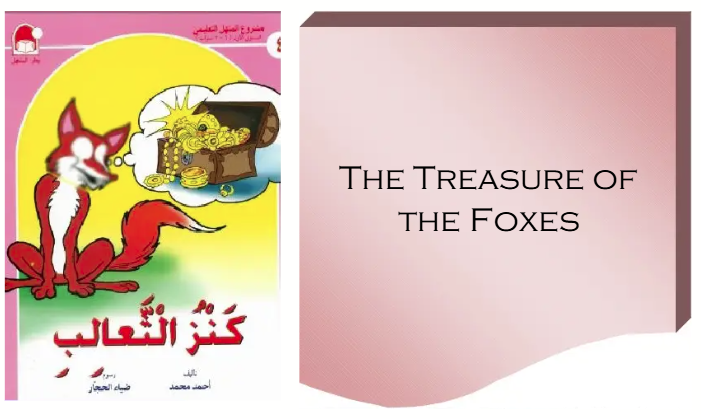
7. The Treasure of the Foxes – كنز الثعالب
The Treasure of the Foxes follows Tha’luub the fox and Kuukuu the rooster as mysterious treasure instructions send the fox on a journey involving a series of tasks and an unexpected outcome. The story introduces children to useful Arabic for animals, places, directions and positions, nature, action verbs, and sequencing events. Alongside its language-learning value, it teaches children that actions have consequences, deceiving others can lead to trouble, and it is important to think carefully before acting.
Read also: Islamic Moral Stories for Kids
Quick Comparison of the Best Arabic Children’s Books With English Translation
| Book | Arabic Title | Best For | Main Vocabulary / Learning Focus | Key Lesson | English Translation Available | Free/Paid |
| Long Live Justice | يحيا العدل | Learning through animal stories | Animals, colors, farm vocabulary, descriptions | Justice, fairness, and sharing | Yes | Free |
| The Girl With the Green Dress | ذات الرداء الأخضر | Family and everyday vocabulary | Family, clothing, colors, feelings | Gratitude, contentment, and obedience | Yes | Free |
| The Tenth Seed | الحبة العاشرة | Everyday Arabic and life lessons | Home objects, numbers, quantities, common actions | Avoid waste and value small things | Yes | Free |
| The Friends and the Ogre | الأصدقاء والغول | Emotions and simple storytelling | Friendship, surroundings, emotions, action verbs | Courage and avoiding assumptions | Yes | Free |
| I and My Brother | أنا وأخي | Beginner everyday Arabic | Greetings, ages, time, family, daily routines | Communication and everyday life skills | Yes | Free |
| The Small Spider and the Four Seasons | العنكبوت الصغير والفصول الأربعة | Beginners learning seasons and weather | Seasons, weather, nature, common verbs | Persistence and determination | Yes | Free PDF |
| The Treasure of the Foxes | كنز الثعالب | Vocabulary through adventure | Animals, places, directions, nature, sequencing | Think before acting; actions have consequences | Yes | Free |
Read also: Best 12 Islamic Apps for Kids
What Parents Should Check Before Downloading Free Arabic Books
Before downloading free Arabic children’s books with English translation, parents should check that the Arabic is clear and accurate, the vocabulary matches their child’s level, and the English translation correctly supports understanding. Books with harakat, illustrations, and pronunciation or transcription support can be especially helpful for beginners.
Parents should also consider the story’s educational value and age suitability. A useful example is The Small Spider and the Four Seasons, which is available in Arabic with Angela as a free PDF featuring Arabic text, English translation, illustrations, and pronunciation support.
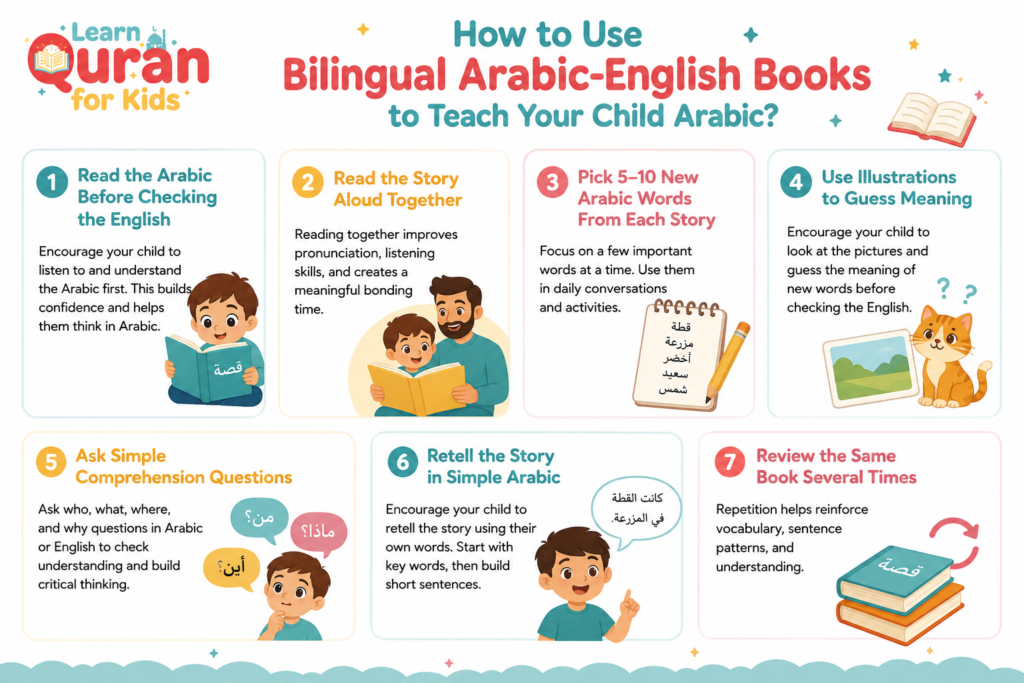
Arabic Children’s Books vs. Structured Arabic Lessons
Bilingual Arabic-English books help children develop vocabulary, reading comprehension, sentence recognition, and confidence through engaging stories. However, books alone cannot provide personalized correction, pronunciation feedback, structured grammar instruction, or speaking practice.
Structured Arabic lessons fill these gaps by giving children guided practice and direct support from a qualified teacher. Combining regular story reading with Arabic lessons allows children to reinforce what they learn through meaningful, enjoyable contexts.
As their vocabulary and comprehension improve, parents can gradually reduce reliance on the English translation. Over time, children can progress from English-supported stories to reading and understanding Arabic independently.
Read also: Seerah for Kids – The Complete Guide to Teaching Prophet Muhammad’s Life
Experience the Magic Firsthand
Watch these short clips from our live classes to see our interactive teaching tools, vibrant student-teacher interactions, and the fun, stress-free ways we make learning easy for kids!
Start Your Child’s Quran Learning Journey Today!
Join Kids Learning Quran Academy and help your child read the Quran with confidence through fun and guided lessons.
Book a Free Trial ClassHelp Your Child Learn Arabic With Learn Quran for Kids
Bilingual stories are a great starting point, but structured lessons can help children take their Arabic skills further. With Learn Quran for Kids, young learners can receive guided practice in Arabic reading and pronunciation while steadily building vocabulary and comprehension.
Developing these skills also provides an important foundation for reading and understanding Quranic Arabic. Explore our Arabic courses for kids and help your child progress from supported story reading to confident Arabic learning.
Our Courses Include:
- Tajweed for Kids
- Quran Memorization for Kids
- Quran Recitation Course for Kids
- Quran Classes for Toddlers
- Quran Tafseer for Kids
- Qaida for Kids
- Quran Reading Course for Kids
- Online Arabic Classes for Kids
- Quranic Arabic for Kids
- Islamic Studies Courses for Kids
- Islamic Studies for Kindergarten
- 5 Pillars of Islam for Kids
- Islamic Education for Kids
Read also: How To Learn Quranic Arabic For Kids?
Conclusion
Arabic children’s books with English translation give young learners an enjoyable way to build vocabulary, improve reading comprehension, and become more familiar with Arabic sentence patterns. Regular story reading at home can turn Arabic practice into a natural part of a child’s routine while keeping learning engaging.
As children gain confidence, parents can gradually reduce their reliance on English translations and encourage more independent Arabic reading. For children ready to take the next step, Learn Quran for Kids provides structured Arabic learning with guided reading, pronunciation practice, vocabulary development, and skills that build a strong foundation for understanding Quranic Arabic.
FAQs About Arabic Children’s Books With English Translation
What Are The Best Arabic Children’s Books With English Translation?
Some good options include Long Live Justice, The Girl With the Green Dress, The Tenth Seed, The Friends and the Ogre, I and My Brother, The Small Spider and the Four Seasons, and The Treasure of the Foxes. These stories combine simple Arabic with English support, useful vocabulary, engaging illustrations, and educational or moral lessons.
Where Can I Find Free Arabic Children’s Books With English Translation?
You can find free Arabic children’s books with English translation on educational Arabic-learning websites that offer downloadable stories and PDFs. For example, Arabic with Angela provides The Small Spider and the Four Seasons as a free bilingual resource with English translation and pronunciation support.
Are Arabic-English Bilingual Books Good For Beginners?
Yes. Arabic-English bilingual books are excellent for beginners because they allow children to read Arabic while checking the English translation when needed. They help build vocabulary, improve comprehension, and gradually develop confidence in reading Arabic independently.
At What Age Should Children Start Reading Arabic Books?
Children can start exploring Arabic books from around ages 3–5 through simple picture books, read-aloud stories, and alphabet books. As their skills develop, parents can introduce short bilingual stories with simple vocabulary and gradually progress to independent Arabic reading.
Should Arabic Children’s Books Include Harakat?
Yes, harakat (Arabic vowel marks) are especially helpful for beginners because they guide children toward correct pronunciation and make unfamiliar words easier to read. As reading skills improve, children can gradually transition to books with fewer harakat.
Are There Free Arabic Storybooks In Pdf With English Translation?
Yes. Some educational websites offer free Arabic storybooks in PDF with English translation for children and beginners. These resources often include simple Arabic, illustrations, and vocabulary support; some, such as The Small Spider and the Four Seasons, also provide pronunciation support.
Should Children Read The Arabic Or English Text First?
Children should generally read or listen to the Arabic text first and use the English translation afterward to check their understanding. This encourages them to think in Arabic, recognize familiar vocabulary, and gradually rely less on English.
Can Arabic Children’s Books Help Kids Learn To Speak Arabic?
Yes. Arabic children’s books can support speaking skills by introducing useful vocabulary, common expressions, and simple sentence patterns. Reading aloud, repeating dialogue, and retelling stories in Arabic can help children improve pronunciation and speak with greater confidence.
How Often Should My Child Read Arabic Stories?
Ideally, children should read Arabic stories several times a week or for 10–15 minutes daily. Short, consistent reading sessions help strengthen vocabulary, comprehension, pronunciation, and overall reading confidence.
Can Non-Arabic-Speaking Parents Use Bilingual Arabic Books With Their Children?
Yes. Bilingual Arabic-English books are especially useful for non-Arabic-speaking parents because the English translation helps them understand the story and support their child. Parents can read together, discuss illustrations, practice vocabulary, and learn Arabic alongside their children.
Related Articles
Arabic Learning Resources