 Learn Quran
Does your child switch off the moment you say “Ikhfa”? Rule names are abstract to a young child. That is why tajweed games and activities for kids work so well. The sounds behind them, a nasal hum or a bouncing echo, are things a child can feel, act out, and enjoy.
A game turns each rule into a movement, a color, or a puzzle, so your child practices correct recitation without it feeling like a lesson. This guide covers 15 fun tajweed activities you can run at home with paper, colored pens, and a short surah, plus 2 digital games. It also explains what to look for in digital tajweed games, which rules to teach first, and which activities suit each age.
A. Movement Tajweed Games For Kids – Rules Children Can Hear And Feel
The first rules to teach are the ones a child can hear instantly: Ghunnah, Qalqalah, and Madd. These rules suit movement games because each has a physical quality you can mirror with the body.
1. The Nose-Pinch Test For Ghunnah
Ghunnah is a resonant, nasal sound held clearly on a shaddah-bearing noon or meem. To bring this concept to life, ask your child to gently pinch their nose while reciting a Quranic word featuring a clear Ghunnah, such as “inna” (إِنَّ) or “thumma” (ثُمَّ). If they notice the sound cutting off completely, it proves that the airflow passes directly through the nose.
Following this, have them test the same pinch on a word completely devoid of Ghunnah to compare the difference firsthand. This interactive, sensory experience guarantees a deep and lasting grasp of the rule far beyond abstract theoretical memorization.

2. The Qalqalah Jump
Qalqalah is that distinct, light acoustic echo or noticeable bounce produced when pronouncing any of the five letters grouped in the famous phrase “qutb jad” (قطب جد). To anchor this rule through engaging physical activity, write these letters clearly on colorful cards and scatter them around the room.
Every time a quiescent Qalqalah letter appears in the recitation, such as in the words “al-falaq” (ٱلْفَلَقِ) or “ahad” (أَحَدٌ), ask your child to perform a small, light jump. This fast-paced kinesthetic strategy aims to link the acoustic rebound of the letter directly to an immediate physical reaction, making the learning process vibrant, joyful, and unforgettable.
3. The Madd Arm-Stretch Race
Madd means lengthening a vowel, and you count the length in beats (harakat). Your child stretches their arms to match the length:
- 2 beats (natural Madd): a short arm stretch
- 4 to 5 beats (connected and separated Madd): both arms half out
- 6 beats (necessary Madd): arms fully spread
Recite wa lad-daalleen (وَلَا ٱلضَّآلِّينَ) and watch for a full six-beat stretch. Children can instantly tell if they cut a Madd short.
4. The Echo Reciter
Recite a verse with a clear rule, such as a strong Ghunnah or Qalqalah, and have your child repeat it like an exaggerated echo. The exaggeration is useful: it makes your child notice the rule’s sound and often makes them laugh, which helps the sound stick.
If you want a teacher to check that your child’s Ghunnah length and Madd counts are accurate, Learn Quran for Kids‘ Tajweed course pairs your child with Ijazah-certified tutors who use these kinds of games inside one-on-one lessons.
See Our Classes in Action!
Wondering what a typical lesson looks like? Take a peek inside our virtual classrooms below to see how our patient teachers keep students smiling, engaged, and learning every step of the way.
Start Your Child’s Quran Learning Journey Today!
Join Kids Learning Quran Academy and help your child read the Quran with confidence through fun and guided lessons.
Book a Free Trial ClassB. Paper And Hands-On Tajweed Activities For Kids
Paper activities suit rules that depend on spotting which letter comes next, such as the rules of Noon Sakinah and Tanween. They also work well for sorting letters by quality.
5. The Noon Sakinah Color Hunt
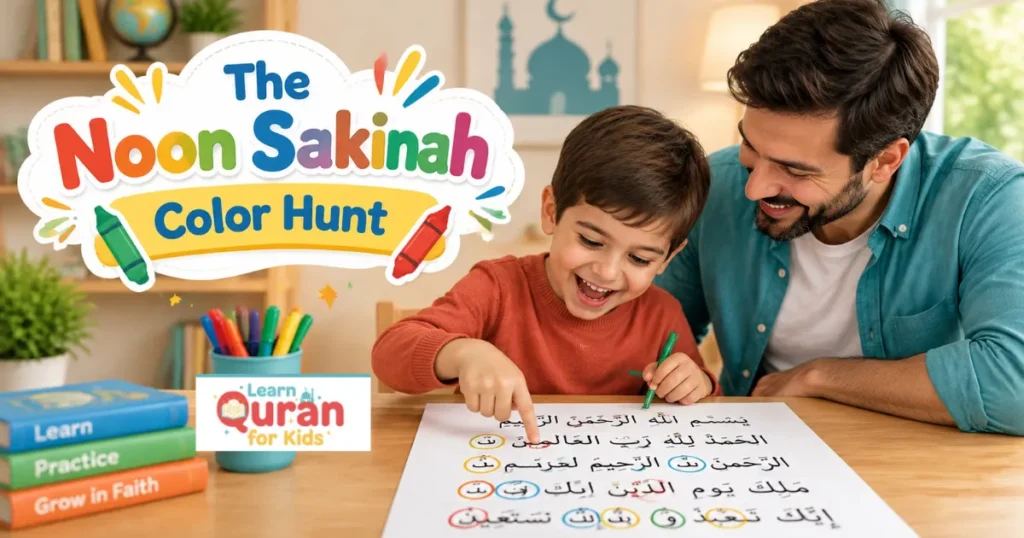
Print a page from a short surah your child already reads, and give them four colored pens. Assign one color to each Noon Sakinah and Tanween rule: red for Ikhfa, green for Idgham, blue for Izhar, and yellow for Iqlab.
Your child marks every example they find, and whoever “catches” the most correct examples wins. The key step comes after coloring: your child reads each marked word aloud. Coloring trains the eye to spot the rule, but only reading aloud trains the tongue to apply it.
6. Heavy And Light Letter Boxes
Tafkheem (heavy letters) and tarqeeq (light letters) are easy to confuse. Label two boxes “heavy” and “light,” then give your child letter cards to sort. The seven always-heavy letters are grouped in the phrase khussa daghtin qiz (خص ضغط قظ).
Once sorting is easy, move up the ladder: read a verse and ask your child to tap the table on every heavy letter.
7. Tanween Fishing
Draw a fish tank on a board and cut out paper fish with words showing Izhar, Idgham, Iqlab, or Ikhfa. Attach a paperclip to each fish. Your child uses a magnetic fishing rod to catch a fish, reads the word aloud, and drops it into the correct rule’s basket. A wrong basket means the fish goes back into the tank.
8. The Madd Train
Draw a train with three carriages: natural Madd, connected Madd, and separated Madd. Your child places Quranic word cards in the right carriage based on how long the vowel is held.
This is a good follow-up once the arm-stretch race is easy, because it moves your child from feeling the length to recognizing which type of Madd causes it.
9. Rule And Letter Memory Match
Make face-down cards where half show a rule name and half show its trigger letter. For example, “Iqlab” matches the letter ba (ب), because a Noon Sakinah before ba turns into a meem sound. Your child flips two cards at a time and keeps any matching pair. Siblings can take turns, which makes it a quick family game.
Read also: Interactive Ways To Teach Quran Reading For Kids – 12 Fun And Effective Methods
C. Fun Tajweed Activities For Listening, Stopping, And Correct Pronunciation
The interactive, ear-training activities are designed to elevate your child’s recitation accuracy by focusing intensely on precise listening, proper stopping mechanics, and flawless pronunciation. They serve as the ultimate next step in the learning journey, yielding the greatest impact and fluency once your child has already mastered the foundational movement and paper-based games for each rule.
10. The Mirror Test For Makharij
Mastering precise articulation points, known as makharij, requires careful visual and auditory feedback. Standing in front of a mirror allows your child to closely observe physical mouth placements, such as noticing how the tip of the tongue gently emerges between the teeth for letters like dhal, tha, and dha.
By comparing this action directly with letters like zay and seen, where the tongue remains entirely hidden behind the teeth, learners can visually verify their own mechanical accuracy. This powerful observational technique permanently corrects common pronunciation habits.

11. The Traffic Light For Waqf
Understanding where to pause and where to continue during recitation is essential for preserving the proper meaning of Quranic verses. This engaging game utilizes familiar visual cues by assigning distinct red, green, and yellow cards to specific stopping signs found within the Mushaf text.
As you recite a verse and pause at a marked symbol, your child must quickly raise the correct corresponding color card. This fast-paced interactive challenge transforms technical stopping rules into an intuitive reaction, successfully bridging theoretical knowledge with fluid, accurate recitation practice.
12. The Little Detective
Recite a verse and deliberately make one tajweed mistake: skip a Ghunnah or shorten a Madd. Your child has to catch it. Children love catching an adult’s mistakes, and spotting an error in someone else’s recitation trains the same ear they need to hear their own.
For siblings or a class, play it as the hot seat: one child recites while the others listen for the rule applied or missed. Whoever catches it correctly takes the seat next.
13. “Who Am I?” Tajweed Riddles
Engaging children through playful linguistic riddles stimulates critical thinking while reinforcing core phonetic concepts without requiring any preparation materials or physical props. Describing the specific behavioral traits of a rule allows your child to deduce the exact terminology through clever clues and structural hints.
This conversational challenge proves exceptionally valuable during long car journeys or transition times, turning idle moments into productive learning opportunities that deeply test their conceptual understanding and quick recall abilities.
14. The Noon Sakinah Family Story
Turn the four Noon Sakinah rules into characters. Noon Sakinah and Tanween are twin sisters with four aunts. Aunt Izhar loves clarity and has six letters she always pronounces clearly. Aunt Iqlab is shy and has only one favorite letter, ba, which she changes into a meem.
Aunt Idgham merges with her six letters, and Aunt Ikhfa hides the noon gently before her fifteen letters. A story gives your child a way to recall which letters belong to which rule.
15. The Weekly Rule Star
Establishing a sustainable daily habit requires focused, incremental practice rather than overwhelming students with too many complex concepts at once. Selecting just one specific Tajweed rule to target throughout an entire week keeps the learning objective clear, manageable, and entirely achievable.
Every time your child successfully incorporates this designated rule into their independent recitation, a bright star gets added to a prominent wall chart. This positive reinforcement system celebrates continuous progress and successfully transforms abstract classroom games into lifelong recitation habits.
Read also: Tajweed Rules For Kids – A Simple Guide To Teaching Children Quran Tajweed
D. Digital Tajweed Games For Kids
Digital tajweed games for kids can add variety, but quality varies widely. The two games below suit different children. The first uses English labels and fits beginners. The second is fully in Arabic and fits children who already read some Arabic.
16. Tajweed Rules Maze Chase
Wordwall is an online platform where teachers build interactive learning games from ready-made templates and share them publicly. The Tajweed Rules Maze Chase is one of these shared games, built for young beginners.
Your child steers a character through a maze and enters the zone that matches the question, such as Qalqalah, Ghunnah, or Madd. Because it focuses on the rules children can hear first, it pairs well with the movement games in Section A. Play the nose-pinch test or the Qalqalah jump first, then use the maze to check that your child can name the rule.
The game uses English labels, so children who don’t read Arabic yet can play on their own. Like all user-made activities, it’s worth playing through once yourself to check the answers before handing it to your child.
17. Super Tajweedoo
Tajweedoo is a platform of digital tajweed games designed for children. Super Tajweedoo is its flagship game: a platform adventure where your child moves through levels by answering tajweed challenges along the way.
The game covers rules across all levels, which makes it a good review once your child has learned several rules through the home activities. Use it as a reward at the end of a week of practice, after your child has earned their weekly rule star.
Super Tajweedoo is fully in Arabic, so it suits children who can already read some Arabic. Younger children or new readers will enjoy it more with a parent beside them to read the questions aloud.
What to Look for in Any Tajweed Game or App
Before you let your child use a tajweed game or app, check it against these criteria:
- Correct examples, checked by you or a teacher, especially in user-made games
- Full diacritics on every word, in standard Mushaf script
- Levels that move from easy to hard, one rule at a time
- Real recitation audio where the game includes sound, not synthetic voices
- No ads or open chat, especially for younger children
Even the best digital game has one limit: it can test whether your child recognizes a rule, but it cannot reliably correct the subtle errors in their own recitation. Ghunnah held too short, a heavy letter read lightly, or a letter produced from the wrong point usually needs a trained ear to catch.
This is where a live teacher makes the difference. Learn Quran for Kids tutors use interactive whiteboards, visual tajweed charts, and gamified challenges in one-on-one online classes, so your child gets the fun of a game with real-time correction.
Experience the Magic Firsthand
Watch these short clips from our live classes to see our interactive teaching tools, vibrant student-teacher interactions, and the fun, stress-free ways we make learning easy for kids!
Start Your Child’s Quran Learning Journey Today!
Join Kids Learning Quran Academy and help your child read the Quran with confidence through fun and guided lessons.
Book a Free Trial ClassWhich Tajweed Rules To Teach First, And At What Age
Tajweed is easier for children when the rules are taught in a deliberate order. A useful sequence starts with rules a child can hear, then moves to rules that depend on the next letter, and ends with the finer points of pronunciation.
The Best Order To Teach Tajweed Rules
- Rules you can hear: Qalqalah, Ghunnah, and Madd
- Noon Sakinah and Tanween: Izhar, Idgham, Iqlab, and Ikhfa, one at a time, then a combined review
- A sakin letter meeting the next letter: Meem Sakinah, and the sun and moon letters (Lam Shamsiyyah and Qamariyyah)
- Heavy and light sounds: Tafkheem and tarqeeq, the rules of Raa, and the lam in the name of Allah
- Waqf: stopping at the end of a word and reading the stop signs in the Mushaf
- Makharij: the articulation points, from the throat to the lips
Each stage builds on the one before it. Teaching Ikhfa before your child can hear Ghunnah, for example, rarely works, because Ikhfa itself carries a Ghunnah.
Tajweed activities by age
| Age | Approach | Best games |
| 4–7 years | Imitation only, no rule names | Nose-pinch test, Qalqalah jump, Madd arm stretch, echo reciter |
| 8–10 years | Core rule names introduced through play | Color hunt, letter boxes, memory match, traffic light, riddles |
| 11+ years | Full rule set, can begin Tuhfat al-Atfal | Little detective, hot seat, record-and-compare, weekly rule star |
Read also: How To Make Quran Reading Fun For Your Kids- 12 Practical Ideas For Parents
Common Mistakes That Make Tajweed Games Stop Working
Tajweed games only help when they lead to better recitation. These are the mistakes that most often turn a fun activity into wasted time.
- Teaching Too Many Rules At Once: Mixing four new rules in one session confuses children. Introduce one rule, play two or three games with it, and apply it in recitation before adding the next. The weekly rule star exists for exactly this reason.
- Using Random Words Instead Of The Child’s Own Surah: Practice words pulled from a worksheet rarely transfer to real recitation. Build your cards and color hunts from the surah your child is currently reading or memorizing, so every game strengthens the verses they actually recite.
- Treating The Game As The Goal: A child can win every sorting game and still recite incorrectly. Close each session by having your child read the verse aloud with the rule applied. A simple 15-minute session works well: a short movement warm-up, one focused game, then a few minutes of real recitation.
- Turning Games Into Tests: When every round is graded, play becomes pressure. Keep correction light, praise the effort, and let your child catch your mistakes too. A relaxed child listens more closely.
Book Your Child’s Free Tajweed Trial Class Today
Games build your child’s love for tajweed. A qualified teacher makes sure every Ghunnah, Madd, and Qalqalah is correct before mistakes become habits.
At Learn Quran for Kids, your child learns tajweed in live one-on-one online classes with Ijazah-certified tutors trained to teach children. Lessons use visual tajweed charts, Quranic stories, and gamified challenges, and you receive a progress report after every session. Children can start from age 4, with morning, evening, and weekend slots across time zones.
Your child’s first class is free, so they can meet their tutor and experience the teaching style before you commit.
Our Courses Include:
- Tajweed Course for Kids
- Quran Memorization Course for Kids
- Quran Recitation Course for Kids
- Quran Classes for Toddlers
- Quran Tafseer Course for Kids
- Qaida Course for Kids
- Quran Reading Course for Kids
Join Kids Learning Quran Academy now and start your child’s learning journey today!
Start Your Child’s Quran Learning Journey Today!
Join Kids Learning Quran Academy and help your child read the Quran with confidence through fun and guided lessons.
Book a Free Trial ClassConclusion
The best tajweed games and activities for kids turn each rule into something a child can feel, see, or hear: a jump for Qalqalah, a nose pinch for Ghunnah, an arm stretch for Madd, and a color for each Noon Sakinah rule.
Start with sound before names, teach one rule at a time in a clear order, and use the Spot it, Find it, Hear it, Say it ladder so every game ends in real recitation. Match the activity to your child’s age, and keep sessions short and relaxed.
Games make tajweed enjoyable. Combined with a teacher who can hear and correct your child, they make it accurate too.
Frequently Asked Questions
What Are The Best Tajweed Games For Kids?
The best tajweed games for kids link each rule to an action: the nose-pinch test for Ghunnah, the Qalqalah jump, the Madd arm stretch, and the Noon Sakinah color hunt. Choose games that end with your child reciting the verse aloud.
At What Age Can Kids Start Tajweed Activities?
Kids can start tajweed activities from about age 4 through imitation and movement games, without rule names. Rule names usually suit children from age 8 or 9, and the full rule set from around age 11.
How Long Should A Tajweed Game Session Last?
A tajweed game session for children works best at around 10 to 15 minutes. Include a short movement warm-up, one focused game on a single rule, and a few minutes of applying that rule in real recitation.
Can Kids Learn Tajweed From Games And Apps Alone?
Kids cannot fully learn tajweed from games and apps alone. Games build understanding and motivation, but subtle errors in Ghunnah length, heavy letters, and articulation points usually need correction from a qualified teacher.
Which Tajweed Rule Should Kids Learn First?
Kids should learn the tajweed rules they can hear first: Qalqalah, Ghunnah, and Madd. After these, move to the four rules of Noon Sakinah and Tanween, then Meem Sakinah and the sun and moon letters.






[…] Read also: Tajweed Games And Activities For Kids – 17 Fun Ideas That Make Tajweed Rules Stick […]