 Learn Quran
Many parents wonder How To Teach The Quran For Kids In A Fun Way without making lessons a daily struggle. Children learn best when they feel safe, curious, and encouraged, so a positive approach can shape their relationship with the Quran as they grow.
Teaching the Quran is not only about memorizing Surahs. It is also about helping children read correctly, understand simple meanings, and build a lasting connection with the Quran.
This guide shares practical Quran activities for kids, simple ways to encourage love of the Quran, and ideas for making learning easier and more engaging for children at different ages.
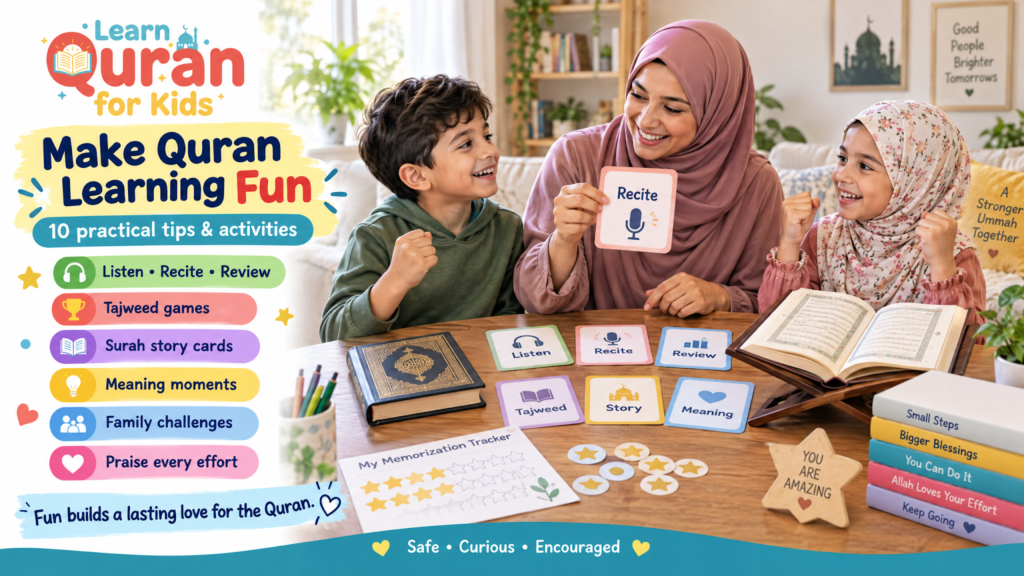
1. Be a Living Example of Loving the Quran
Children copy what they see far more than what they are told. When a child regularly sees a parent reciting the Quran calmly, perhaps after Fajr prayer or before bedtime, the Quran becomes a familiar and loved part of family life rather than a school subject that only happens in class.
Show your child small signs of respect for the Mushaf, such as making wudu (ablution) before holding it, placing it on a clean, high shelf, and listening quietly when someone recites. These simple actions teach children that the Quran is the Book of Allah, special and different from every other book at home.
Parents can also recite with a gentle, beautiful voice and invite the child to sit close beside them. This shared moment is one of the easiest ways to instill love of the Quran in kids, because the child links the Quran with warmth, attention, and quality time with the people they love most.
2. Start Small With Short Surahs and Short Sessions
One of the best ways to make the Quran easy for kids is to begin with Surah Al-Fatiha and the short surahs of Juz Amma, the 30th part of the Quran. Surahs such as Al-Ikhlas, Al-Falaq, and An-Nas are short, rhythmic, and recited often in daily prayers, so children hear them repeatedly.
Keep each session short, around 10 to 15 minutes for younger children, and stop while your child is still enjoying it. Ending on a happy note makes children look forward to the next lesson, while long sessions often lead to fatigue, distraction, and a negative feeling about Quran time.
Read Also: Teaching the Quran to kids step by step
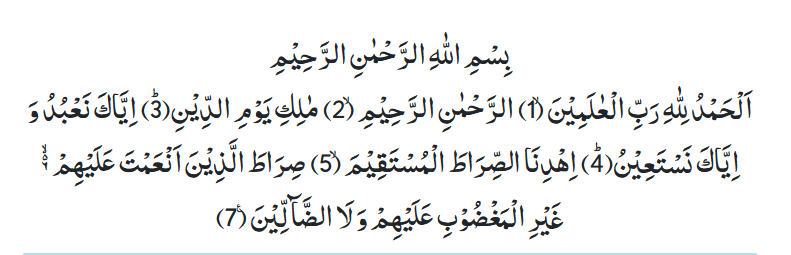
3. Turn Arabic Letters Into Games
Before a child can read the Quran fluently, they need to recognize Arabic letters and their sounds. Make this stage enjoyable with colorful flashcards, magnetic letters, matching puzzles, or simple games where the child searches for a specific letter in the Mushaf.
It is also a good opportunity to share the Hadith that each letter recited from the Book of Allah brings a good deed multiplied ten times. Children can enjoy counting the letters in a short word and learning about the reward of reciting the Quran.
مَنْ قَرَأَ حَرْفًا مِنْ كِتَابِ اللَّهِ فَلَهُ بِهِ حَسَنَةٌ وَالْحَسَنَةُ بِعَشْرِ أَمْثَالِهَا لاَ أَقُولُ الم حَرْفٌ وَلَكِنْ أَلِفٌ حَرْفٌ وَلاَمٌ حَرْفٌ وَمِيمٌ حَرْفٌ
“Whoever recites a letter from Allah’s Book, then he receives the reward from it, and the reward of ten the like of it. I do not say that Alif Lam Mim is a letter, but Alif is a letter, Lam is a letter and Mim is a letter.”
Jami’ at-Tirmidhi 2910 (graded Hasan Sahih by at-Tirmidhi)
If you would like structured support, the Quran reading course for kids at Kids Learning Quran Academy guides children from the Arabic alphabet to confident reading through fun.
Experience the Magic Firsthand
A child’s Quran learning journey begins with the basics of Arabic letters and gradually develops into confident Quran recitation.
Start Your Child’s Quran Learning Journey Today!
Join Kids Learning Quran Academy and help your child read the Quran with confidence through fun and guided lessons.
Book a Free Trial Class4. Use Listening and Echo Recitation
Children are natural imitators, so listening is one of the most effective ways to How To Teach The Quran For Kids In A Fun Way. Play a clear, slow recitation of a short Surah during car rides, breakfast, or quiet time, allowing your child to hear the same verses repeatedly before asking them to repeat.
Echo recitation can make practice feel like a simple call-and-response game. The parent or teacher recites a short phrase, and the child repeats it, taking turns with siblings or leading the next phrase to stay engaged.
Listening also helps children develop correct pronunciation from the beginning. As they grow, a Tajweed course for kids can introduce recitation rules in simple, child-friendly steps.

5. Make Quran Memorization Playful
Hifz, or memorizing the Quran, is a beautiful goal, but children often memorize best when repetition feels like play rather than pressure. Long or repetitive sessions can make children lose focus, while short and enjoyable activities can keep their minds active and make learning feel more rewarding.
Parents can mix regular review with simple games, fun challenges, and small rewards to help children stay engaged. This approach reduces boredom, strengthens recall, and helps verses become firmly established in a child’s long-term memory.
Over time, consistent and enjoyable practice can make Quran memorization a positive part of the child’s daily routine.
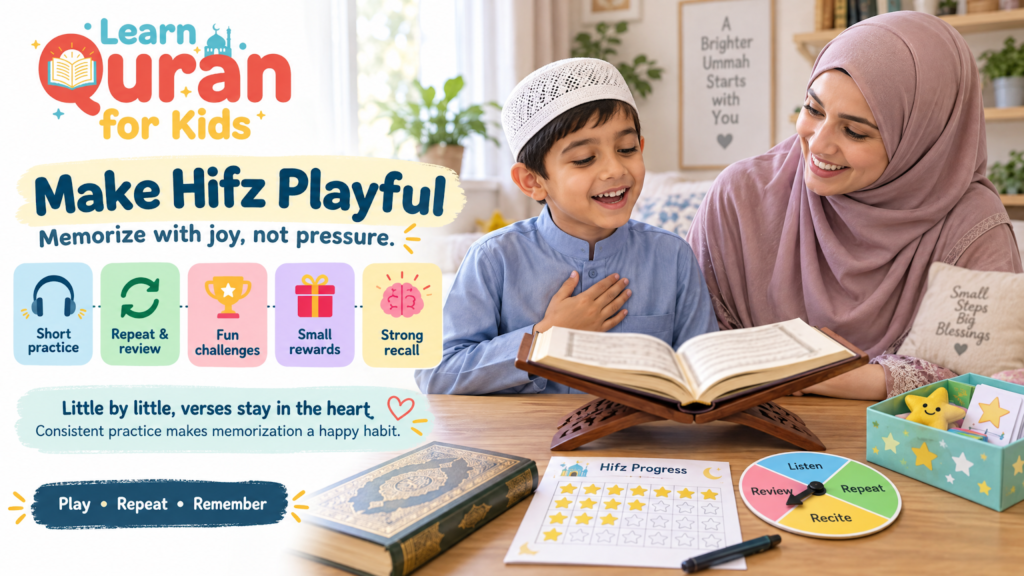
Fun Memorization Activities to Try at Home
These simple fun Quran activities for kids can make memorization and repetition more enjoyable and engaging. Instead of relying only on traditional repetition, parents can use games, movement, and simple challenges to help children recall verses in a relaxed way.
For families looking for additional support, a Quran memorization course for kids can provide regular revision, personalized hifz goals, and guidance from a qualified teacher.
- Verse puzzle: Mix cards with verses from a short surah and ask your child to put them in the correct order.
- Missing word game: Pause before the last word of a verse and let your child complete it from memory.
- Treasure hunt: Hide verse cards around the house and ask your child to recite each one when they find it.
- Memory jar: Add a bead or marble for every memorized verse and celebrate when the jar is full.
- Surah of the week: Choose one short surah to recite together each day until it is memorized.
Start Your Child’s Quran Learning Journey Today!Join Kids Learning Quran Academy and help your child read the Quran with confidence through fun and guided lessons.

6. Tell Quran Stories That Spark Curiosity
The Quran contains many stories of prophets and righteous people, including Prophet Yusuf, Prophet Musa, Prophet Yunus, and Prophet Nuh, peace be upon them. Children are naturally drawn to stories, so linking a story to the verses where it appears is a powerful way to make kids engage with the Quran.
نَحْنُ نَقُصُّ عَلَيْكَ أَحْسَنَ ٱلْقَصَصِ بِمَآ أَوْحَيْنَآ إِلَيْكَ هَٰذَا ٱلْقُرْءَانَ وَإِن كُنتَ مِن قَبْلِهِۦ لَمِنَ ٱلْغَٰفِلِينَ
“We relate to you, [O Muhammad], the best of stories in what We have revealed to you of this Qur’an although you were, before it, among the unaware.”
Tell each story simply, then read a few related verses together. For example, the story of Prophet Yunus can teach children about patience and turning to Allah during difficult times.
Read Also; fun facts and information about the Quran for kids.
7. Connect Quran Verses to Everyday Life
Children understand the Quran more deeply when they see how its teachings apply to everyday life. When your child tells the truth, shares, or helps others, gently connect these actions to the good manners encouraged by the Quran. This helps children see the Quran as a guide for life, not only a book to recite.
Simple Tafseer (explanation of the Quran) also helps children understand what they recite. Learning the basic meaning of Surah Al-Fatiha or Surah Al-Ikhlas can make prayer more meaningful and strengthen their connection with the words of Allah.
To support this approach, Kids Learning Quran Academy offers a Quran tafseer course for kids that explains short Surahs through simple language, examples, and stories suited to children’s age.
8. Add Arts, Crafts, and Hands-On Activities
Hands-on projects are among the most memorable ways to How To Teach The Quran For Kids In A Fun Way, especially for children who learn by doing.
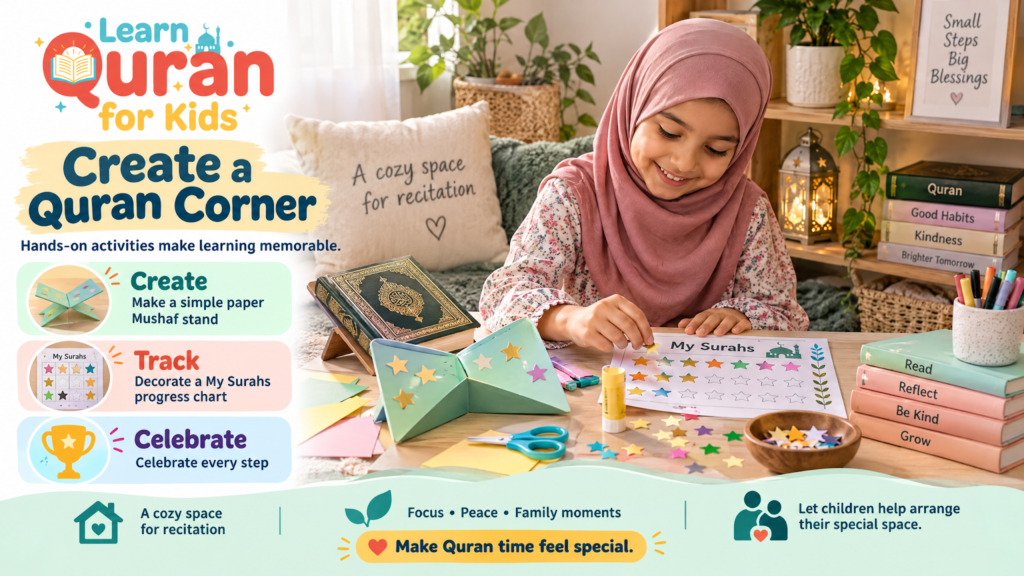
Coloring Arabic letters, making a simple paper Quran stand, or decorating a “My Surahs” progress chart with stickers gives children a creative way to practise and celebrate their progress.
You can also create a cozy Quran corner at home with a small rug, cushions, a Mushaf, and good lighting. Let your child help arrange the space so they feel connected to it.
A calm, special place for recitation can help children associate Quran time with focus, peace, and positive family moments.
9. Create Friendly Competitions and Reward Effort
Friendly challenges can make Quran learning more exciting. Families can try a simple recitation contest, a weekly Quran story quiz, or challenges that encourage children to improve their own previous progress.
Rewards should focus on effort, using stickers, small treats, family outings, or heartfelt praise. This is especially meaningful in light of the Hadith:
الْمَاهِرُ بِالْقُرْآنِ مَعَ السَّفَرَةِ الْكِرَامِ الْبَرَرَةِ وَالَّذِي يَقْرَأُ الْقُرْآنَ وَيَتَتَعْتَعُ فِيهِ وَهُوَ عَلَيْهِ شَاقٌّ لَهُ أَجْرَانِ
“One who is proficient in the Qur’an is associated with the noble, upright, recording angels; and he who falters in it, and finds it difficult for him, will have two rewards.”
Sharing this Hadith with a child who finds reading difficult can be deeply encouraging. It teaches them that Allah values sincere effort, and that stumbling over words is not a failure but part of a rewarded journey toward reading the Quran beautifully and confidently.
10. Use Technology and Teaching Quran to Kids Online
Technology can support Quran learning when used with purpose and limits. Quran apps, audio recitations, and educational videos allow children to hear correct recitation while following the text, supporting different learning styles.
Online Quran classes with a qualified teacher add live correction and personal attention that apps cannot provide. One-to-one lessons also save travel time and offer flexible scheduling around school and family activities.
At Kids Learning Quran Academy, interactive online lessons use games, visual aids, and encouragement to keep children engaged. Parents can also follow their child’s progress and support practice at home.
Free Ways to Support Quran Learning for Kids at Home
Quran learning for kids does not have to be expensive. Many of the most effective methods are completely free, including reciting together after prayer, playing recitations at home, telling stories of the prophets at bedtime, and using printable letter cards or homemade memorization games.
Free resources work best alongside some expert guidance, because parents may not always notice pronunciation mistakes. Booking a free trial class with an experienced Quran teacher is a simple way to assess your child’s current level and receive a clear learning plan before committing to regular lessons.
Common Mistakes That Make Kids Lose Interest in the Quran
Even well-meaning parents can sometimes make Quran learning feel stressful or overwhelming for a child without intending to. Parents naturally want their children to learn quickly and make steady progress, but too much pressure can have the opposite effect.
A supportive approach focuses on building a positive relationship with the Quran while allowing children to learn at a pace that suits their age and ability. Avoiding a few common mistakes can help keep lessons calm, encouraging, and enjoyable while supporting steady progress.
- Making lessons too long: Long sessions can cause boredom and make it harder for children to stay focused.
- Comparing children: Comparing a child with siblings or classmates can reduce confidence and motivation.
- Using Quran time as punishment: Quran recitation should remain associated with love and guidance, not punishment or fear.
- Focusing only on speed: Progress should not be measured only by how quickly a child memorizes, but also by correct reading and understanding.

Start Your Child’s Quran Learning Journey Today!
Join Kids Learning Quran Academy and help your child read the Quran with confidence through fun and guided lessons.
Book a Free Trial ClassGive Your Child a Joyful Start With Kids Learning Quran Academy
If you want expert help to teach your child the Quran in a fun and structured way, Kids Learning Quran Academy is here for your family. Our qualified teachers offer one-to-one online classes in Quran reading, tajweed, memorization, and tafseer, all designed specifically for children and their learning needs.
Book a free trial class today to meet a teacher, see how our interactive lessons work, and receive a personalized learning plan for your child.
Our Courses Include:
- Tajweed Course for Kids
- Quran Memorization Course for Kids
- Quran Recitation Course for Kids
- Quran Classes for Toddlers
- Quran Tafseer Course for Kids
- Qaida Course for Kids
- Quran Reading Course for Kids
- Online Arabic Classes for Kids
- Quranic Arabic Course for Kids
- Islamic Studies Courses for Kids
- Islamic Studies Course for Kindergarten
- 5 Pillars of Islam Course for Kids
- Islamic Education Course for Kids
Don’t wait to invest in your child’s Akhirah and future. Enroll today and watch your child grow with confidence, knowledge, and love for the Quran.
Join Kids Learning Quran Academy now and start your child’s learning journey today!
Conclusion
Knowing how to teach the Quran to kids in a fun way can transform Quran time from a daily struggle into something your child looks forward to. Short sessions, playful activities, meaningful stories, and sincere praise can help children read, memorize, and understand the Quran while building confidence and positive learning habits.
Creating a calm and supportive environment also helps children stay motivated and develop a natural love for learning.
Above all, children learn to love the Quran by seeing it loved at home. When parents make Quran time a positive part of family life, children are more likely to see it as a source of comfort and guidance rather than a difficult task.
With patience, consistency, encouragement, and the right guidance, every small step is valuable and helps build a lasting connection with the Book of Allah.
May Allah make the Quran the light of your child’s heart, a source of peace, joy, and guidance, and a blessing for your whole family.
Frequently Asked Questions
What is the best age to start teaching the Quran to kids?
Many children can start listening to the Quran from infancy and begin learning Arabic letters around ages 3 to 5. Islamic texts do not set one fixed starting age, so readiness depends on the child’s attention span, speech development, and interest.
How long should a Quran lesson for kids be?
For young children, 10 to 15 minutes a day is usually enough, while older children can often manage 20 to 30 minutes. Short, consistent Quran sessions work better than long, occasional ones because they build a habit without causing boredom.
What are some fun Quran activities for kids?
Fun Quran activities for kids include verse puzzles, missing-word games, Arabic letter flashcards, verse treasure hunts, echo recitation, and story time about the prophets. These activities make repetition enjoyable and help children remember what they learn.
How can I instill love of the Quran in my child?
You can instill love of the Quran in your child by reciting it regularly in front of them, telling Quran stories, praising every effort, and linking verses to daily life. Children tend to love what they see their parents love and enjoy.