 Learn Quran
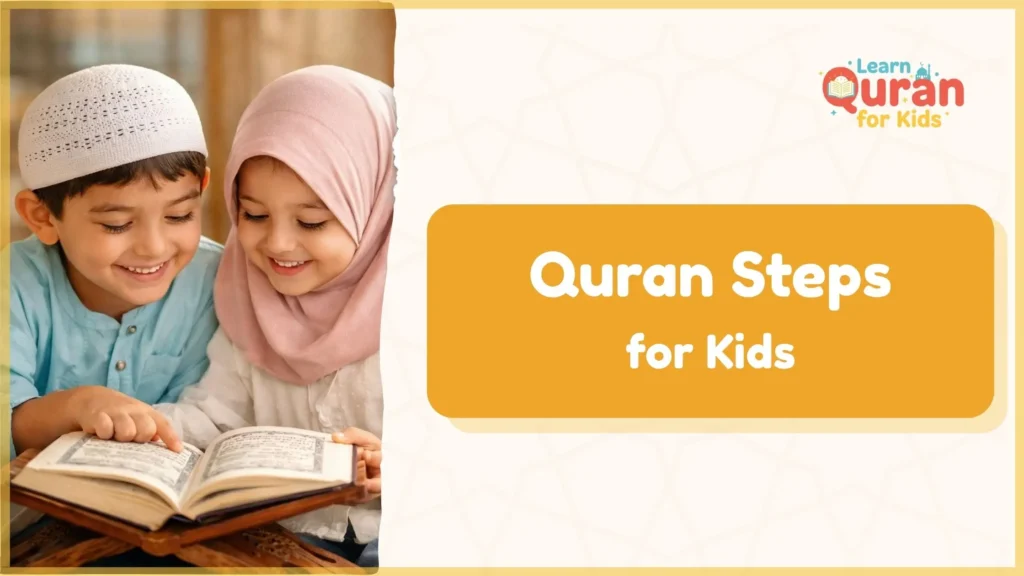
Many Muslim parents dream of seeing their children read the Quran with confidence, clarity, and love for Allah’s words. Building that relationship does not happen in a single lesson; it develops gradually through structured learning that strengthens a child’s reading, recitation, and understanding step by step.
The Quran steps for kids provide a clear learning path that begins with mastering Arabic letters and gradually moves through vowels, word reading, short Surah memorization, Tajweed application, fluent recitation, and eventually deeper understanding of Quranic meanings.
1. Mastering All 28 Arabic Letters
Reading Arabic is a child’s first step into being able to read the Quran. Children should become familiar with all 28 letters of the alphabet and how to pronounce them. There are no shortcuts past this stage, and there should not be.
Each letter must be recognized visually, distinguished from similar-looking letters, and produced from its correct articulation point. This phonological groundwork determines the accuracy of everything that follows.
The Noorani Qaida is the most trusted structured tool for this stage. It helps learners progress from recognizing individual letters to connecting them and forming words, sentences, and eventually full Quranic verses, with 16 lessons each containing step-by-step learning exercises.
Kids Learning Quran Academy’s Noorani Qaida for Kids course uses this proven methodology with certified instructors trained in child phonics, ensuring every letter is fully mastered before the next stage begins.
Enroll your child in Noorani Qaida for kids with a free trial class

– Teaching Letters in Small Groups Prevents Overwhelming Young Learners
Instead of studying all letters at once, dividing them into small groups of five or six prevents overload and increases retention.
For young children especially, this grouping approach makes each session feel achievable rather than daunting.
– Similar Letters Require Dedicated Focused Practice to Avoid Lasting Confusion
Arabic contains several letter groups that look nearly identical. Using unique letter characters to introduce the Arabic letters helps kids spot the differences between similar letters and improves reading proficiency. A skilled instructor catches these confusions early before they become ingrained habits.
– Multi-Sensory Activities Cement Letter Recognition for Young Learners
Clay games, salt or sand tray tracing, and flashcards with letter shapes and sounds all help beginners memorize effectively.
Children learn through their bodies and senses, and these hands-on methods work far better than passive repetition alone.
Shots Videos from Our Courses
Start Your Child’s Quran Learning Journey Today!
Join Kids Learning Quran Academy and help your child read the Quran with confidence through fun and guided lessons.
Book a Free Trial Class2. Kids Move from Isolated Letters into Vowels and Word Reading
Once all 28 letters are recognized and correctly pronounced, children move into the Arabic vowel system.
This step transforms individual letter sounds into readable, meaningful combinations that form actual Arabic words.
Short vowels, Fatha, Kasra, and Damma, come first. Arabic does not have independent letters for vowels as English does.
Instead, short vowels are indicated by diacritical marks placed above or below consonants, and these marks are essential for beginners and religious texts such as the Quran.
Children then move to long vowels, Tanween, Sukoon, and Shaddah, each introduced one at a time with extensive practice before the next is added. Rushing through this stage is the most common cause of reading errors that persist into later years.
Kids Learning Quran Academy’s Quran Reading Course for Kids sequences these vowel stages precisely, with certified instructors monitoring each child’s individual mastery before advancing to connected reading.
Book a Free Session for Your Child in the Quran Reading Course

3. Kids Join Letters Together to Read Complete Arabic Words
Joining letters is where reading truly begins. Children who have mastered isolated letters and vowels now learn how Arabic letters connect, and how their shapes change depending on their position in a word.
Each letter has four possible forms: isolated, initial, medial, and final. Understanding these forms transforms a child from someone who recognizes letters into someone who can actually read flowing Arabic text.
This stage is where the Noorani Qaida structure proves its value most clearly. It follows a structured and progressive approach, starting with basic letters and gradually advancing to words and then short sentences, ensuring a firm foundation before moving on to more complex concepts.
Skilled instructors at this stage use real Quranic words, words like بِسْمِ and رَبِّ and اللَّهِ, so children feel immediate connection to what they are reading rather than practicing abstract exercises.
Read also: When Should Children Begin Learning the Quran?
4. Introduce Kids to Their First Short Surahs from Juz Amma
With basic reading ability established, children are ready to open the Quran itself. After Bismillah, beginning with Surah Al-Ikhlas in the last Juz is recommended as it is easy to recite as well as memorize.
Surah Al-Fatihah, Surah Al-Ikhlas, Surah Al-Falaq, and Surah An-Nas are the standard early milestones. These Surahs carry enormous daily use in Salah and in Du’a, making them immediately meaningful to children from the very beginning.
Allah ﷻ describes the Quran as a clear guide for all who pursue it with sincerity:
إِنَّ هَٰذَا الْقُرْآنَ يَهْدِي لِلَّتِي هِيَ أَقْوَمُ
Inna hatha alqur-ana yahdee lillatee hiya aqwamu
Indeed, this Qur’an guides to that which is most suitable.
Surah Al-Isra: 9
Every short Surah a child memorizes is a step deeper into this divine guidance, Alhamdulillah.
– Reading Before Memorizing Produces Much Stronger Long-Term Retention
Children who can read a Surah fluently before memorizing it retain it far more reliably than those who memorize through pure audio repetition alone. Reading familiarity provides a structural map that memory naturally follows.
– Daily Review of Memorized Surahs Prevents Gradual Forgetting Over Time
A child who memorizes Surah Al-Ikhlas but never reviews it will lose accuracy within weeks. Short daily review, even just two to three minutes, maintains what has been learned and builds the consistent review habit that later Hifz will require.
– Connecting Surah Meanings to Daily Life Makes Memorization Deeply Meaningful
Children who understand that Surah Al-Ikhlas describes Allah’s oneness experience it differently in Salah than children who memorize sounds alone.
Word-by-word meaning introduced gently at this stage transforms recitation into real communication with Allah ﷻ.
Kids Learning Quran Academy’s Quran Memorization for Kids program builds meaning-awareness and daily review structure into every session, ensuring children retain what they memorize through proven child-friendly methods.
Book a Free Trial for Your Child in the Best Hifz Course for Kids
Read also: Free Online Quran Classes for Kids
5. Build Proper Tajweed Rules into a Child’s Everyday Recitation
Tajweed is not an advanced topic reserved for older students. It is a gradual process that begins the moment a child starts reading, introduced gently and built consistently over time through patient, repeated exposure.
Learning the Tajweed rules is important to read Quran correctly because the wrong reading of a word might change its meaning, so children should be taught Tajweed rules slowly and made to practice each rule to ensure they understood it correctly.
The Prophet ﷺ said:
“الْمَاهِرُ بِالْقُرْآنِ مَعَ السَّفَرَةِ الْكِرَامِ الْبَرَرَةِ وَالَّذِي يَقْرَأُ الْقُرْآنَ وَيَتَتَعْتَعُ فِيهِ وَهُوَ عَلَيْهِ شَاقٌّ لَهُ أَجْرَانِ”
“The one who is proficient in the Qur’an will be with the noble, righteous, recording angels.”
Sahih Muslim: 798a
Giving children correct Tajweed from early on is one of the greatest gifts a parent can offer, and one of the most lasting acts of care for their Deen.
– Ghunna and Madd Are the Most Accessible First Tajweed Rules for Children
Ghunna, the nasal sound in Noon and Meem, and Madd, the elongation of long vowels, are the two rules children internalize most naturally through imitation. A skilled instructor models these consistently until the child produces them automatically.
– Noon Sakinah and Tanween Rules Come After Basic Fluency Is Established
Ikhfa, Idgham, Iqlab, and Izhaar are introduced once a child reads with reasonable fluency. Introducing these rules too early, before fluency is secure, creates cognitive overload that slows rather than accelerates progress.
– Consistent Live Correction Is What Separates Good Tajweed from Approximate Tajweed
Video resources can model correct recitation. Only a live certified instructor can hear your child’s specific errors and correct them in real time. This distinction determines whether a child develops genuine Tajweed or simply approximate recitation.
Kids Learning Quran Academy’s Tajweed for Kids course provides exactly this live correction environment, with certified Qaris who specialize in patient, age-appropriate Tajweed instruction for non-Arabic speaking children worldwide.
Enroll your child in Tajweed for kids with a free trial class

6. Take Kids into Fluent Continuous Quran Reading Across Full Pages
Once letters, vowels, joining, short Surahs, and basic Tajweed rules are in place, children move into reading longer passages of the Quran continuously.
This stage builds the reading stamina and fluency that full Quran completion eventually requires.
Fluency at this stage means reading with correct pronunciation, accurate voweling, and basic Tajweed application simultaneously, without stopping to decode individual letters. This automatic processing takes consistent daily practice over several months to develop fully.
Children should practice reading the Quran every day, as consistent daily practice is one of the most important factors in developing reading fluency and retaining what has been learned.
A practical reading target for children at this stage is one half to one full page of Quran daily, read aloud to a parent or instructor for feedback. Volume of correct reading practice is what builds genuine fluency at this level.
Our Students Reviews
Start Your Child’s Quran Learning Journey Today!
Join Kids Learning Quran Academy and help your child read the Quran with confidence through fun and guided lessons.
Book a Free Trial Class7. Open the Door to Quran Memorization Beyond Short Surahs
With fluent reading and solid Tajweed in place, children are ready to pursue meaningful Hifz, memorization that extends beyond the short Surahs of Juz Amma into longer chapters of the Quran.
For Quran memorization, children should start with shorter and easier Surahs and gradually move to longer ones, ensuring that each Surah is well memorized before proceeding to the next. This progression principle applies across the entire Hifz journey.
The Prophet ﷺ said:
“خَيْرُكُمْ مَنْ تَعَلَّمَ الْقُرْآنَ وَعَلَّمَهُ”
“The best among you are those who learn the Qur’an and teach it.”
Sahih al-Bukhari: 5027
Parents who invest in their child’s memorization at this stage plant seeds whose rewards extend across this life and the next, Insha’Allah.
– Setting Realistic Daily Memorization Targets Prevents Burnout
A realistic daily new memorization target for children aged 7 to 10 is three to five Ayahs per session.
Ambitious targets that exceed a child’s capacity create pressure, frustration, and eventual disengagement from memorization entirely.
– The Three-Day Rule Strengthens New Memorization Before Moving Forward
A new portion should be reviewed on the day of memorization, the following day, and again three days later before new material is added.
This spaced repetition schedule moves memorized content from short-term into long-term memory reliably.
– Linking New Memorization to Previously Memorized Portions Builds Chain Retention
Each new Ayah should be connected to the previous Ayahs in recitation, not practiced in isolation.
Children who always recite from the beginning of a Surah build stronger sequential retention than those who practice individual Ayahs disconnected from their context.
Kids Learning Quran Academy’s Quran Memorization for Kids program structures daily targets, spaced review, and sequential retention techniques into every session, making Hifz genuinely sustainable for young learners.
Book a Free Trial for Your Child in the Best Hifz Course for Kids
8. Deepen a Child’s Connection Through Basic Quran Tafseer and Word Meaning
The final step in the Quran steps for kids’ progression is meaning. A child who reads fluently, recites correctly, and has memorized portions of the Quran is ready to begin understanding what Allah ﷻ is actually saying.
Teaching children the meaning of what they recite helps them develop a deeper connection with the Quran and makes their recitation more heartfelt and spiritually enriching. This connection is ultimately the goal that all previous steps have been building toward.
Allah ﷻ invites deep reflection on His words throughout the Quran:
أَفَلَا يَتَدَبَّرُونَ الْقُرْآنَ
Afala yatadabbaroona alqur-ana
Then do they not reflect upon the Qur’an?
Surah An-Nisa: 82
This invitation is for children too. Age-appropriate Tafseer begins the lifelong practice of genuine Quranic reflection.
– Starting Tafseer with Surah Al-Fatihah Connects Immediately to Daily Salah
Every Muslim recites Surah Al-Fatihah in every Rakah of Salah. A child who understands its meaning experiences Salah differently from that day forward. This is the most impactful starting point for any child’s Tafseer education.
– Simple Word-by-Word Translation Comes Before Scholarly Commentary
Children at this stage benefit most from knowing what individual words mean before engaging with interpretive commentary.
Building a Quranic vocabulary of 200 to 300 common words transforms their relationship with recitation across the entire Quran.
– Connecting Tafseer Lessons to Real Life Makes Meanings Genuinely Memorable
A child who learns that Surah Al-Asr teaches the importance of time, and then discusses how they use their own time each day, retains that meaning permanently.
Abstract understanding becomes lived knowledge when connected to a child’s actual experience.
Kids Learning Quran Academy’s Quran Tafseer for Kids course introduces meanings through stories, discussions, and age-appropriate explanations that make Quranic wisdom genuinely accessible and memorable for young learners.
Book a Free Trial for Your Child in Quran Tafseer Course for Kids

Enroll Your Child at Kids Learning Quran Academy and Begin the Quran Steps for Kids Today
Every step in this guide comes to life most powerfully with a certified instructor who knows your child, tracks their progress, and teaches with patience and expertise.
Kids Learning Quran Academy offers:
- Certified instructors experienced in teaching non-Arabic speaking children at every stage
- Courses covering every step: Qaida for Kids, Quran Reading Course for Kids, Tajweed for Kids, Quran Memorization for Kids, and Quran Tafseer for Kids
- One-on-one live sessions tailored to your child’s current level and learning pace
- Flexible scheduling that fits your family’s routine
- Safe, monitored online environment with verified instructors
- Regular progress updates keeping parents fully informed
Check out our top courses for children in Hifz Quran, Arabic language skills, and Islamic studies:
- Online Arabic Classes for Kids
- Noorani Qaida for Kids
- Tajweed for kids
- Quran Reading Course for Kids
- Quran Memorization Course for Kids
- Quran Tafseer for Kids
- Islamic Studies Courses for Kids
Start Your Child’s Quran Learning Journey Today!
Join Kids Learning Quran Academy and help your child read the Quran with confidence through fun and guided lessons.
Book a Free Trial ClassConclusion
Children progress most successfully when Quran learning follows a clear sequence, beginning with letter recognition and moving steadily toward connected reading, memorization, and Tajweed. Each stage builds essential skills that prepare young learners for the next level of Quranic fluency.
Following the Quran steps for kids helps parents avoid common learning gaps by ensuring that pronunciation, reading ability, and memorization grow together through consistent practice and structured guidance. This balanced approach supports both accuracy and confidence in recitation.
With patient instruction, daily practice, and supportive teaching methods, children can develop strong Quran reading skills while forming a meaningful spiritual connection. These early foundations guide them toward lifelong engagement with the Quran and a deeper understanding of its message.
Related Articles
Learn Quran