 Learn Quran
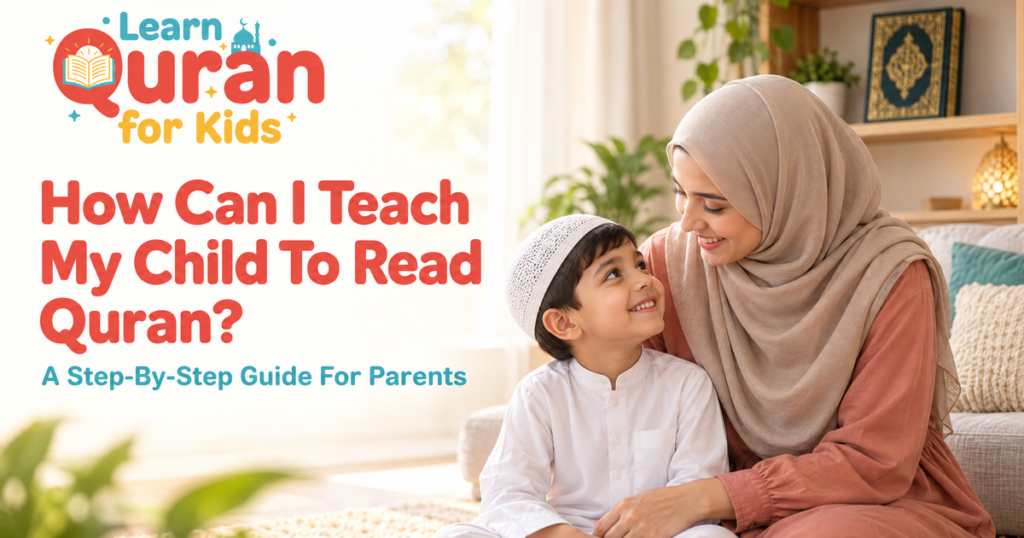
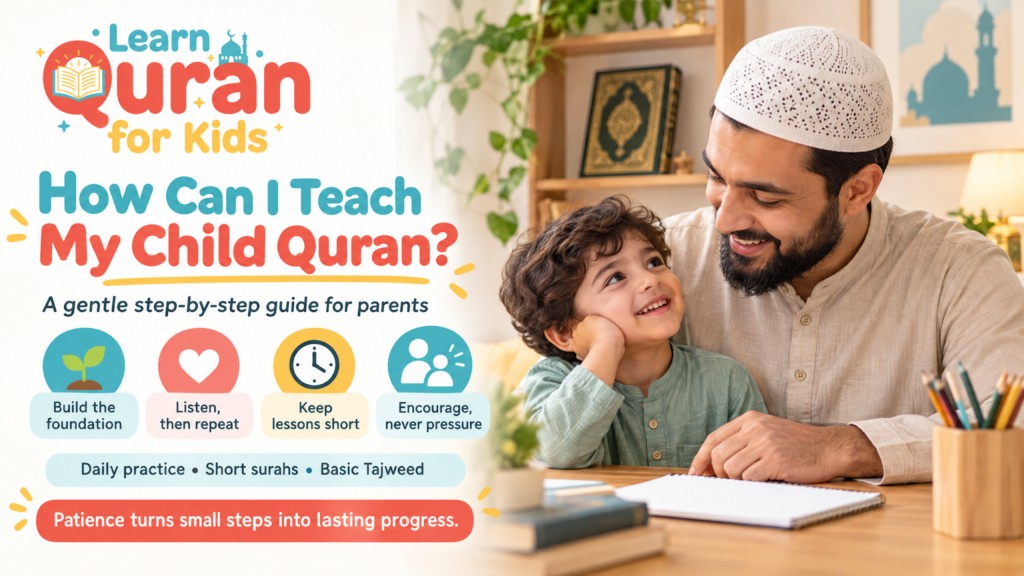
“How can I teach my child to read Quran?” is a common question among Muslim parents. Teaching a child to read the Quran is not about rushing through the Mushaf, but about building a strong foundation in Arabic letters, correct pronunciation, and love for the Book of Allah.
Children learn more willingly when lessons are short, consistent, enjoyable, and pressure-free. With patience and the right approach, even parents who are still improving their own recitation can support their child’s progress step by step.
In this guide, you will find a practical method that covers the Arabic alphabet, listening, short Surahs, basic Tajweed, daily practice, and motivation, along with guidance from the Quran and authentic Hadith and answers to common questions.
1. Make the Quran Part of Your Child’s Daily Environment
The first step in teaching a child to read the Quran is daily listening, called Sama’ in Arabic. Before a child can read a single letter, their ears can become familiar with the sounds, rhythm, and pronunciation of Quranic Arabic. Play the recitation of a clear, slow reciter at home during breakfast, in the car, or before sleep, so that the Quran becomes a natural and comforting part of the child’s day.
Your own voice matters even more than recordings. When parents recite the Quran softly near their child, the child learns that the Quran is valued and loved in the family.
Children naturally pick up words and short phrases while they play, so a home filled with recitation prepares them to read much faster when formal lessons begin. The Prophet ﷺ encouraged Muslims to keep their homes alive with Quran recitation:
لاَ تَجْعَلُوا بُيُوتَكُمْ مَقَابِرَ إِنَّ الشَّيْطَانَ يَنْفِرُ مِنَ الْبَيْتِ الَّذِي تُقْرَأُ فِيهِ سُورَةُ الْبَقَرَةِ
“Do not make your houses as graveyards. Satan runs away from the house in which Surah Baqara is recited.”
2. Teach the Arabic Alphabet Before Opening the Mushaf
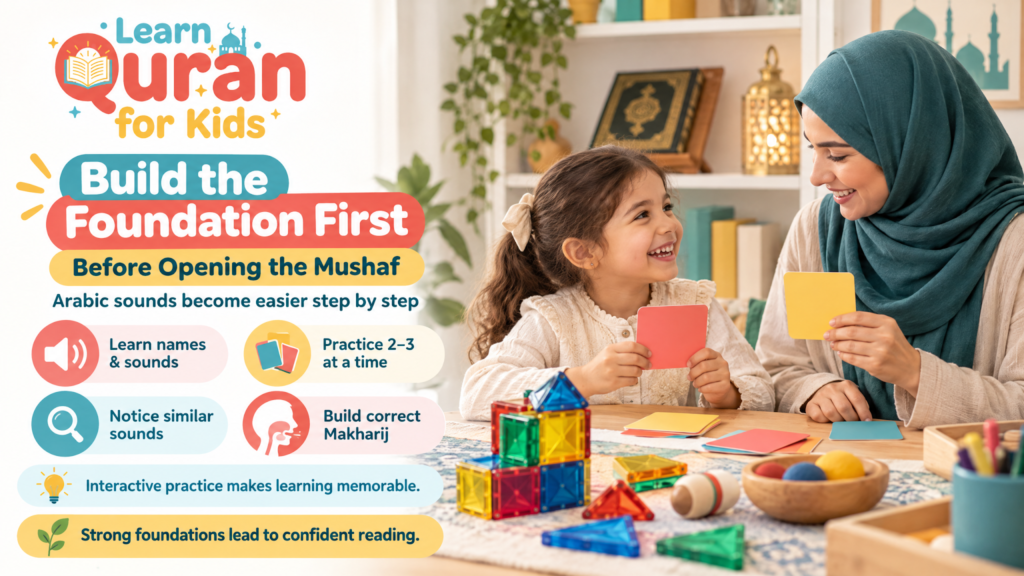
The Arabic alphabet, known as Al-Huroof Al-Hijaiyyah (الحروف الهجائية), is the foundation of Quran reading for kids. Children should learn the 28 letters, their names, sounds, and different forms at the beginning, middle, and end of words.
Skipping this stage can make reading difficult later, as children may memorize words by sight instead of reading them. Make learning interactive with colourful flashcards, magnetic letters, tracing sheets, and simple songs, focusing on two or three letters per session. Pay extra attention to similar sounds, such as ح and ه or ق and ك, to build correct Makharij from the start.
For children ready to go beyond letters and understand what they read, this guide on how kids can learn Quranic Arabic explains how vocabulary and simple grammar can be introduced alongside reading lessons.
3. Use a Structured Beginner Book Such as the Noorani Qaida
A Qaida is a structured beginner book that teaches children to read Arabic step by step, from single letters to Quranic words. Noorani Qaida (القاعدة النورانية) and Qaida Rashidi are common examples. Children gradually learn Fatha, Kasra, Damma, Sukun, Tanween, Shaddah, and long vowels, helping them decode Quranic words instead of guessing.
Work through the Qaida slowly, moving forward only when your child can read each lesson smoothly. Use colourful editions to keep learning engaging, review the previous lesson at the start of each session, and reinforce new skills through regular practice.
After completing the Qaida, moving to the Mushaf becomes much easier. Parents who want teacher guidance can explore the Quran reading course for kids, which helps children progress from letters to fluent reading through short, age-appropriate lessons.
4. Start Reading with the Short Surahs of Juz Amma
Juz Amma, the thirtieth and final part of the Quran, contains most of the short Surahs, making it a practical starting point for children learning to read the Mushaf. Short verses and familiar Surahs can help children stay motivated, and many families begin with Surah Al-Fatiha.
Teachers may start with Surah An-Nas and move backward, or begin with Surah Ad-Duha. Both are educational choices, so parents can choose what suits their child.
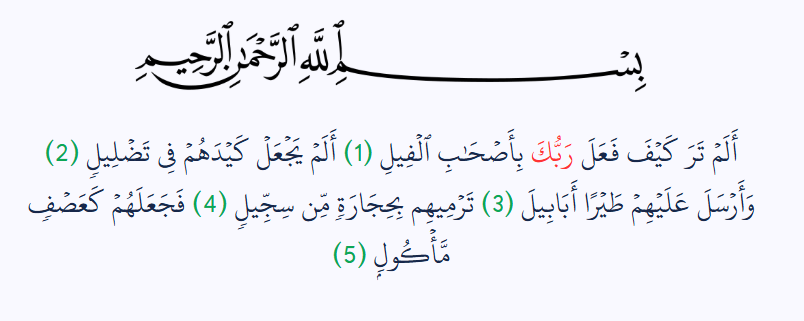
Short Surahs can also make learning more engaging through stories. For example, Surah Al-Fil tells the story of the army of the elephant and can introduce children to animal stories from the Quran for kids.
5. Use Talqeen: Read Aloud and Let Your Child Repeat
Talqeen (التلقين) is the traditional method of teaching the Quran in which the teacher recites a verse slowly and clearly, and the student repeats it until the pronunciation is correct. It is how the Quran has been passed from teacher to student for centuries, and it remains one of the most effective ways to teach children, because young learners copy what they hear very accurately.
To use Talqeen at home, recite one short verse or even half a verse, pause, and ask your child to repeat it. Correct gently, then repeat the same verse three to five times before moving on.
If your own recitation is not yet strong, play a teaching recording in which a qualified reciter pauses for children to repeat, and sit beside your child so the activity feels shared rather than mechanical.
The Quran recitation course for kids focuses on exactly this, helping children recite with clear pronunciation, a steady pace, and growing confidence under the guidance of a qualified teacher.
Experience the Magic Firsthand
Watch these short clips from our live classes to see our interactive teaching tools, vibrant student-teacher interactions, and the fun, stress-free ways we make learning easy for kids!
Start Your Child’s Quran Learning Journey Today!
Join Kids Learning Quran Academy and help your child read the Quran with confidence through fun and guided lessons.
Book a Free Trial Class6. Connect the Sound with the Written Words in the Mushaf
Connecting the sound of each word with its written form is what turns listening and repeating into real reading.
Always keep the Mushaf or reading book open in front of your child during lessons, and ask them to point to each word with their finger as they recite. This simple habit trains the eyes to follow the text and stops the child from reciting purely from memory.
A colour-coded Tajweed Mushaf can be especially helpful for children, because it highlights letters that need special pronunciation in different colours.
Choose a Mushaf with a clear, large script, and let your child have their own copy that they treat with respect. Owning a personal Mushaf often makes children feel proud and responsible for their Quran learning.
7. Introduce Tajweed Rules Gradually and Simply
Tajweed (التجويد) is the set of rules that ensures every letter of the Quran is pronounced correctly, with its proper qualities and timing. Children do not need to memorize long definitions at the start. Instead, introduce one rule at a time, show it in a verse your child already knows, and practise it until it becomes natural.
The table below shows beginner Tajweed rules that many teachers introduce first, together with a simple explanation that a child can understand. Explaining rules through familiar verses from Juz Amma makes them far easier to remember than abstract lists.
| Tajweed Rule | Arabic | Simple Explanation for Kids |
| Madd | المد | Stretching a long vowel sound for a set count, like counting on your fingers |
| Qalqalah | القلقلة | A small bouncing sound on the letters ق ط ب ج د when they have a sukun |
| Ghunnah | الغنة | A gentle nasal sound from the nose on noon and meem with shaddah |
| Idgham | الإدغام | Merging a noon sakinah or tanween into the next letter |
| Ikhfa | الإخفاء | Hiding the noon sound softly with a light nasal sound |
When your child is ready to apply these rules consistently, a teacher can listen closely and correct small mistakes before they become habits. The Tajweed course for kids teaches these rules step by step through practical recitation rather than heavy theory.

8. Keep Lessons Short, Daily, and Consistent
Short daily Quran lessons are more effective for children than long, occasional sessions. For most young children, 15–20 minutes a day is enough, while older children can gradually study for longer. Choose a fixed time, such as after Fajr or Maghrib, to make Quran reading a consistent daily habit.
Begin each lesson by reviewing what your child learned the previous day, then introduce a small amount of new material. Repetition (Takrar) and revision (Muraja’ah) help build fluent reading and lasting memorization. Setting aside one day each week for revision can also prevent earlier Surahs and Qaida lessons from being forgotten.
A simple weekly or monthly progress chart can help parents and children track improvement and stay motivated as they move through each stage.
9. Tell Quran Stories to Build Love and Understanding
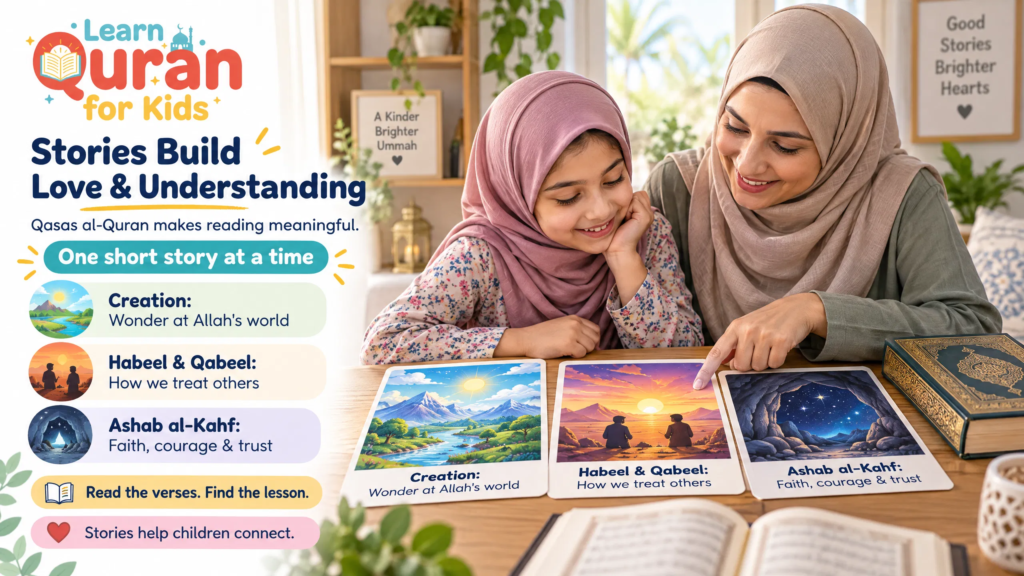
Quran stories (Qasas al-Quran) can make Quran reading more engaging for children. When they understand the story behind a passage, the verses become more meaningful and familiar. Sharing one short Quran story at a time can encourage children to look for the verses connected to it.
The Quran creation story for kids introduces how Allah created the heavens and earth in simple, age-appropriate language, helping children connect Quranic teachings with the world around them.
Stories of people in the Quran can also teach important values. The story of Habeel and Qabeel for kids offers lessons about jealousy, anger, and how we treat others.
For older children, the story of Ashab al-Kahf in the Quran can make Surah Al-Kahf more meaningful while introducing themes of faith, courage, and trust in Allah.
10. Be the Role Model Your Child Copies
Children imitate what they see far more than what they are told. When a child sees their mother and father reading the Quran daily, praying on time, and speaking about Allah with love, they understand that the Quran is a real priority in the family.
Parents who are still learning can share that journey openly, because a parent who learns alongside their child is a powerful example.
Try reading the Quran together as a family for a few minutes each day, even if each person reads a different amount. You can also strengthen your child’s understanding of faith with simple Islamic studies lessons for kids, so that Quran reading is connected to belief, prayer, manners, and the life of Prophet Muhammad ﷺ.

11. Encourage, Praise, and Reward Every Step of Progress
Consistent encouragement keeps children motivated through the slower stages of Quran learning. Praise effort as well as results, using specific words such as “You pronounced that letter beautifully” rather than a general “Good job.” Let your child recite what they have learned in front of grandparents or relatives, because a proud audience often encourages a child more than any gift.
Small rewards, such as stickers, a favourite outing, or a special book, can celebrate the completion of a surah or a Qaida level.
When your child finishes an important milestone such as Juz Amma, consider a small family celebration. These moments help the child link the Quran with happiness and achievement, which builds the inner motivation that lasts beyond childhood.
12. Create Friendly Quran Challenges at Home
Friendly Quran challenges can make reading practice exciting, especially for families with more than one child. You might set a weekly goal for each child according to their level, then celebrate everyone who reaches it. The aim is to encourage effort and teamwork, not to make one child feel less capable than a sibling.
As your child grows in confidence, local masjid or community Quran competitions can provide a wonderful goal to work toward.
Preparing for a competition encourages regular revision, careful pronunciation, and the courage to recite in front of others, while also helping children meet friends who share the same love for the Quran.
How to Make a Child Read Quran When They Lose Interest
Every child goes through periods of low motivation, and this is completely normal. Knowing how to make a child read Quran during these times is about understanding the cause and adjusting the approach, rather than adding pressure.
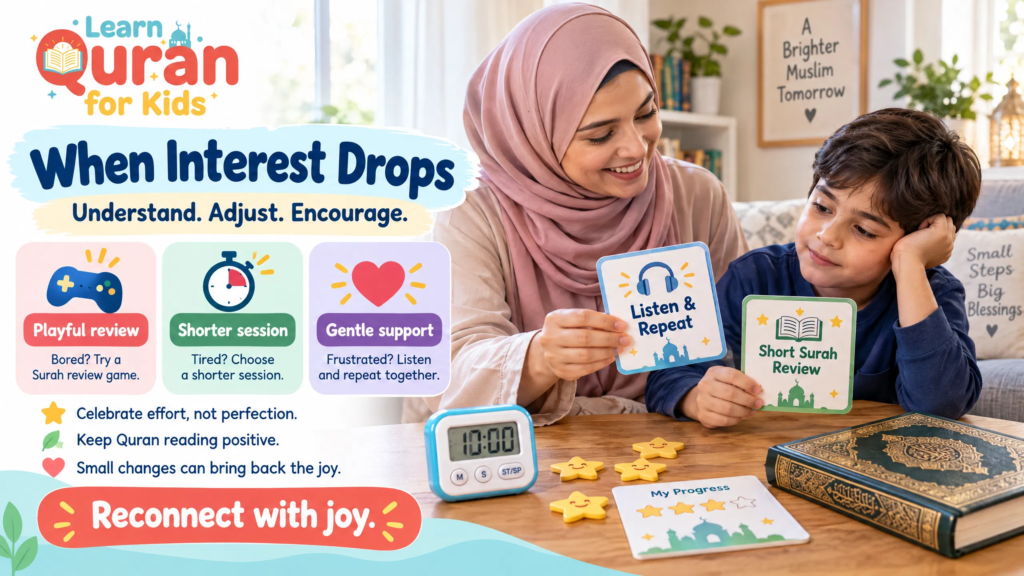
A child may feel bored, tired, or frustrated when lessons become repetitive or difficult. Parents can respond with shorter sessions, more encouragement, or engaging activities that make learning feel enjoyable again. The following strategies can help bring back your child’s enthusiasm while keeping Quran reading a positive part of their daily routine.
1. Find the Real Reason Behind the Resistance
A child who refuses to read the Quran is usually tired, bored, embarrassed by mistakes, or overwhelmed by a lesson that is too long or too difficult. Ask calmly how they feel about their lessons. Often a small change, such as a shorter session, an easier passage, or a different time of day, solves the problem quickly.
2. Change the Format While Keeping the Habit
When enthusiasm drops, keep the daily habit but change how it looks. Read outdoors, use a recitation app with a progress tracker, or let your child “teach” a younger sibling or a toy. Stories also work well here: children who love animals are often fascinated by these bird stories in the Quran for kids, such as the hoopoe of Prophet Sulaiman (peace be upon him).
3. Never Use the Quran as a Punishment
The Quran should never be used as a punishment, such as making a child read extra pages because they misbehaved. This links the Quran with negative feelings and can push the child away from it. Instead, keep Quran time warm and positive, so the child associates it with love, calm, and closeness to Allah and to their parents.
Start Your Child’s Quran Learning Journey Today!
Join Kids Learning Quran Academy and help your child read the Quran with confidence through fun and guided lessons.
Book a Free Trial ClassEnroll Your Child at Kids Learning Quran Academy
Kids Learning Quran Academy offers online, one-on-one Quran classes designed specifically for children. Qualified and patient teachers guide each child from the Arabic alphabet and Noorani Qaida to fluent Quran reading, Tajweed, and memorization, using interactive lessons that keep young learners engaged.
Parents receive regular progress updates and can choose class times that fit their family’s schedule. Book a free trial class today and see how much your child can achieve.
Our Courses Include:
- Tajweed Course for Kids
- Quran Memorization Course for Kids
- Quran Recitation Course for Kids
- Quran Classes for Toddlers
- Quran Tafseer Course for Kids
- Qaida Course for Kids
- Quran Reading Course for Kids
- Online Arabic Classes for Kids
- Quranic Arabic Course for Kids
- Islamic Studies Courses for Kids
- Islamic Studies Course for Kindergarten
- 5 Pillars of Islam Course for Kids
- Islamic Education Course for Kids
Don’t wait to invest in your child’s Akhirah and future. Enroll today and watch your child grow with confidence, knowledge, and love for the Quran.

Conclusion
If you have been asking, “How can I teach my child to read Quran?”, the answer lies in following a clear, gradual path: daily listening, mastering the Arabic letters, working through a beginner Qaida, reading the short Surahs of Juz Amma, and introducing Tajweed one rule at a time.
Short daily lessons, regular revision, and guidance from a supportive teacher can make this journey easier and more achievable for your child.
Above all, the way you teach shapes how your child feels about the Quran. Patience, praise, Quran stories, and your own example can help your child develop a genuine love for the Book of Allah, rather than simply learning to read it.
With consistent encouragement and a positive routine, Quran reading can become a meaningful and lasting part of your child’s life.
Frequently Asked Questions
What is the best age to start teaching a child to read the Quran?
Many children are ready to learn the Arabic letters between three and five years old. Listening to the Quran can begin from infancy. The right age depends on the child’s attention span and readiness, so watch your child rather than following a fixed rule.
How long does it take for a child to learn to read the Quran?
Most children need around one to two years of consistent practice to read the Quran fluently. Daily lessons, regular revision, and a qualified teacher can shorten this time, while irregular practice usually makes it longer.
Can I teach my child to read the Quran if my own Arabic reading is weak?
Yes, you can support your child by learning alongside them, using teaching recordings for Talqeen, and enrolling them with a qualified teacher. Your encouragement and daily routine matter as much as your own reading level.
Should my child learn Tajweed from the beginning?
Children should learn correct letter pronunciation (Makharij) from the very beginning, while named Tajweed rules are usually introduced gradually once the child can read words smoothly. Learning rules through familiar verses works best for young learners.
Should a child learn Quran reading or memorization first?
Most teachers recommend building basic reading skills first while memorizing short surahs at the same time. Reading allows the child to revise memorized surahs from the Mushaf correctly and continue learning independently later.
Are online Quran classes effective for kids?
Yes, online Quran classes are effective for kids when lessons are one-on-one, interactive, and led by qualified teachers. They offer flexible timing, individual attention, and easy progress tracking for parents.