 Quran Learning Resources
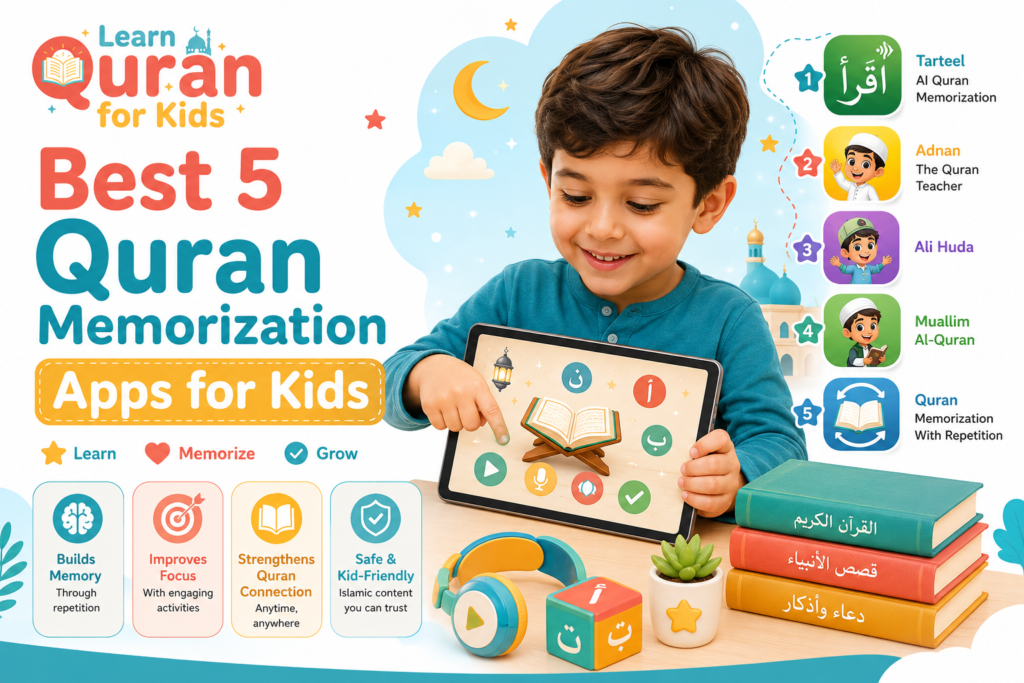
Screens are already part of your child’s day. The real question isn’t whether to hand them a tablet — it’s whether that screen time builds something lasting or just fills time. A good Quran memorization app for kids can turn passive scrolling into active hifz practice, but not every app on the store shelf does this well.
This guide walks through what actually makes a Quran memorization app for kids effective, compares the most downloaded options on the market today, and shows you where apps genuinely help — and where they fall short of what a real teacher provides.

1. Tarteel – AI Quran Memorization
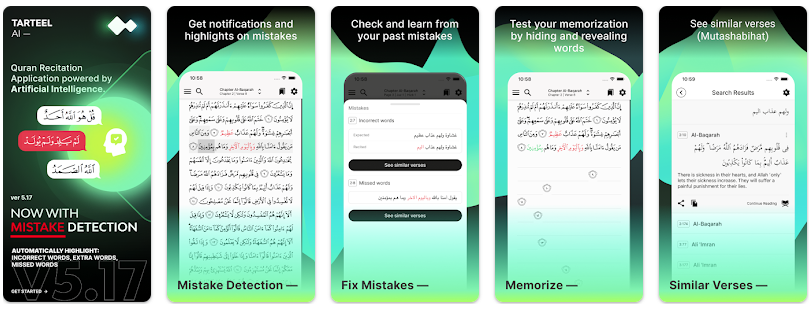
Tarteel – AI Quran Memorization is a smart Quran memorization app that uses AI to make learning easier and more effective for kids.
It listens to Quran recitation and helps children identify mistakes while they practice.
The app highlights missed or incorrect words, allowing kids to correct their recitation immediately.
Its memorization mode encourages children to recall verses without relying on the written text.
The Similar Verses feature helps them distinguish between verses that may sound alike.
Children can review previous mistakes and focus more attention on areas that need improvement.
Instant feedback encourages independent practice and builds confidence in Quran recitation.
With regular use, Tarteel can strengthen memorization, accuracy, concentration, and long-term Quran retention.
Read also: How To Teach A Child To Memorize The Alphabet?
Read also: The Benefits of Reading Quran for Kids
2. Adnan The Quran Teacher
Adnan The Quran Teacher is an interactive app designed to make Quran memorization enjoyable and engaging for children. It helps kids learn and memorize the complete Quran through a colorful, child-friendly learning environment.
Interactive activities encourage children to practice regularly without making memorization feel difficult or boring. The app combines Quran learning with playful visuals that can help maintain children’s attention and motivation.
Repeated listening and practice support stronger memorization and better long-term retention of Quranic verses. Children can also learn the Arabic alphabet, helping them build an important foundation for reading the Quran.
The app includes supplications and Hadith, expanding children’s Islamic knowledge alongside Quran memorization. Its offline availability allows kids to continue learning and reviewing the Quran conveniently without an internet connection.
Read also: Islamic Topics for Children
3. Ali Huda
Ali Huda is a child-friendly Islamic app that makes Quran memorization engaging through educational videos and animated content. It offers Quran-focused shows that help children listen to, repeat, and enjoyably memorize verses.
Kids can learn Quranic letters and improve their reading foundation before progressing to memorization. Tajweed lessons from teachers help children develop clearer and more accurate Quran recitation. Colorful animations and friendly characters keep young learners interested and motivated to practice regularly.
Islamic songs and Nasheeds use melodic learning to support memory and make lessons easier to remember. Interactive quizzes, challenges, and activities encourage active learning rather than passive screen time. Its safe Islamic environment allows children to strengthen Quran memorization while also learning duas, prayer, and Islamic values.
Read also: Islamic Animations for Kids

See Our Classes in Action!
Wondering what a typical lesson looks like? Take a peek inside our virtual classrooms below to see how our patient teachers keep students smiling, engaged, and learning every step of the way.
Start Your Child’s Quran Learning Journey Today!
Join Kids Learning Quran Academy and help your child read the Quran with confidence through fun and guided lessons.
Book a Free Trial Class4. Muallim Al-Quran
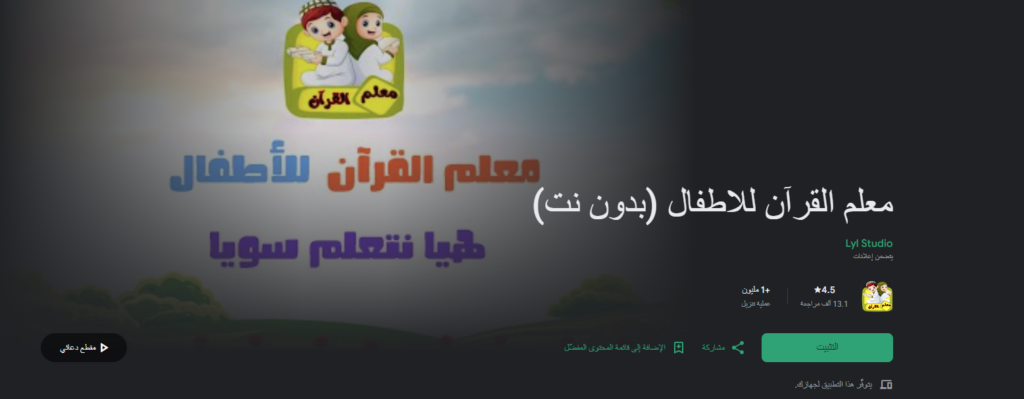
Muallim Al-Quran (The Quran Teacher) for Kids provides an engaging and interactive way for children to memorize and learn the Quran. It combines listening and reading activities to help kids repeat verses and strengthen their memory.
Audio recitation supports correct pronunciation and helps children become familiar with Quranic verses. Colorful characters and child-friendly visuals make memorization more enjoyable and keep young learners motivated.
The app also introduces Islamic teachings such as prayer, daily supplications, and Islamic manners alongside Quran learning. Its simple activities encourage regular practice, helping children build confidence and develop a stronger connection with the Quran.
Read also: Best 6 Islamic Ebooks for Kids
Read also: 7 Best Arabic Children’s Books With English Translation for Kids
5. Quran Memorization With Repetition
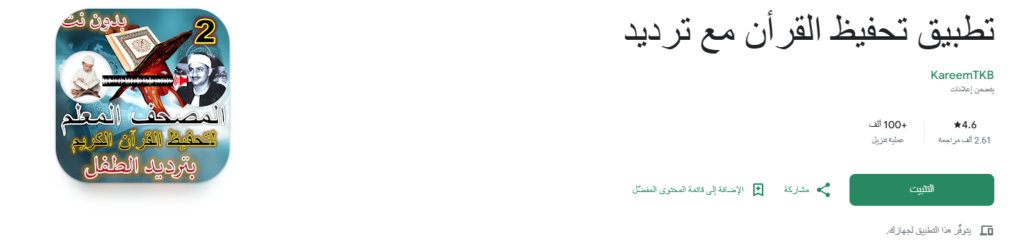
Quran Memorization with Repetition App helps children memorize Quranic verses through repeated listening and regular practice. It provides clear audio recitations that allow kids to hear verses repeatedly and become familiar with correct pronunciation.
The repetition feature makes memorization easier by reinforcing verses until children can recall them confidently. Kids can access Quran recitations offline, making practice convenient without requiring an internet connection.
The app also includes useful Islamic supplications and learning materials that support children’s broader Islamic education. Its simple interface and audio-based approach make Quran review accessible and practical for young learners.
Read also: Teaching Children Islam – A Practical Guide for Muslim Parents
Key Features To Look For In A Quran Memorization App For Kids
A good Quran memorization app for kids should combine voice recognition, child-friendly gamification, and offline access to support effective daily practice. The best apps provide instant feedback and engaging progress tools without letting games distract from Quran memorization.
1. Voice Recognition And Mistake Detection
This is the feature that separates a modern memorization tool from a simple audio player. Apps like Tarteel AI use voice recognition that follows a child’s recitation word by word, flagging incorrect words, extra words, or skipped words as they happen.
That real-time correction matters because a child reciting alone, without any feedback, can practice the same mistake for weeks before anyone notices.
Voice-detection apps interrupt that pattern immediately — though the detection is only as good as the underlying speech model, and background noise or unclear child pronunciation can still trigger false flags.
2. Character Design And Gamification For Young Attention Spans
Children under 8 rarely stay engaged with a plain text-and-audio interface. This is why apps built specifically for kids — such as Adnan: The Quran Teacher — lean heavily on animated mascots, colorful menus, and game-like navigation (badges, stars, personal profiles) rather than the stripped-down layout adult-focused apps use.
The tradeoff is real: heavy gamification keeps a 5-year-old engaged longer, but it can also shift focus toward collecting stars rather than the recitation itself.
The better-designed kids’ apps keep the reward layer thin — visible progress markers, not distracting mini-games layered over the Quran text.
3. Offline Access For Consistent Daily Practice
Several popular kids’ apps, including versions of Adnan and the Muallim Al-Quran family of apps, are built to work entirely without an internet connection. This matters more than it sounds — a child’s daily five-minute session shouldn’t depend on WiFi being available in the car, at a relative’s house, or during travel.
Read also: Quran Books for Kids
Read also: Seerah for Kids – The Complete Guide to Teaching Prophet Muhammad’s Life
Comparing the Top Quran Memorization Apps for Kids
Each app on the market takes a different approach. Some prioritize AI-driven correction, some prioritize child-friendly design, and some function more as an Islamic entertainment platform than a dedicated memorization tool.
| App | Best For | Key Feature | Age Range | Cost Model |
| Tarteel AI | Mistake correction, ear-training | Live voice recognition + mistake detection | 7+ (reads independently) | Free core features, paid premium tier |
| Adnan: The Quran Teacher | Young children, offline use | Cartoon-guided memorization, works without internet | 3–10 | Free with in-app ads |
| Ali Huda | Broader Islamic learning, not memorization-focused | Video library of Islamic shows and Quran-for-kids content | 3–8 | Subscription with free trial |
| Muallim Al-Quran (Lyl Studio) | Foundational prayer + Quran together | Combines Salah teaching with Quran recitation modules | 4–9 | Free with ads |
Where Tarteel AI Fits for Kids
Tarteel AI was built with mistake detection as its core feature, using AI voice recognition to catch incorrect, missing, or extra words the moment they’re recited.
For children who already read independently — generally ages 7 and up — this makes it a genuinely useful self-check tool between lessons. The free tier covers voice-guided recitation tracking and verse search.
The full mistake-detection and history-log features sit behind a subscription, though scholarship access exists for families who can’t afford it. For younger children who aren’t reading fluently yet, Tarteel’s adult-oriented interface can feel like a mismatch — it wasn’t designed with a 4-year-old’s attention span in mind.
Where Cartoon-Led Apps Like Adnan Are Fit For Kids
Apps built specifically around a child mascot — such as Adnan the Quran Teacher — solve a different problem: keeping a young child engaged long enough to build a daily habit at all. The interface uses a friendly character, bright colors, and simple tap-to-navigate menus instead of adult-style text lists.
These apps work well for ages 3 to 8, specifically because the design assumes the child cannot yet read fluently. Audio-first navigation, repeat-after-me recitation modes, and offline playback matter more here than advanced correction algorithms — a 4-year-old doesn’t yet benefit from detailed mistake analytics the way an older child does.
Read also: Explaining Religion to a Child – The Complete Islamic Parent’s Guide
Common Mistakes Parents Make When Using Quran Apps For Kids
An app can support memorization, but it cannot replace the judgment a parent or teacher brings to the process. Three mistakes come up repeatedly.
1. Treating App Time As Unsupervised Screen Time
Handing a child the app and walking away turns an active memorization tool into passive screen time.
The apps that work best are used with a parent nearby for at least the first several weeks — correcting posture, praising effort, and making sure the child is actually engaging with the recitation rather than tapping through menus.
2. Relying On Voice Detection Instead Of A Trained Ear
AI mistake-detection is genuinely useful, but it identifies word-level errors — not subtler Tajweed issues like incorrect makharij (articulation points) or elongation length.
A trained teacher catches errors that an algorithm simply isn’t built to hear. Apps work best as a practice supplement between lessons, not as a substitute for a qualified instructor’s correction.
If you’re building a home routine around app-based memorization, our guide on the phases of Quran learning by age can help you match app use to your child’s actual developmental stage rather than a one-size-fits-all approach.
3. Choosing An App Before Choosing An Age-Appropriate Method
Parents often download whichever app has the most stars, without checking whether it fits their child’s age. A 4-year-old given a mistake-detection tool built for independent readers will get frustrated fast.
A 9-year-old given a cartoon-heavy toddler app will disengage from boredom. Matching the app’s design to the child’s actual reading stage — not just picking the top result — prevents both problems.
Read also: Top 5 Tajweed Books for Kids
Read also: 7 Best Arabic Children’s Books With English Translation for Kids
Why Structured Guidance Still Matters Alongside Apps?
Apps are excellent for daily repetition and self-checking between sessions. What they cannot replicate is a teacher noticing that your child’s tongue placement on a specific letter is slightly off, or adjusting the pace because your child had a hard day at school.
This is where a program like Learn Quran for Kids fits into the picture — combining the consistency of daily app-style practice with live, qualified instruction that catches what recitation software can’t. A short, guided 1-on-1 session a few times a week gives your child the real-time correction that an app cannot, while the app remains a helpful tool for practice in between.
Many families find the strongest results come from pairing both: the app for daily five-minute repetition, and a real instructor for weekly correction and structured progress tracking.
Experience the Magic Firsthand
Watch these short clips from our live classes to see our interactive teaching tools, vibrant student-teacher interactions, and the fun, stress-free ways we make learning easy for kids!
Start Your Child’s Quran Learning Journey Today!
Join Kids Learning Quran Academy and help your child read the Quran with confidence through fun and guided lessons.
Book a Free Trial ClassStart Your Child’s Hifz Journey with Expert Guidance Today
An app can build the habit — a qualified teacher builds the accuracy. With Learn Quran for Kids, give your child both, and watch their memorization progress faster than either tool alone could manage.
Our Courses Include:
- Tajweed for Kids
- Quran Memorization for Kids
- Quran Recitation Course for Kids
- Quran Classes for Toddlers
- Quran Tafseer for Kids
- Qaida for Kids
- Quran Reading Course for Kids
- Online Arabic Classes for Kids
- Quranic Arabic for Kids
- Islamic Studies Courses for Kids
- Islamic Studies for Kindergarten
- 5 Pillars of Islam for Kids
- Islamic Education for Kids
Start Your Child’s Quran Learning Journey Today!
Join Kids Learning Quran Academy and help your child read the Quran with confidence through fun and guided lessons.
Book a Free Trial ClassConclusion
Choosing the right Quran memorization app for kids comes down to matching the tool to your child’s age and reading stage — mistake-detection apps like Tarteel AI suit independent readers, while cartoon-led apps like Adnan work better for younger children still building the habit. No app, however well designed, replaces the correction a trained teacher provides in real time.
The most effective approach uses both: daily app practice to build consistency, and structured, qualified instruction to catch the errors software can’t hear. Combined this way, a Quran memorization app for kids becomes a genuine accelerator of your child’s hifz journey rather than just another download on the home screen.
Frequently Asked Questions
What Is The Best Quran Memorization App For Kids?
There is no single best app — it depends on your child’s age and reading level. Tarteel AI suits children aged 7 and up who already read independently and benefit from mistake detection.
Cartoon-led apps like Adnan work better for children aged 3 to 8 who need engaging, audio-first navigation.
Are Quran Memorization Apps Free For Kids?
Most popular apps, including Adnan and Ali Huda, offer free versions supported by ads or a free trial period. Tarteel AI’s core recitation-tracking features are free, while advanced mistake-detection and history logs sit behind a paid subscription tier.
Can An App Replace A Quran Teacher For My Child?
No. Apps are effective for daily repetition and catching basic word-level errors, but they cannot detect subtler Tajweed issues like articulation points or elongation mistakes the way a trained teacher’s ear can. Apps work best as a supplement to, not a replacement for, qualified instruction.
At What Age Should My Child Start Using A Quran Memorization App?
Children as young as 3 can benefit from audio-first, cartoon-guided apps designed for listening and repetition. Apps built around independent voice recognition and mistake detection work better once a child is reading independently, generally from age 7 onward.
How Much Daily App Practice Is Enough For A Young Child?
Five to fifteen minutes of focused daily practice produces better results than a single long weekly session, since children’s memory consolidates recitation during sleep across multiple short daily exposures rather than one intensive sitting.
Related Articles
Quran Learning Resources