 Learn Islam
Your child is already learning — from screens, friends, and the world around them. The question isn’t whether they’ll absorb values and beliefs, but whose values and which beliefs they will adopt. For Muslim parents, teaching children Islam early isn’t optional: it’s the most important thing you’ll do.
This guide gives you a clear, step-by-step framework for introducing Islamic faith, worship, and character to children at every stage — not through pressure or rote memorization, but through connection, daily habits, and love.
1. Teaching Children Islam Starts with Love, Not Rules
The most common mistake in Islamic teaching for kids is starting with obligations before building love. A child who is taught to pray before they understand who Allah is will pray mechanically — or eventually stop. A child who grows up genuinely loving Allah prays because they want to.
This is the “love before law” sequence: first connect the child to Allah emotionally, then introduce the practices that flow from that relationship.
Dr. Jassim Al-Mutawa, a renowned specialist in Islamic child-rearing, emphasizes that building a strong relationship between a child and Allah requires parents to talk about Allah consistently, in the right moments, using language the child can grasp. He specifically recommends using the reverse-teaching method — asking children what they already know and feel about a topic — rather than lecturing. Children retain far more when they discover meaning than when they receive it passively.
This changes everything about how you teach. Islam isn’t a subject children study — it’s a life they live alongside you.
2. Introduce Allah as the source of everything they love
Children can’t love what they don’t know. Start with what a child already sees and feels: “Who made the sky? Who made your favorite food? Who made you?” The answer — Allah — becomes personal, not abstract.
Introduce the names of Allah gradually, starting with Ar-Rahman (The Most Merciful) and Al-Khaliq (The Creator). Children aged 4–7 connect beautifully to these two names because mercy and creation are things they experience daily. By ages 8–12, children can begin exploring more of the 99 Names and what each one means in their own lives.
A practical daily habit: end each day by asking your child, “What did Allah give us today that we should thank Him for?” This single question, asked consistently, fosters the habit of gratitude and God-consciousness that scholars call tawakkul and taqwa — long before those words are ever formally introduced.
Shots Videos from Our Courses
Start Your Child’s Quran Learning Journey Today!
Join Kids Learning Quran Academy and help your child read the Quran with confidence through fun and guided lessons.
Book a Free Trial Class3. Build love for the Prophet Muhammad ﷺ through stories
The Prophet ﷺ is the living example of Islam, and children need to love him as a person before they follow him as a guide. The most powerful stories for young children are the ones that show his gentleness with children specifically.
The hadith narrated in Sahih Muslim reports that Anas ibn Malik said:
“By Allah, I have never seen anyone more merciful to children than the Messenger of Allah ﷺ.” This isn’t a theological claim — it’s an observable character trait children can relate to and aspire to imitate.
Share the story of the Prophet ﷺ comforting a young boy whose pet bird had died — showing kindness toward a child’s grief rather than dismissing it. Share how he would let his grandsons, Hasan and Husayn, climb on his back during prayer. These moments make the Prophet ﷺ real and admirable, not a distant historical figure.
Read Also: Best Islamic 11 Games for Kids
4. Teach the Shahada with meaning, not just sound
The Shahada — La ilaha illallah, Muhammadun Rasulullah — is the first Islamic teaching for children and the most fundamental. But children who memorize it without understanding have only learned a phrase.
Explain it in two parts: “No one deserves our worship except Allah” and “Muhammad ﷺ showed us exactly how to worship Him.” When children understand both parts, the Shahada becomes a lens they can apply to decisions — not just words they recite.
Read Also: The Ultimate Islamic Quiz Games for Kids With Questions
5. Use Fun Ways to Teach Islam Through Daily Moments
The richest Islamic teaching for kids doesn’t happen in a classroom. It happens in the kitchen, at bedtime, in the car, and at the dinner table. Every routine moment is a teaching opportunity when parents know the Islamic etiquette that belongs there.
Here is a practical daily framework drawn from the Sunnah — what scholars call adab (Islamic etiquette) — that parents can introduce gradually:
| Daily Moment | Islamic Practice | What to Say with Your Child |
| Waking up | Morning dhikr | “Alhamdulillah alladhi ahyana ba’da ma amatana” |
| Leaving the house | Leaving dua | “Bismillah, tawakkaltu ‘alallah” |
| Entering the house | Entering dua | “Bismillah walajna, wa bismillah kharajna” |
| Before meals | Bismillah | Say it together before every bite |
| After meals | Alhamdulillah | Thank Allah for the food |
| Sneezing | Say & respond | Child says “Alhamdulillah”, you reply “Yarhamukallah” |
| Hearing the Adhan | Repeat after it | Pause what you’re doing and repeat together |
| Bedtime | Bedtime dhikr | “Bismillah” before sleep, dua for parents |
The power of this approach is repetition through natural context. A child who says Bismillah thirty times a day during meals alone will have it embedded in their character within weeks — without a single formal lesson.
When teaching children to hear the Adhan, for example, explain: “When the muezzin says ‘Hayya ‘alas-salah’ (come to prayer), we don’t repeat those words — we say ‘La hawla wa la quwwata illa billah’ instead.” This kind of specific, actionable detail is what children actually need, and what most Islamic parenting guides skip over.
At Learn Quran for Kids, children learn exactly these daily practices — Adhan etiquette, morning and evening adhkar, and prayer preparation — through short, structured sessions designed for children aged 4 to 15.
Read also: Islamic Manners For Kids
6. Teaching Children the Five Pillars in Order of Readiness
The Five Pillars of Islam give children a clear framework for what “being Muslim” looks like in practice. But not all five are equally ready for a young child, and introducing them in order of readiness prevents overwhelm.
Shahada and Salah come first
Salah is the pillar that children can observe and participate in from the earliest age. Even a two-year-old can stand next to a parent in prayer, bow when they bow, and prostrate when they prostrate — without knowing a single Arabic word. This physical familiarity creates a bond with prayer long before formal instruction begins.
The Prophet ﷺ instructed parents to begin encouraging prayer at age seven and to become firmer about it at the age of ten — a three-year window that signals how gradual the process is meant to be. Salah for a seven-year-old should look like practice with praise, not obligation with consequences.
For ages 8–12, focus on Al-Fatiha and the short surahs required for prayer: Al-Ikhlas, Al-Falaq, and An-Nas. Short daily practice of five minutes is more effective than one long weekly session. For ages 12 and up, work toward consistent independent prayer and begin explaining the meaning of what is recited.
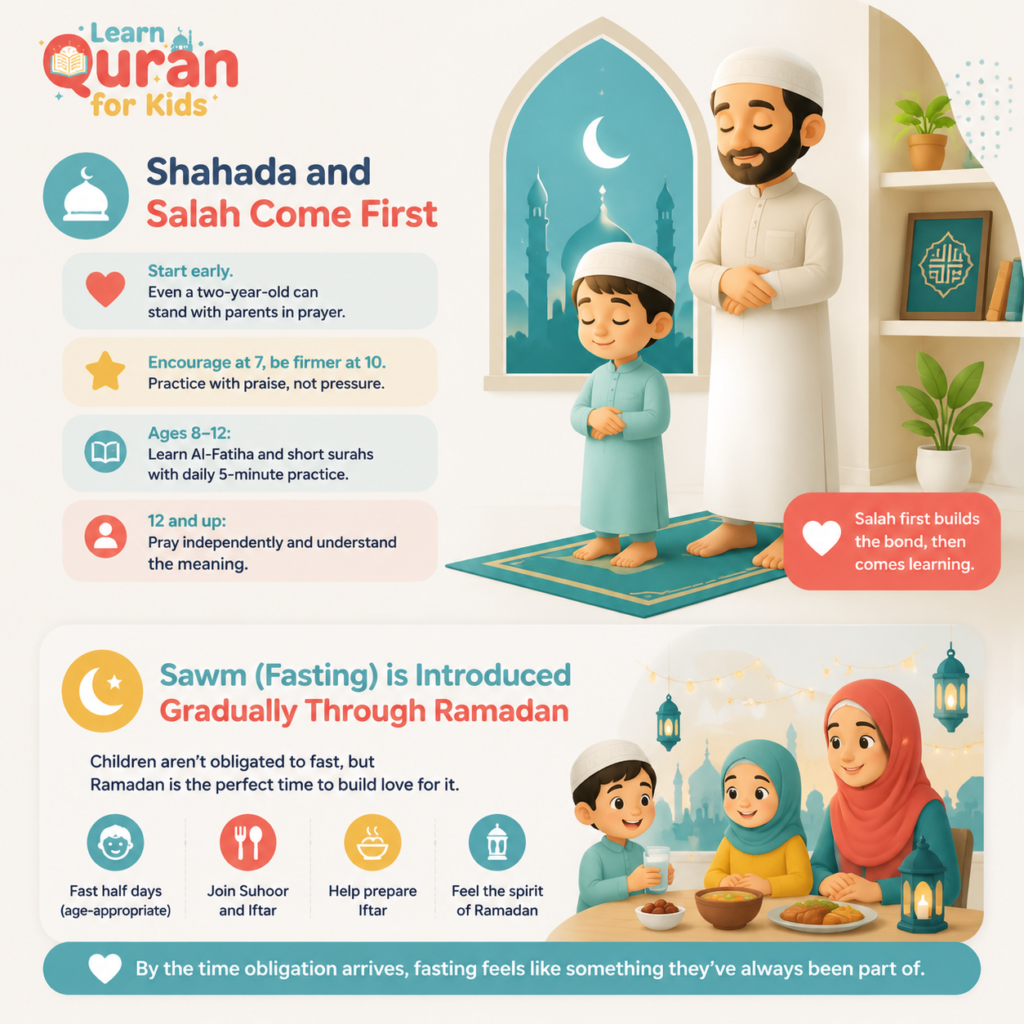
Sawm (fasting) is introduced gradually through Ramadan participation
Children younger than puberty are not obligated to fast, but Ramadan is the perfect environment to build love for it. Let younger children fast half days, join in Suhoor, help prepare Iftar, and feel the spirit of the month fully. By the time obligation arrives, fasting feels like something they’ve always been part of — not something suddenly imposed.
Zakat is taught through personal giving, not a lecture
Give a child their own small amount of money to donate. When a child personally drops coins into a charity box and understands that Allah sees this act, generosity becomes part of their identity. Abstract lessons about Zakat percentages come much later — the feeling of giving comes first.
7. Lead by Example in Teaching Islam Through Their Parents
Islamic schools, Quran teachers, and online courses are valuable tools — but they are not the primary source of a child’s Islamic identity. You are.
Children learn far more from what they observe than what they are told. When a child sees their parents:
- stopping to pray on time without being reminded
- saying Bismillah naturally before every meal
- treating others with patience and honesty
- speaking about Allah with love, not fear
…they absorb those behaviors as the normal way adults live. No curriculum can replicate this.
The most common parenting error here is inconsistency: teaching values verbally but not embodying them. A child who hears “be honest” but watches adults dodge difficult truths learns that honesty is for the mosque, not for life. Close that gap deliberately.
Read Also: Best 6 Islamic Ebooks for Kids
Our Students Reviews
Start Your Child’s Quran Learning Journey Today!
Join Kids Learning Quran Academy and help your child read the Quran with confidence through fun and guided lessons.
Book a Free Trial ClassRead also: When Should Children Begin Learning the Quran?
Start Your Child’s Islamic Education Today with Learn Quran for Kids
Home is where Islamic character begins, but structured guidance from qualified teachers helps it grow with clarity and confidence.
Learn Quran for Kids connects children aged 4–15 with experienced, patient instructors who specialize in teaching non-Arabic speaking children. Sessions are short, interactive, and designed around how children actually learn — through stories, repetition, and encouragement, never pressure.
Our Courses Include:
- Tajweed for Kids
- Quran Memorization for Kids
- Quran Recitation Course for Kids
- Quran Classes for Toddlers
- Quran Tafseer for Kids
- Qaida for Kids
- Quran Reading Course for Kids
- Online Arabic Classes for Kids
- Quranic Arabic for Kids
- Islamic Studies Courses for Kids
- Islamic Studies for Kindergarten
- 5 Pillars of Islam for Kids
- Islamic Education for Kids
What your child will learn:
- Quran reading with proper Tajweed
- Daily adhkar and Islamic etiquette
- Salah preparation and short surah memorization
- Prophetic stories and Islamic values
Book a free trial session and see the difference child-focused Islamic education makes.
Start Your Child’s Quran Learning Journey Today!
Join Kids Learning Quran Academy and help your child read the Quran with confidence through fun and guided lessons.
Book a Free Trial ClassConclusion
Teaching children Islam is not a single event — it is a continuous, layered process that begins at birth and deepens through every stage of childhood. Start with love for Allah, build a connection to the Prophet ﷺ, and introduce worship through daily moments before ever assigning formal obligation.
The home is the first and most powerful madrasa a child will ever attend. When parents model Islamic values consistently, answer questions honestly, use stories rather than lectures, and connect every routine moment to its Islamic meaning, children grow up with faith as part of who they are — not as a subject they studied once.
Start early. Make it warm. Be the example your child needs. The rest follows naturally, insha’Allah.
Frequently Asked Questions
When should I start teaching children Islam?
You can begin from birth by playing the Quran at home and saying duas aloud. Structured teaching of concepts like Allah’s names and Islamic manners begins around the ages of two to three. Formal prayer instruction starts at age seven, following the Prophet’s ﷺ guidance.
What is the most important first step in Islamic teaching for kids?
Introduce Allah before anything else. A child who knows Allah, loves Him, and feels that He is merciful and close will embrace every other Islamic practice from a place of genuine motivation, not external pressure.
How do I make Islamic learning fun for my child?
Use stories from the Seerah and Quran, turn daily duas into household habits, play Quran in the background at home, and frame every new practice as something to discover together rather than a rule to enforce. Islamic quiz games and age-appropriate books also make learning interactive and enjoyable.
What are the basics of Islam every child should learn first?
The foundational sequence is: knowing Allah and His names, loving the Prophet ﷺ, understanding the Shahada with meaning, learning daily adhkar and Islamic etiquette, then gradually working toward Salah, Quran recitation, and understanding the Five Pillars.
How long does it take for a child to learn how to pray?
Salah requires roughly two to three years of consistent, gentle practice before a child can perform it independently and habitually. Begin with observation at age four or five, introduce the movements and short surahs around age seven, and work toward consistent independent prayer by age ten.
Can online Islamic classes work for young children?
Yes, when sessions are short (20–30 minutes), age-appropriate, and taught by instructors experienced with young learners. Children aged four and up tend to engage well with structured online learning when the environment is encouraging and interactive, rather than lecture-based.
Related Articles
Learn Islam