 Learn Islam
You want your child to grow up knowing Allah, loving the Quran, and living Islam with genuine confidence. Yet every time you try explaining religion to a child, you face the same challenge: how do you make something this profound feel real to a four-year-old?
This question weighs on Muslim parents everywhere. The way you introduce faith today shapes everything your child will believe, practice, and carry into adulthood. Islam must always feel like a positive presence in your child’s life, never a burden imposed from outside.
This guide brings together the most effective, Islamically grounded methods for explaining religion to a child at every stage of development, so you can approach this sacred responsibility with real clarity.
Every Muslim Parent Carries a Direct Religious Obligation
“ يَا أَيُّهَا الَّذِينَ آمَنُوا قُوا أَنفُسَكُمْ وَأَهْلِيكُمْ نَارًا وَقُودُهَا النَّاسُ وَالْحِجَارَةُ ”
Yā ayyuhā alladhīna āmanū qū anfusakum wa-ahlīkum nāran wa-qūduhā al-nāsu wal-ḥijārah
” O you who have believed, protect yourselves and your families from a Fire whose fuel is people and stones.”
This verse places a clear duty on every Muslim parent. Protecting your family from the Fire means teaching your children about Allah, how to worship Him, and how to live as upright Muslims from the earliest possible age.
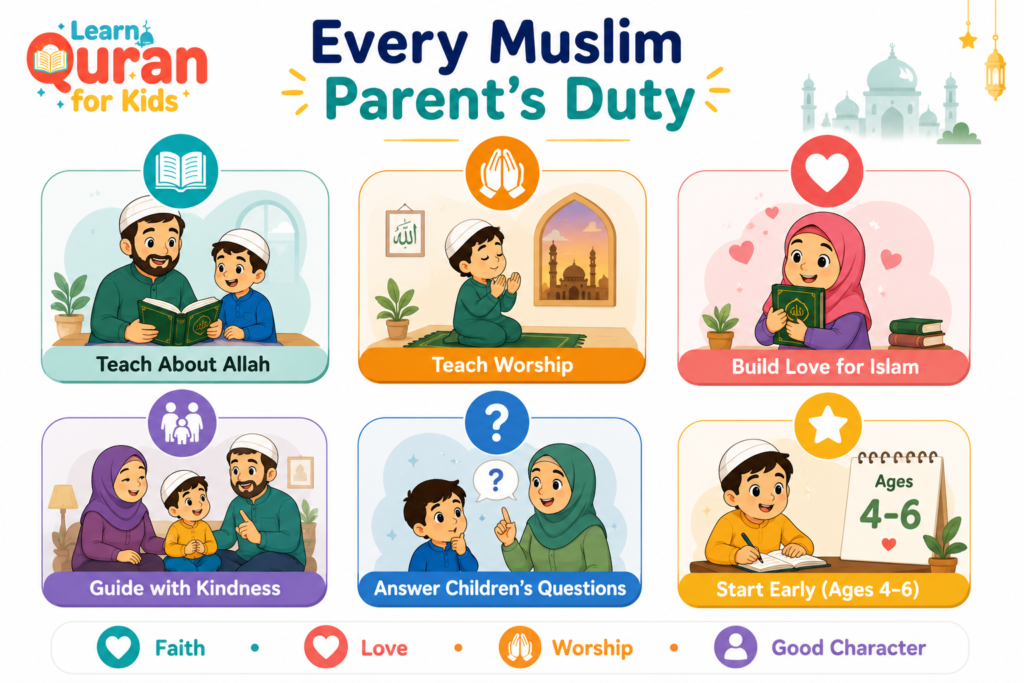
Religion, in the simplest terms a child can grasp, is the relationship between a person and their Creator. For Muslim children, religion means Islam: a complete way of life built on worshipping Allah alone. The word Islam means submission to the will of Allah, and it also carries the meaning of peace.
Children need to understand that Islam is not named after a person, tribe, or culture. It describes the bond between the servant and the Creator. This distinction prevents confusion and builds clarity as children grow older and encounter questions from the world around them.
Research confirms that ages 4 to 6 represent the peak period of religious curiosity in a child’s life. Children at this stage ask a flood of “why” questions about Allah, creation, angels, and right and wrong. Simple, emotionally connected responses are far more effective than abstract explanations at this age.
Younger children struggle to connect with abstract Islamic concepts without the right foundation. The Quran Classes for Toddlers course at Kids Learning Quran Academy introduces the very youngest learners to Allah’s words through gentle, age-appropriate live sessions with certified teachers.
Start your child’s journey today.
Age-Appropriate Language Makes Explaining Religion to a Child Effective
Matching your approach to your child’s developmental stage is the single most important decision when explaining religion to a child. The table below shows what children can understand and which methods work best at each stage:
| Age Group | What Children Can Understand | Best Teaching Method |
| 0 to 3 years | Sounds, emotions, daily routine | Reciting Quran aloud, saying Bismillah, modeling duas |
| 3 to 5 years | Simple stories, love, basic concepts | Short Prophet stories, songs, gentle repetition |
| 6 to 9 years | Meaning behind words and actions | Explaining the pillars, Quranic meaning, open discussion |
| 10 years and above | Purpose, reasoning, deeper belief | Tafseer, structured Islamic studies, reflective dialogue |
For children aged 0 to 3, frame Allah through love and closeness first. When a 3-year-old asks “Where is Allah?”, the most developmentally appropriate answer is: “Allah is very close and He loves you.” Children at this age learn through what they observe, so let them see you pray, hear you say Bismillah, and watch you make dua.
At ages 4 and 5, focus on one concept per conversation and use repetition across days and weeks. Children this age lose interest quickly when too many ideas arrive at once.
Children aged 6 to 9 begin asking how and why things work. This is the time to explain what each pillar of Islam actually means, not just what it involves. Open questions like “Why do you think we pray five times a day?” build a thinking Muslim, not just a routine-following one.
Read also: Who Is Allah for Kids?
See Our Classes in Action!
Wondering what a typical lesson looks like? Take a peek inside our virtual classrooms below to see how our patient teachers keep students smiling, engaged, and learning every step of the way.
Start Your Child’s Quran Learning Journey Today!
Join Kids Learning Quran Academy and help your child read the Quran with confidence through fun and guided lessons.
Book a Free Trial ClassStorytelling Builds Faith Better Than Any Direct Instruction
The Quran is filled with the stories of Prophets precisely because Allah knows how human hearts absorb truth through narrative. Stories make abstract values like patience, trust in Allah, and honesty tangible and memorable for young children.
Prophet Stories That Each Target a Specific Core Value
Islamic stories drawn from Quranic narratives stay with children for life. Each of the following stories targets a specific value:
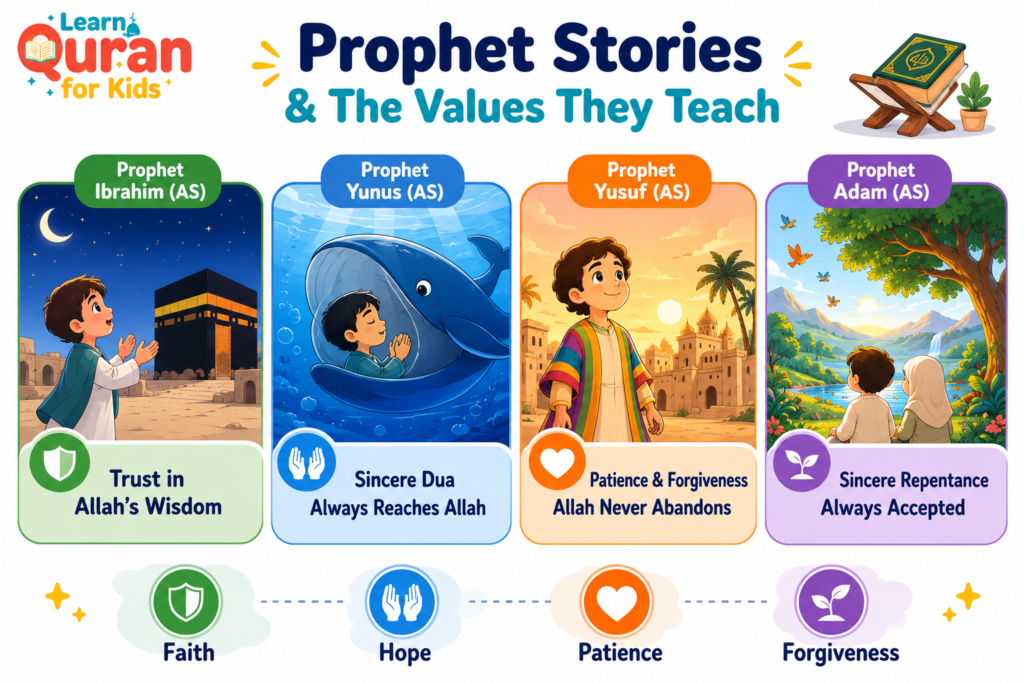
- The story of Prophet Ibrahim (AS) teaches that true faith means trusting Allah’s wisdom even in the hardest moments.
- The story of Prophet Yunus (AS) teaches that sincere dua reaches Allah in every situation, no matter how desperate.
- The story of Prophet Yusuf (AS) teaches patience and forgiveness, and that Allah never abandons those who remain steadfast.
- The story of Prophet Adam (AS) teaches that sincere repentance is always accepted and that mistakes do not end our relationship with Allah.
Storytelling Techniques That Make Lessons Memorable
The following techniques make Quranic stories deeply memorable for children:
- Pause dramatically before the exciting moment in the story.
- Whisper during suspenseful scenes and raise your tone during major events.
- Use dialogue and action words to make the Prophets feel real and present.
- Ask one reflection question at the end, such as: “What would you say to Allah if you were in Yunus’s place?”
Keep each story under five minutes for children under 10. Focus on one powerful lesson per sitting. Children remember how a story made them feel far more than its details.
Read also: Islamic Worksheets for Kids
Daily Home Habits That Reinforce What Stories Teach
The following daily habits strengthen what children learn about religion through storytelling:
- Say Bismillah before every meal and explain that it means we begin everything in Allah’s name.
- Make dua together before bed and teach children that dua is a direct conversation with Allah.
- Recite a short Surah together daily and gradually explain its meaning in simple words.
- Celebrate Eid and Ramadan with genuine joy, creating lifelong positive associations with the Deen.
The Islamic Studies Courses for Kids at Kids Learning Quran Academy weaves Quranic stories and Islamic values into a structured curriculum delivered by certified native Arab tutors. If storytelling at home is the seed, this course provides the structure your child builds upon.
Build your child’s foundation now.
The Five Pillars of Islam Explained in Child-Friendly Language
The Five Pillars of Islam are the foundation of every Muslim’s practice. The table below shows how to present each pillar at two levels, matched to age:
| Pillar | Simple Version (Ages 3 to 5) | Explained Version (Ages 6 and above) |
| Shahadah | “We say Allah is One and Muhammad is His messenger.” | The declaration of faith that confirms Tawhid and makes a person Muslim. |
| Salah | “We talk to Allah five times every day.” | Five daily prayers that connect a Muslim to Allah throughout every day. |
| Zakah | “We give some of what we have to people in need.” | Giving a portion of savings annually to those in need as an act of worship. |
| Sawm | “In Ramadan we don’t eat to remember Allah.” | Fasting from dawn to sunset in Ramadan to build taqwa and gratitude. |
| Hajj | “We visit the Kaaba like Prophet Ibrahim did.” | The pilgrimage to Makkah, required once in a lifetime for those who are able. |
Teaching Shahadah at Each Stage of Childhood
For children aged 3 to 5, teach the Shahadah through songs, rhymes, and daily repetition. Children this age learn through rhythm and routine, so incorporate it into bedtime rituals or morning moments.
For children aged 6 to 9, begin explaining what each word means. “There is no god but Allah” becomes a conversation about who created everything around them. Children should understand that Muslims love and respect Prophet Muhammad (peace be upon him) deeply, but they worship Allah alone. He is the final messenger who delivered Allah’s guidance to all of humanity.
Teaching Salah as a Lifelong Habit
The Prophet (peace be upon him) gave clear guidance on when to begin teaching prayer:
“” مُرُوا أَوْلاَدَكُمْ بِالصَّلاَةِ وَهُمْ أَبْنَاءُ سَبْعِ سِنِينَ وَاضْرِبُوهُمْ عَلَيْهَا وَهُمْ أَبْنَاءُ عَشْرِ سِنِينَ وَفَرِّقُوا بَيْنَهُمْ فِي الْمَضَاجِعِ ”
“Command your children to pray when they become seven years old, and beat them for it (prayer) when they become ten years old; and arrange their beds (to sleep) separately.”
Prayer appears in a Muslim child’s life first as observation, then as imitation, and finally as obligation. Let your toddler watch you pray and imitate your movements. When they are old enough, give them their own prayer mat and a dedicated prayer corner. This builds spiritual ownership and responsibility from the earliest age.
Teaching Zakah and Hajj Through Direct Participation
The following hands-on approaches make Zakah and Hajj real for children:
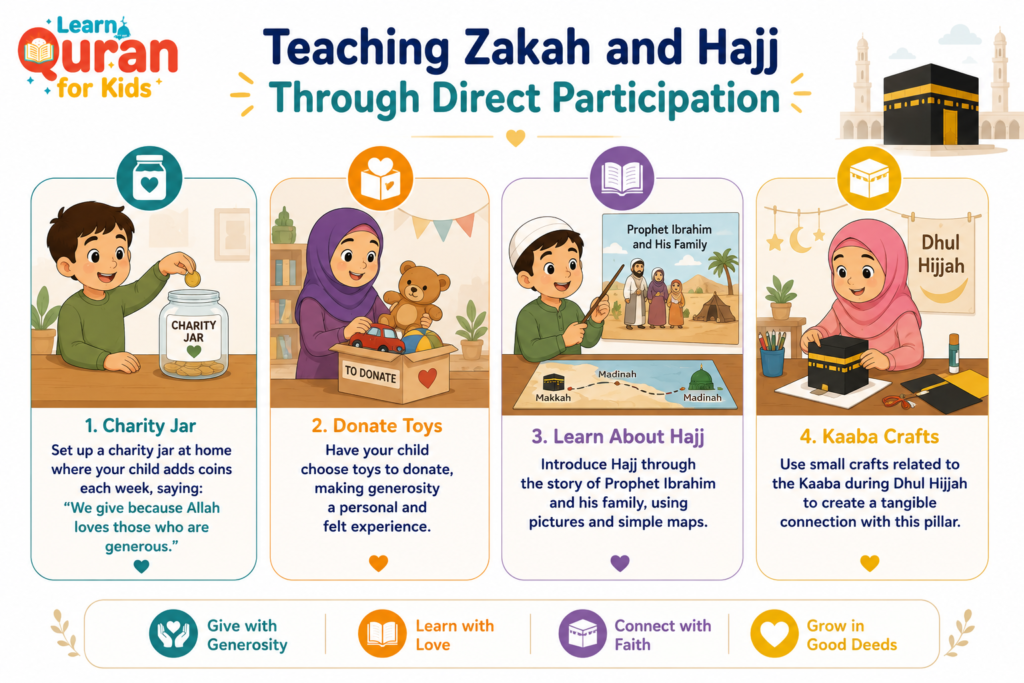
- Set up a charity jar at home where your child adds coins each week, saying: “We give because Allah loves those who are generous.”
- Have your child choose toys to donate, making generosity a personal and felt experience.
- Introduce Hajj through the story of Prophet Ibrahim and his family, using pictures and simple maps.
- Use small crafts related to the Kaaba during Dhul Hijjah to create a tangible connection with this pillar.
How to Explain Allah to a Child at Every Age
Explaining Allah to a child is the most important and most delicate task in Islamic parenting. The Quran itself provides the model through the example of Prophet Luqman:
“وَإِذْ قَالَ لُقْمَانُ لِابْنِهِ وَهُوَ يَعِظُهُ يَا بُنَيَّ لَا تُشْرِكْ بِاللَّهِ ۖ إِنَّ الشِّرْكَ لَظُلْمٌ عَظِيمٌ ﴿١٣﴾ ”
Wa-idh qāla Luqmānu li-ibnihi wa huwa yaʿiẓuhu yā bunayya lā tushrik billāhi inna al-shirka laẓulmun ʿaẓīm
“And [mention, O Muhammad], when Luqman said to his son while he was instructing him, “O my son, do not associate [anything] with Allah. Indeed, association [with him] is great injustice.” (13).”
The starting point for every conversation about Allah should be His love and mercy, never fear. Children who associate Allah primarily with punishment develop an unhealthy relationship with their faith as they grow. Introduce Allah through His visible blessings first. Point to the sun, the rain, food on the table, and the love of family. Teach your child to say: “Allah made this for us because He loves us.”
When children ask “Why can’t we see Allah?”, respond simply: just as we cannot see the wind but feel it all around us, we cannot see Allah but feel His presence through His creation and blessings every single day.
Teach Tawhid as the absolute core of Islamic belief. Explain that Allah is one, unique, and unlike anything in creation. He has no partner, no child, and no equal. This foundational understanding protects your child’s faith against confusion later in life.
A child who understands Allah deeply is ready to understand why the Five Pillars exist. The 5 Pillars of Islam for Kids Course at Kids Learning Quran Academy connects belief in Allah directly to Islamic practice through certified native Arab tutors in structured live sessions.
Connect your child to Islam’s foundations today.
How to Explain Other Religions to a Child Without Causing Confusion
Muslim children growing up in diverse communities will encounter other religions from friends, at school, and online. How you handle these conversations early makes a lasting difference in how your child holds their Islamic identity.
The Two Main Types of Religion Children Need to Understand
Understanding how religions differ helps children place Islam in context. The two main categories are:
- Monotheistic religions: These believe in one God. Islam, in its final and complete form, is the purest expression of monotheism. Judaism and others also fall in this category but do not follow the final revelation.
- Polytheistic religions: These believe in multiple gods or divine beings. Islam clearly distinguishes itself from this category through Tawhid, the absolute oneness of Allah.
How to Teach Differences Without Creating Hostility
Children do not need to be taught that other religions are wrong in harsh terms. They need to be taught that Islam is the final, complete, and preserved revelation from Allah. The following points guide this conversation clearly:
- Explain that people around the world follow different religions, and Islam teaches Muslims to treat all people with respect.
- Teach that all Prophets, from Adam to Isa (peace be upon them all), brought the same core message of Tawhid.
- Help your child understand that Prophet Muhammad (peace be upon him) came as the seal of all Prophets, completing Allah’s guidance to humanity.
- Explain that the Quran is the only divine book preserved in its original language without any change since its revelation.
How Knowledge of Other Religions Strengthens Islamic Identity
When a child learns that Islam is the last and most complete message from Allah, their relationship with their own faith deepens. A child who loves and deeply understands their own religion will not be shaken when they encounter others. Knowledge of what makes Islam unique, its preserved book, its final Prophet, and its pure Tawhid, is the strongest protection a Muslim child can carry.
Read Also: Hadith About Children
Experience the Magic Firsthand
Watch these short clips from our live classes to see our interactive teaching tools, vibrant student-teacher interactions, and the fun, stress-free ways we make learning easy for kids!
Start Your Child’s Quran Learning Journey Today!
Join Kids Learning Quran Academy and help your child read the Quran with confidence through fun and guided lessons.
Book a Free Trial ClassPractical Ways to Strengthen Your Child’s Islamic Identity at Home
A child’s Islamic identity is built in the small, repeated moments of daily life at home, not in formal lessons alone.
Making Islam the Natural Rhythm of Daily Life
The way your family eats, greets others, handles difficulty, and speaks about Allah communicates a living religion to your child. The following steps make Islam the natural context of every day:
- Begin every meal with Bismillah and explain its meaning clearly to your child.
- Greet family members with Assalamu Alaikum at all times, not only in formal settings.
- Refer to Allah naturally in daily speech: “Alhamdulillah for this food,” “Inshallah we will go tomorrow.”
- When facing difficulty, say “Alhamdulillah ala kulli hal” and explain that a Muslim thanks Allah in every situation.
Creating a Physical Islamic Environment at Home
The physical environment of your home communicates values without words. The following changes build an Islamic atmosphere:
- Place a dedicated prayer mat in a fixed corner your child considers their own.
- Display simple Arabic calligraphy of Allah’s name or short duas where your child sees them daily.
- Keep an age-appropriate Quran or Islamic storybook within your child’s reach at all times.
- Use a Ramadan or Hijri calendar to connect your child to the Islamic year visually and naturally.
Read Also: Seerah for Kids
Using Islamic Learning Tools to Reinforce What Parents Teach
Technology and Islamic learning tools reinforce what parents teach, when used with clear purpose. The following tools support Islamic identity at home:
- Age-appropriate Islamic apps that introduce the names of Allah and short Surahs through interactive exercises.
- Islamic audiobooks and nasheed recordings children can listen to during play or before sleep.
- Short, age-appropriate Islamic video content that brings Quranic stories to life visually for young children.
- Islamic coloring books that teach the names of Allah, Prophets, and Islamic practices through creative activity.
A child whose Islamic identity is strong at home needs the Quran’s meanings to anchor that identity for life. The Quran Tafseer for Kids course at Kids Learning Quran Academy teaches children the meanings behind Allah’s words in age-appropriate live sessions with certified teachers.
Read Also: Who Is Allah for Kids?
Deepen your child’s connection now and give his identity its deepest root.
Kids Learning Quran Academy Gives Your Child a Complete Islamic Education
Your child deserves certified teachers, structured learning, and real results. Kids Learning Quran Academy provides one-on-one live sessions with certified native Arab tutors trained specifically to teach children. Every session is tailored to your child’s pace, level, and individual learning needs.
Kids Learning Quran Academy offers the following advantages for every enrolled family:
- Real-time Tajweed and Makharij correction using audio-visual feedback during every session.
- Flexible scheduling covering all global time zones: EST, PST, GMT, CET, IST, GST, and MYT.
- Female teacher options available for families who prefer them.
- Monthly progress reports sent to parents after every session.
- A free trial class available before any commitment is required.
Our Courses Include:
- Tajweed Course for Kids
- Quran Memorization Course for Kids
- Quran Recitation Course for Kids
- Quran Classes for Toddlers
- Quran Tafseer Course for Kids
- Qaida Course for Kids
- Quran Reading Course for Kids
- Online Arabic Classes for Kids
- Quranic Arabic Course for Kids
- Islamic Studies Courses for Kids
- Islamic Studies Course for Kindergarten
- 5 Pillars of Islam Course for Kids
- Islamic Education Course for Kids
Don’t wait to invest in your child’s Akhirah and future. Enroll today and watch your child grow with confidence, knowledge, and love for the Quran.
Join Kids Learning Quran Academy now and start your child’s learning journey today!
Start Your Child’s Quran Learning Journey Today!
Join Kids Learning Quran Academy and help your child read the Quran with confidence through fun and guided lessons.
Book a Free Trial ClassConclusion
Explaining religion to a child is one of the most meaningful responsibilities you carry as a Muslim parent. It begins with your own example, continues through daily habits, and deepens through stories, open conversations, and structured learning.
Start early, stay consistent, and always make Islam a source of love and joy in your child’s life. When your child grows up knowing Allah, understanding the pillars, and loving the Quran, every effort you made will have been worth it. Kids Learning Quran Academy is here to support you at every step.
Register today and take the first step toward your child’s complete Islamic education
Frequently Asked Questions About Explaining Religion to a Child
How do I start explaining religion to a 4-year-old?
Begin with simple concepts: Allah loves you, Allah made everything, and we thank Allah every day. Short Prophet stories and daily duas work best at this age.
How do I explain religion to a child who asks why we cannot see Allah?
Tell them that just as we cannot see the wind but feel it everywhere, we cannot see Allah but feel His love and blessings all around us every day.
What is the meaning of religion for kids in simple terms?
Religion means the relationship between a person and their Creator. For Muslim children, it means Islam: the complete way of life that Allah revealed for all of humanity.
At what age should I begin explaining religion to a child?
Begin from birth by reciting Quran aloud. Structured explanations start at age 3 to 5 with simple concepts, growing gradually as your child develops.
How do I explain the types of religion for kids without causing confusion?
Explain that some religions believe in one God and some in many. Then teach clearly that Islam is the final and complete message from Allah, the one true God.
How do I explain religion to a child who asks about other faiths at school?
Strengthen their Islamic identity at home daily. Teach them clearly what Muslims believe and why, so they can answer questions from others with confidence and calm.
Related Articles
Learn Islam