 Learn Quran
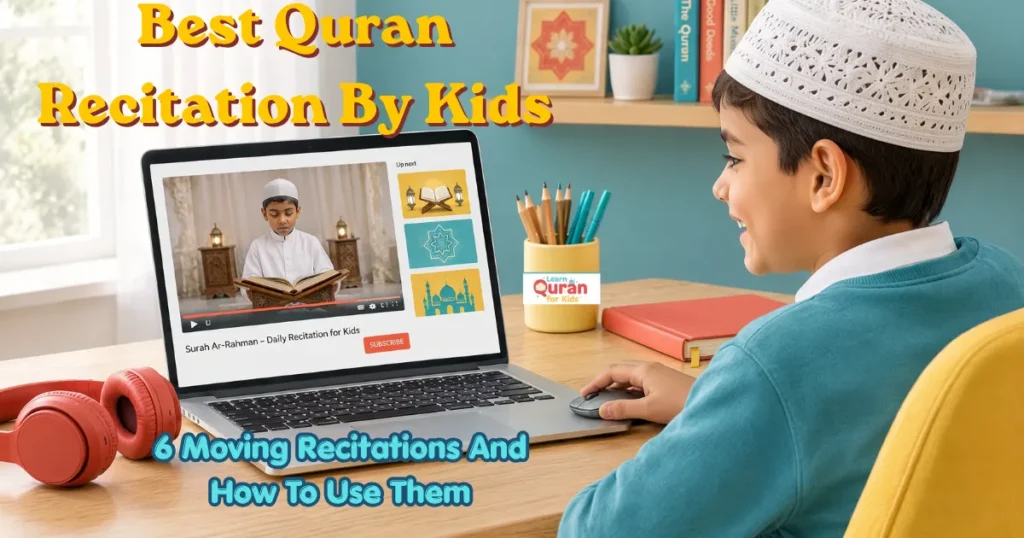
Searching for the best Quran recitation by kids usually starts with a single clip: a young voice reciting Surah Al-Balad or Maryam with such control that adults stop what they’re doing to listen. Many parents then wonder how a child that age learned to recite like that, and whether their own child could too.
This article collects some of the most-listened-to child recitations available today, organized by where you can find them. It also gives you a simple way to judge which recitations are worth playing for your child, and a practical method for turning listening into real recitation skill.
A child’s recitation earns a place on this list for its correct Tajweed and steady pace, not only for a beautiful voice.

1. TV Quran’s Children’s Recitations Collection
TV Quran runs a dedicated children’s recitations section where you can stream or download recitations by young Qaris. Each track is labeled with the surah and verse range, so you can choose a passage your child is currently learning.
Recitations featured there include Yusuf Kalo reciting Surah Maryam (verses 66–98), Mahmoud Al-Shitani reciting Surah Yasin (20–30) and Surah Al-Mulk, Mahmoud Hegazy reciting Surah Al-Kahf (27–31), Ahmed Saud reciting Surah At-Tin and Al-Alaq, Mohamed Taha reciting Surah Muhammad (15–25), and Khaled Dawi reciting Surah An-Naml (82–93). Several of these tracks have been played hundreds of thousands of times.
Because it is audio-only, this is one of the calmest ways for a child to listen: no autoplay feed and no comments section.
2. The “Children’s Recitations” Playlist On YouTube
The Holy Quran Recitations channel keeps a children’s recitations playlist of more than 150 videos. It shows children reciting with Tarteel, imitating senior Sheikhs, and in some clips leading congregational prayer.
This playlist is useful for older children who are motivated by seeing other kids their age stand up and recite confidently in front of a congregation. Watch a clip together first, then let your child pick one short passage to practice that same week.
3. Young Quran Reciter On MyQuran
The MyQuran channel’s “Young Quran Reciter” clip features a boy reciting Surah Al-Balad in the style of Sheikh Abdul Basit Abdus-Samad. It is one of the most-shared examples of a child copying a master reciter’s mujawwad style.
A separate MyQuran clip of a child’s closing recitation, around nine minutes long, has also circulated widely for its emotional, humble delivery. Both clips suit the 3T check: listen together, then ask your child whether the madd lengths and breathing pauses sound steady.
4. Young Reciters On The Mahfel Program
Mahfel, a Quran recitation progr+am, has published a long compilation of more than an hour featuring children reciting before a live audience. It gives your child a chance to hear many young voices, styles, and surahs in one sitting.
Because the compilation is long, avoid playing it all at once. Split it into short segments of ten to fifteen minutes across several days. After each segment, ask which reciter your child liked most and make that voice their practice model.
5. Yusuf – Completed The Quran By Age Nine
Yusuf, a boy who memorized the entire Quran by the age of nine, recited on DMC’s morning show. The clip on DMC TV’s Facebook page is a strong motivator for children doing Hifz, because it pairs a beautiful recitation with a clear, achievable story.
Watch it with your child before starting a new memorization goal. Hearing that another child finished the whole Quran makes a single surah feel possible.
Afterward, set one Hifz target your child can complete this week.
6. Quran Teacher Apps With Children Repeating
For offline listening, the “Quran Teacher for Kids” app on Google Play uses Sheikh Muhammad Siddiq Al-Minshawi’s teaching recitation, where a group of children repeats each verse after him. It lets you repeat a single verse and set exactly where a memorization session starts and stops.
This “Sheikh recites, children repeat” format is the closest thing to a classroom you can play at home, and it shows your child exactly what correct repetition sounds like, even without a teacher present.
See Our Classes in Action!
Wondering what a typical lesson looks like? Take a peek inside our virtual classrooms below to see how our patient teachers keep students smiling, engaged, and learning every step of the way.
Start Your Child’s Quran Learning Journey Today!
Join Kids Learning Quran Academy and help your child read the Quran with confidence through fun and guided lessons.
Book a Free Trial ClassHow To Judge The Best Quran Recitation Child Performances
A child’s recitation is “best” for your child when it is correct before it is impressive. Viral clips are not reviewed for Tajweed, so it helps to have a quick filter before you add a recitation to your child’s routine.
The 3T Check – Tajweed, Tone, And Tempo
Use this three-part check, which takes about a minute per clip:
- Tajweed: Are the madd lengths consistent? For example, natural madd should stay at two counts and not stretch to sound more melodic.
- Tone: Is the voice relaxed, or is the child straining to reach a pitch that belongs to an adult reciter?
- Tempo: Can your child follow the words? A recitation that is too slow and ornamented is harder to learn from than a steady one.
A clip that passes all three is a good model. A clip that fails Tajweed is better kept for enjoyment, not imitation.
Read also: Quranic Studies For Children Online – 5 Essential Stages To Raise A Confident Quran Reader
Murattal For Learning, Mujawwad For Inspiration
Murattal is a steady, measured style of recitation used for daily reading and memorization. Mujawwad is a slower, melodic style used in public gatherings, the style many children imitate from Sheikh Abdul Basit.
Mujawwad clips inspire children, but murattal clips teach them. A practical rule: let your child listen to mujawwad for motivation, then practice the same passage in murattal.
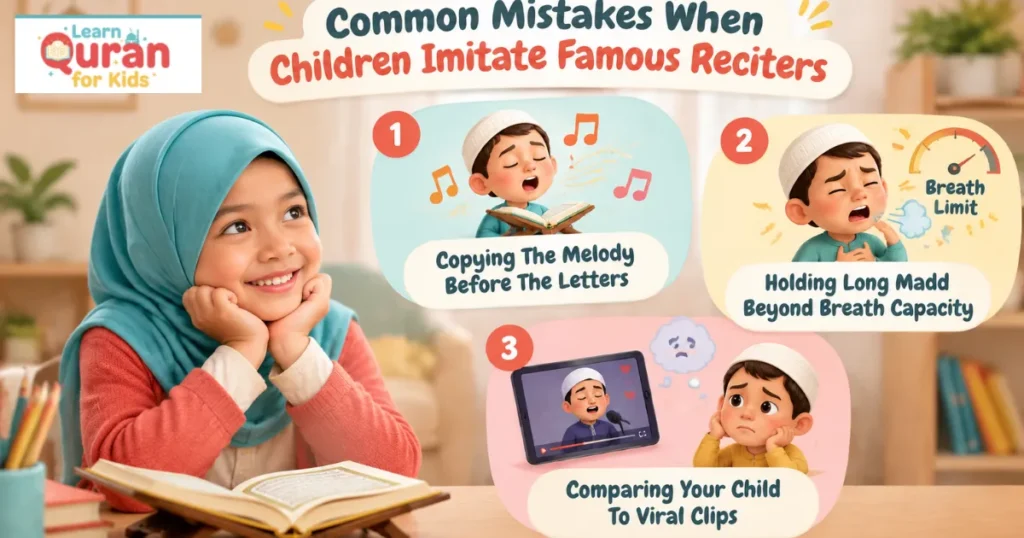
Common Mistakes When Children Imitate Famous Reciters
Children copy what they hear, mistakes included. Knowing the most common slips helps you correct them early, before they settle into habit.
- Copying The Melody Before The Letters: The most frequent mistake is learning the maqam (melodic mode) before the makharij. A child may reproduce Sheikh Abdul Basit’s rise and fall perfectly while still turning ح into ه or ع into a plain alif sound, which can change a word’s meaning.
- Holding Long Madd Beyond Breath Capacity: Six-count madd and long pauses are much harder for a child’s lungs than an adult’s. Children who force them often break mid-word or take breaths in places that alter the meaning. Shorter passages solve this better than “try harder.”
- Comparing Your Child To Viral Clips: The children in these recitations often had years of daily practice with a teacher. Treat the clips as a destination, not a benchmark for this month. The Prophet ﷺ said that the one who recites the Quran with difficulty and struggles gets a double reward (Bukhari and Muslim), a reminder worth sharing with your child.
If you want someone to listen to your child’s recitation and correct these slips live, Learn Quran for Kids pairs each child with a one-on-one tutor who holds an Ijazah in recitation and Tajweed.
Read also: Tajweed Games And Activities For Kids – 17 Fun Ideas That Make Tajweed Rules Stick
Experience the Magic Firsthand
Watch these short clips from our live classes to see our interactive teaching tools, vibrant student-teacher interactions, and the fun, stress-free ways we make learning easy for kids!
Start Your Child’s Quran Learning Journey Today!
Join Kids Learning Quran Academy and help your child read the Quran with confidence through fun and guided lessons.
Book a Free Trial ClassThe Echo Loop – Turning Listening Into Recitation
The Echo Loop is a simple at-home routine that turns your child’s favorite recitation into a practice tool. It works best with short passages of 3 to 5 verses from Juz ‘Amma or a surah your child already knows.
- Step 1 – Listen To One Verse Three Times: Play a single verse from a recitation that passed the 3T check. Your child listens only, without reciting, so the sound pattern settles first.
- Step 2 – Echo The Verse Aloud: Your child repeats the verse right after the recording, the same way the children in the Al-Minshawi teaching recitation do. Focus on one correction per round, not five.
- Step 3 – Record And Compare: Record your child on your phone and play both recordings one after the other. Children often hear their own mistakes faster than they accept a correction from a parent.
- Step 4 – Move On Only When The Verse Is Steady: Add the next verse only after your child recites the first one smoothly twice in a row. Ten minutes a day of this beats an hour on the weekend.
Some Tajweed errors are hard for a parent to hear, especially in families where Arabic is not the first language. This is where Learn Quran for Kids’ Quran Recitation Course for Kids helps: tutors correct articulation in real time and send a progress report after each session.
Read also: Interactive Ways To Teach Quran Reading For Kids – 12 Fun And Effective Methods
Give Your Child The Voice Behind The Recitations They Love
Every young reciter in these clips had someone who listened, corrected, and encouraged them, verse by verse. Your child can have the same.
Learn Quran for Kids teaches children from age 4 in live, one-on-one online classes with Ijazah-certified tutors trained to teach young learners. Lessons use visual Tajweed charts, Quranic stories, and rewards, and you choose class times that fit around school. You can also watch any session.
Book your child’s free trial recitation class today and hear the difference after the very first lesson.
Our Courses Include:
- Qaida Course for Kids
- Quran Reading Course for Kids
- Online Arabic Classes for Kids
- Quranic Arabic Course for Kids
- Islamic Studies Courses for Kids
- Islamic Studies Course for Kindergarten
- 5 Pillars of Islam Course for Kids
- Islamic Education Course for Kids
Start Your Child’s Quran Learning Journey Today!
Join Kids Learning Quran Academy and help your child read the Quran with confidence through fun and guided lessons.
Book a Free Trial ClassConclusion
The best Quran recitation by kids can be found on TV Quran’s children’s collection, YouTube playlists such as Holy Quran Recitations and MyQuran, the Mahfel program, inspiring stories like young Yusuf’s, and teaching apps based on Sheikh Al-Minshawi’s recitation.
Choose clips that pass the 3T check, use mujawwad recitations for inspiration and murattal for practice, and watch for the common imitation mistakes. Above all, turn listening into practice with a short daily Echo Loop.
The takeaway: a beautiful child recitation is built on correct letters and steady practice, and with guidance, your child can get there too.
Frequently Asked Questions
Who Is The Best Child Quran Reciter?
There is no official ranking of the best child Quran reciter. Widely played young reciters include Yusuf Kalo, Mahmoud Al-Shitani, Mohamed Taha, and Mahmoud Hegazy, whose recitations are featured in TV Quran’s children’s collection.
Can My Child Learn Quran Recitation By Imitating Other Kids?
Yes, children can learn Quran recitation by imitating other kids, as long as the recitation they copy has correct Tajweed. Imitation works best when combined with a teacher who corrects letter articulation.
At What Age Can A Child Start Reciting The Quran With Tajweed?
Most children can start basic Tajweed for Quran recitation around age 5 or 6, after learning the Arabic letters. Younger children benefit from listening and repeating short surahs without formal rules.
Is It Okay For A Child To Imitate A Famous Reciter’s Melody?
Yes, a child can imitate a famous reciter’s melody once the letters and madd lengths are correct. Melody should never come at the cost of Tajweed or force a child’s voice beyond its natural range.
Where Can Kids Listen To Quran Recitation Offline?
Kids can listen to Quran recitation offline using apps such as “Quran Teacher for Kids” on Google Play, which uses Sheikh Al-Minshawi’s recitation with children repeating, or by downloading tracks from TV Quran.