 Learn Quran
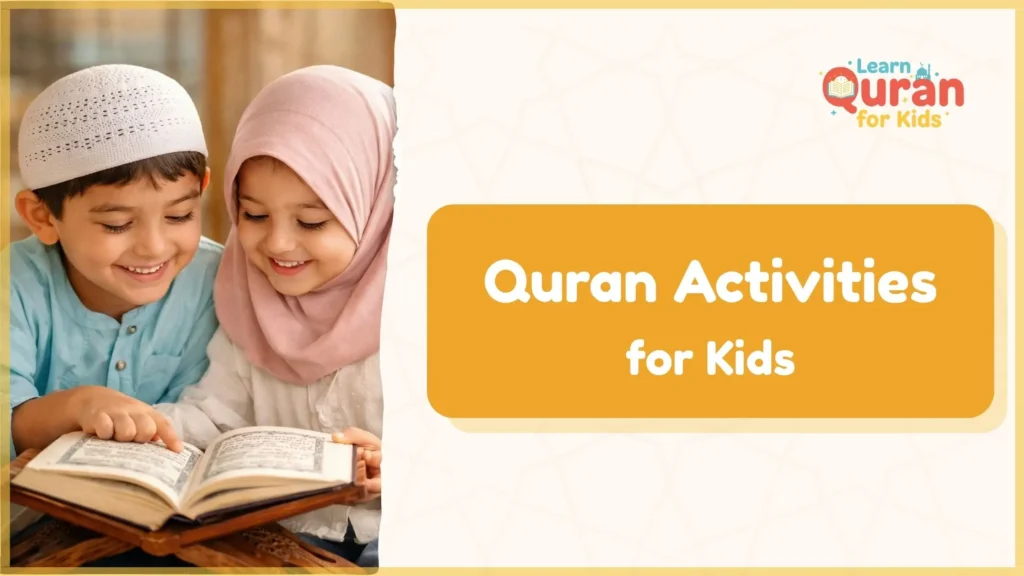
Helping children connect with the Quran often requires more than routine memorization—it calls for creativity, movement, and moments that make learning feel joyful. When the Quran becomes part of play and daily life, children naturally develop a lasting attachment to its words and meaning.
Through engaging activities like memory games, scavenger hunts, and reflection journals, children strengthen memorization, improve Tajweed, and build a personal relationship with the Quran. These simple, parent-led methods turn learning into an experience children actively enjoy and seek out.
1. The Surah Memorization Tracker Turns Hifz Progress Into a Visual Achievement
The Surah Memorization Tracker is one of the most effective Quran activities for kids for sustaining long-term memorization motivation because it makes invisible progress visible.
When a child can see their own growth displayed on a wall chart, completing the next Surah becomes a personal goal they pursue independently rather than a task assigned by a parent.
Create a large chart on paper or card listing all 114 Surahs of the Quran, starting from Surah An-Nas and working backward through Juz Amma.
For each Surah your child memorizes, they color in, stamp, or place a sticker over that Surah’s name. Display the chart in a prominent place in their room or in the family area.
Review the chart together every Friday and celebrate each newly completed Surah with a small acknowledgment, a special meal, a chosen family activity, or a written certificate they keep.
This quran activity for kids works on multiple psychological levels simultaneously. The visual display creates a public commitment that children feel motivated to honor.
The act of physically coloring or stamping a completed Surah provides a satisfying moment of closure that reinforces the behavior of memorizing.
Children who use memorization trackers consistently show higher completion rates and lower dropout during difficult revision periods because they can see how far they have come and feel genuine reluctance to break their streak.
Kids Learning Quran Academy’s Quran Memorization for Kids program provides structured weekly memorization goals that pair perfectly with a home tracker.
Certified instructors set realistic targets based on each child’s age and capacity, test recitation weekly in live one-on-one sessions, and adjust the pace to ensure strong retention at every stage.
Book a Free Trial for Your Child in the Best Hifz Course for Kids

2. The Quranic Verse Memory Card Game Builds Retention Through Playful Repetition
The Quranic Verse Memory Card Game is among the most effective Quran activities for kids for building verse-level memorization because the mechanics of the game require children to actively recall Quranic content repeatedly in a context that feels like play rather than study.
Active recall is the single most powerful memorization technique available, and this game delivers it without the child noticing.
Write ten to fifteen Quranic verses on individual cards, one verse per card, using clear, large Arabic text with transliteration underneath. Create a matching set of cards showing the English meaning of each verse.
Shuffle all cards and lay them face down in a grid on the floor or table. Players take turns flipping two cards at a time, looking for a verse and its matching meaning. When a match is found, the player keeps the pair and recites the verse aloud before the next player’s turn. The player with the most pairs at the end wins.
Begin with verses your child already knows partially and introduce one or two new verses per game session. As your child’s knowledge grows, add more cards to the deck gradually.
This quran activity for kids can be adapted for different age groups simply by adjusting the number of cards and the complexity of the verses used.
Younger children aged 4 to 7 work well with five to eight pairs. Older children aged 10 and above can handle fifteen to twenty pairs comfortably.
3. Quran Freeze Tag Takes Memorization Outdoors and Into the Body
Quran Freeze Tag is one of the most energetic and memorable Quran activities for kids because it combines physical movement with active Quran recitation, engaging the kinesthetic and auditory learning channels simultaneously.
Children who learn Quranic content through movement retain it with measurably greater durability than those who learn through seated repetition alone.
| Learning Style | How Quran Freeze Tag Serves It | Expected Benefit |
| Kinesthetic (movement) | Running, tagging, and physical freezing | Body memory links physical states to Quranic content |
| Auditory (listening) | Reciting aloud to be unfrozen | Oral repetition in a high-engagement context |
| Social (peer interaction) | Group play and mutual recitation | Positive emotional associations with Quran learning |
| Competitive | Points and winning conditions | Intrinsic motivation to memorize more to play better |
How to do it: Choose one or two Surahs or a short set of verses that children are currently memorizing. One child is designated as “it” and chases the others. When a player is tagged, they freeze in place with one hand raised.
To be unfrozen, another player must come and recite the current memorization portion to them correctly. Players holding their memorization reference paper are permitted during the early stages. The child who is “it” cannot interrupt a recitation in progress. Rotate the role of “it” regularly. Every five minutes, pause the game entirely and have all players recite the current portion together as a group before resuming.
This Quran activity for kids works particularly well for children aged 6 to 12 and for groups of three or more. Families with multiple children can play it in a garden or large indoor space.
The game creates positive emotional associations with Quranic memorization because the Quran becomes the key to freedom in the game, and children experience that association at a physical, felt level.
Shots Videos from Our Courses
Start Your Child’s Quran Learning Journey Today!
Join Kids Learning Quran Academy and help your child read the Quran with confidence through fun and guided lessons.
Book a Free Trial ClassRead also: Islamic Activities for Kids
4. The Animals in the Quran Matching Game
The Animals in the Quran Matching Game is a unique quran activity for kids because it introduces children to the Quran as a book of knowledge about the created world, not only a book of rules and worship.
When children discover that Allah mentions elephants, bees, ants, camels, and fish by name in His Book, their curiosity about the Quran’s content expands in a direction that opens doors to lifelong learning.
Create two sets of cards. The first set shows an illustration or name of an animal mentioned in the Quran: the elephant (Surah Al-Fil), the bee (Surah An-Nahl), the ant (Surah An-Naml), the fish (in the story of Yunus), the cow (Surah Al-Baqarah), the spider (Surah Al-Ankabut), the camel (Surah Al-Ghashiyah), and the hoopoe bird (Surah An-Naml).
The second set shows the Surah name or a brief description of why that animal appears in the Quran. Children match each animal to its Quranic reference.
After each match is made correctly, read or tell the brief story or verse connected to that animal. This turns the matching game into a natural entry point for Tafseer discussion at a child’s level.
A child who knows that the bee received a direct command from Allah in Surah An-Nahl will approach that Surah with a completely different level of personal interest than one who encounters it without context.
This quran activity for kids is particularly effective for children aged 7 to 12 and serves as an excellent introduction to Quran Tafseer for Kids.
Kids Learning Quran Academy’s Quran Tafseer for Kids course takes exactly this kind of curiosity-driven discovery and develops it into structured, age-appropriate understanding of Quranic meaning and context.
Certified instructors guide children through the deeper meanings behind verses in sessions designed to be genuinely engaging rather than academic.
Book a Free Trial for Your Child in Quran Tafseer Course for Kids

5. The Tajweed Coloring Worksheet Makes Pronunciation Rules Visual and Memorable
Tajweed Coloring Worksheets are among the most practically effective quran activities for kids for introducing Tajweed rules because they transform abstract pronunciation concepts into something a child can see, touch, and interact with directly.
When a child colors every Ghunnah letter green and every Qalqalah letter blue across a full page of Quranic text, those rules enter their visual memory in a way that listening to explanations alone cannot achieve.
How to do it: Print or hand-write a short Surah your child knows well, such as Surah Al-Ikhlas, Surah Al-Falaq, or Surah An-Nas, in large, clear Arabic text with wide spacing between letters.
Assign a specific color to each Tajweed rule you are working on. For example, use green for letters with Ghunnah, blue for Qalqalah letters, red for Madd letters requiring elongation, and yellow for Idgham positions.
Ask your child to read through the Surah slowly and color each letter according to its rule. Once complete, recite the Surah together using the colored page as a visual guide.
This quran activity for kids serves multiple learning channels simultaneously. The coloring process engages fine motor skills and visual attention. The color-coded result creates a personal learning reference the child has built themselves.
The subsequent recitation using the colored page connects the visual color associations directly to the sound of correct Tajweed.
In our experience at Kids Learning Quran Academy, children who use color-coded Tajweed practice alongside their formal lessons demonstrate noticeably faster rule internalization than those using text-based study alone.
Read also: Noah’s Ark Story for Kids
6. The Good Deed Tree Worksheet Connects Quranic Values to Daily Life Actions
The Good Deed Tree Worksheet is a Quran activity for kids that bridges the gap between learning Quranic verses and living by them.
When a child searches the Quran for good deeds mentioned by Allah, then records the good deeds they actually performed that week on the same tree, the Quran stops being a text they study and becomes a guide they follow.
How to do it: Draw or print a large tree outline on paper or card. Label the roots with the phrase “Allah’s Commands in the Quran.”
Ask your child to search through short Surahs and familiar verses to find good deeds that Allah mentions or encourages, such as being kind to parents, helping others, giving to those in need, and speaking truthfully.
Write each one found on a branch of the tree. Each day of the following week, whenever your child performs one of those good deeds, they add a leaf or flower to the branch of the corresponding deed.
At the end of the week, count the leaves together and reflect on which deeds came most naturally and which ones were more challenging.
This Quran activity for kids is particularly powerful for children aged 8 to 14 because it develops the habit of referencing the Quran as a practical guide rather than a text reserved for recitation only.
Children who complete the Good Deed Tree consistently over several weeks begin to notice their own behavior more consciously and make connections between their daily choices and Quranic guidance independently, without prompting.
| Age Group | Suggested Verses to Explore | Number of Deeds to Find |
| Ages 5 to 7 | Surah Al-Asr, Surah Al-Humazah | 3 to 5 deeds |
| Ages 8 to 11 | Surah Al-Baqarah 2:177, Surah Al-Isra 17:23 | 5 to 8 deeds |
| Ages 12 to 15 | Surah Al-Mu’minun 23:1-11, Surah Al-Furqan 25:63-76 | 8 to 12 deeds |
Our Students Reviews
Start Your Child’s Quran Learning Journey Today!
Join Kids Learning Quran Academy and help your child read the Quran with confidence through fun and guided lessons.
Book a Free Trial Class7. The Surah Scavenger Hunt Makes Quran Revision an Exciting Physical Adventure
The Surah Scavenger Hunt is one of the most energizing quran activities for kids for revision because it combines physical movement with Quranic retrieval in a format children experience as an adventure rather than a study session.
The excitement of searching and finding creates a strong positive emotional association with the verses being revised.
Write the opening verses of five to eight Surahs your child is currently revising on separate slips of paper. Hide each slip in a different room or location around the home.
Give your child a clue sheet that describes where each slip is hidden using simple, fun descriptions. When they find a slip, they must recite the complete Surah from memory before they receive the next clue.
If they cannot recite it fully, they return the slip and must study that Surah for five minutes before searching for it again. The hunt ends when all slips are found and all Surahs are recited correctly.
This quran activity for kids works exceptionally well for children aged 6 to 11 and can be adapted for both solo play and group play with siblings.
The physical act of searching creates anticipation, and the recitation requirement ensures that finding the slip only counts when the Quranic knowledge is demonstrated.
Children consistently report this as one of their favorite revision activities precisely because it does not feel like revision at all.
This quran activity for kids pairs naturally with Kids Learning Quran Academy’s Quran Tafseer for Kids program, where certified instructors provide the scholarly context that makes a child’s personal reflection more informed and accurate.
Book a Free Trial for Your Child in Quran Tafseer Course for Kids

8. The Surah Name Scramble Builds Quran Navigation Skills Through Word Play
The Surah Name Scramble is a quick, effective quran activity for kids for building familiarity with the names, order, and content of Quranic Surahs.
Children who know the Quran’s structure navigate it with confidence and develop a mental map of the Book that supports both memorization and comprehension throughout their lives.
Write the names of ten to fifteen Surahs on individual cards with the letters of each name scrambled. For younger children aged 4 to 8, work with Surahs from Juz Amma that they already know by sound: AN-NAS, AL-FALAQ, AL-IKHLAS, AL-MASAD, AL-KAWTHAR. For older children aged 9 and above, include Surahs from earlier Juz: AL-BAQARAH, AL-IMRAN, AN-NISA, AL-MAIDA.
Children unscramble each name and then place the cards in the correct order of the Quran from beginning to end. Award a point for each correct unscrambling and an additional point for correct placement in sequence.
After the game, choose one of the Surahs from the scramble and ask your child to tell you one thing they know about its content or the reason it was revealed. This brief discussion turns a word game into a genuine Quran knowledge review.
This quran activity for kids is particularly effective for children aged 7 to 13 and requires no materials beyond pen and paper.
Kids Learning Quran Academy’s Online Arabic Classes for Kids help children develop the Arabic literacy that makes engaging with Surah names in their original Arabic script a natural and enjoyable skill rather than a source of confusion.
Certified instructors teach Arabic reading and recognition through games, stories, and interactive sessions that match each child’s current level.
Start your kid’s Arabic journey with a free lesson

Enroll Your Child at Kids Learning Quran Academy
Every quran activity for kids in this article builds one dimension of a child’s relationship with Allah’s Book. Structured online education builds the complete foundation beneath all of it.
Kids Learning Quran Academy offers:
- A free trial session to explore the learning experience with no commitment.
- Safe and secure online classes that parents can اعتماد عليها.
- Qualified teachers who explain Quranic stories in a clear and simple way.
- Fun and engaging methods that help children enjoy learning.
- Personalized lessons based on each child’s level and pace.
- Flexible schedules that fit different family routines.
- Easy progress tracking so parents stay updated.
Check out our top courses for children in Hifz Quran, Arabic language skills, and Islamic studies:
- Online Arabic Classes for Kids
- Noorani Qaida for Kids
- Tajweed for kids
- Quran Reading Course for Kids
- Quran Memorization Course for Kids
- Quran Tafseer for Kids
- Islamic Studies Courses for Kids
Frequently Asked Questions About Quran Activities for Kids
How Long Should a Quran Activity Session Be for Young Children?
Children aged 4–7 should have 10–15 minute sessions, while ages 8–11 can handle 15–25 minutes. Teenagers can stay engaged for 25–40 minutes. Ending early keeps them motivated.
Which Quran Activities for Kids Work Best for Very Young Children Under 6?
Young children benefit from listening to Quran recitation, coloring worksheets, and simple games like stickers or gentle movement. The focus is building love and positive feelings toward the Quran.
How Can Parents Do Quran Activities With Kids When They Are Not Hafiz Themselves?
Parents can still lead activities using simple games, apps, and translations. Playing recitations and joining children in practice shows effort and encourages learning without needing perfect knowledge.
How Do Quran Activities at Home Complement Formal Online Quran Education?
Home activities strengthen what children learn online by improving memory, understanding, and engagement. Practice at home makes lessons easier, while structured sessions guide proper learning and correction.