 Learn Islam
Every parent wants to raise a child who is confident, kind, and connected to their faith — yet many Muslim families today feel unsure where to start. The Islamic way of raising a child is not a set of rigid rules but a living, breathing approach drawn directly from the Quran and the Sunnah of the Prophet Muhammad ﷺ. It builds a child spiritually, emotionally, and morally, all at once.
This guide brings together the clearest instructions from Islamic scholarship on what raising a child the Islamic way actually looks like in daily practice — and how you can apply it starting today.
There are six pillars the Prophet ﷺ taught parents to build. Islamic parenting is not improvised. The Quran, through the advice of Luqman to his son, and the Sunnah, through the Prophet’s direct interactions with children, give us a structured framework. These six pillars are the core of that framework.
1. Begin with Tawheed — Pure Belief in Allah
The first thing a child’s heart should receive is the knowledge of Allah — not rules, not prohibitions, but relationship. Luqman’s very first counsel to his son was:
“O my son, do not associate anything with Allah. Indeed, associating others with Him is a great injustice.” — (Luqman: 13)
In practice, this means naming Allah in daily moments: “Who made the rain?” “Who gave you that voice?“ When a child grows up connecting creation to Creator, Tawheed becomes felt knowledge — not memorized text.
Teach children Allah’s Beautiful Names (Asma ul Husna) early. A child who knows that Allah is Ar-Rahman (the Merciful) and Al-Wadud (the Loving) will approach worship with love, not just obligation.
2. Teach the Quran as a Way of Life, Not a Recitation Exercise
The Prophet ﷺ said: “The best of you are those who learn the Quran and teach it.“ (Bukhari)
Teaching the Quran to children goes beyond correct tajweed. The goal is for the child to grow up with the Quran as their reference point for how to live. Begin with short surahs and connect them to daily situations — Surah Al-Asr when discussing how to spend time well, Surah Al-Humazah when teaching about respecting others.
A child who understands the meaning of what they recite is being shielded from misguidance in a way that memorization alone cannot achieve.
If your child is ready to begin their Quran journey with qualified instructors who understand how young learners actually think, explore Learn Quran for Kids — structured, age-appropriate Quran learning from home.
Read also: The benefits of reading Quran for kids
3. Introduce Prayer Gradually and Positively
The Prophet ﷺ gave parents a precise, tiered instruction:
“Command your children to pray at age seven, and hold them accountable for it at age ten, and separate them in their sleeping arrangements.” (Abu Dawud)
Notice the seven-year gap between introduction and accountability. This is intentional — the child first builds familiarity, then develops a habit, then takes on responsibility. A parent who punishes a five-year-old for missing prayer is running three years ahead of the prophetic schedule.
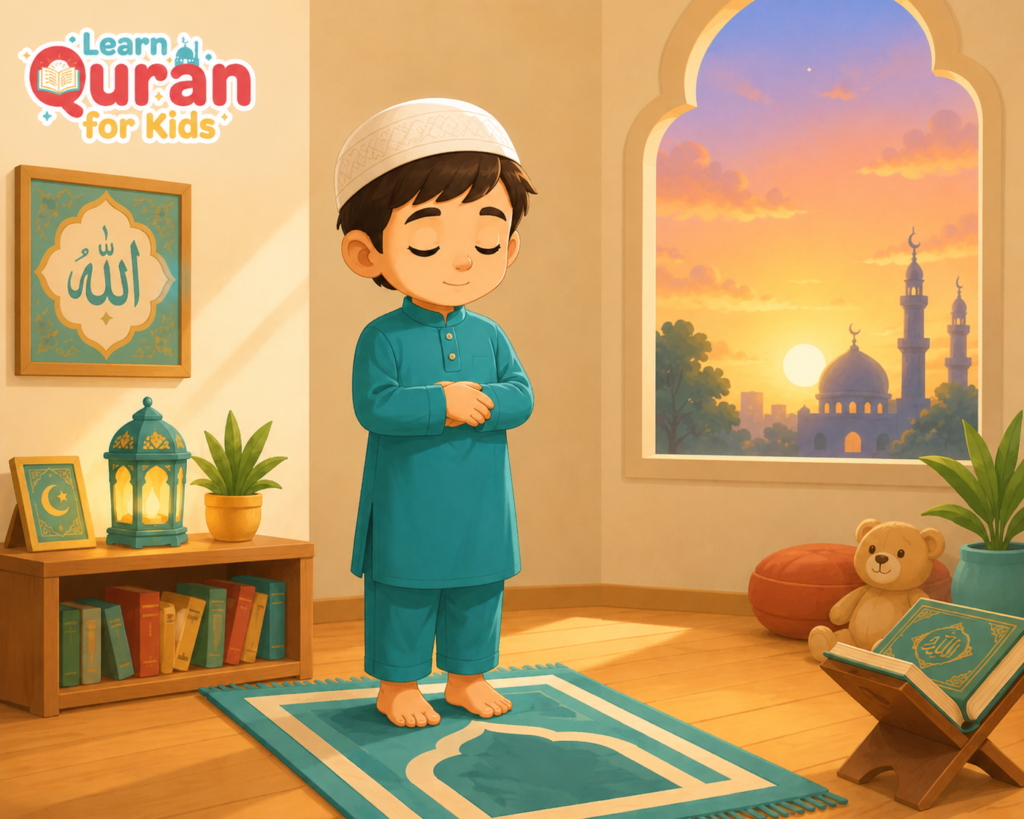
Make the early years of prayer joyful: pray alongside your child, let them imitate your postures, and celebrate when they join you. The emotional memory of prayer as something safe and shared lasts a lifetime.
4. Raise Your Child on Noble Character
“I was sent only to complete the best of character,“ said the Prophet ﷺ. (Ahmad)
Character is not taught in lectures — it is absorbed through daily exposure. A child raised in a home where honesty is consistently practiced, where kindness is a reflex, and where the weak are respected will internalize those values without being told.
Luqman’s advice covers the specific character traits children need: humility in walking, moderation in speech, gratitude, and commanding what is right. (Luqman: 17–19)
Practically: correct dishonesty every single time, even in small moments. When the Prophet ﷺ saw a mother who called her child over, promising him something, He asked what she intended to give. She said: dates.
He then told her: “Had you not given him anything, a lie would have been recorded against you.“ (Abu Dawud)
— showing that even a small, well-intentioned deception leaves a mark.
Shots Videos from Our Courses
Start Your Child’s Quran Learning Journey Today!
Join Kids Learning Quran Academy and help your child read the Quran with confidence through fun and guided lessons.
Book a Free Trial ClassRead also: Islamic manners for kids
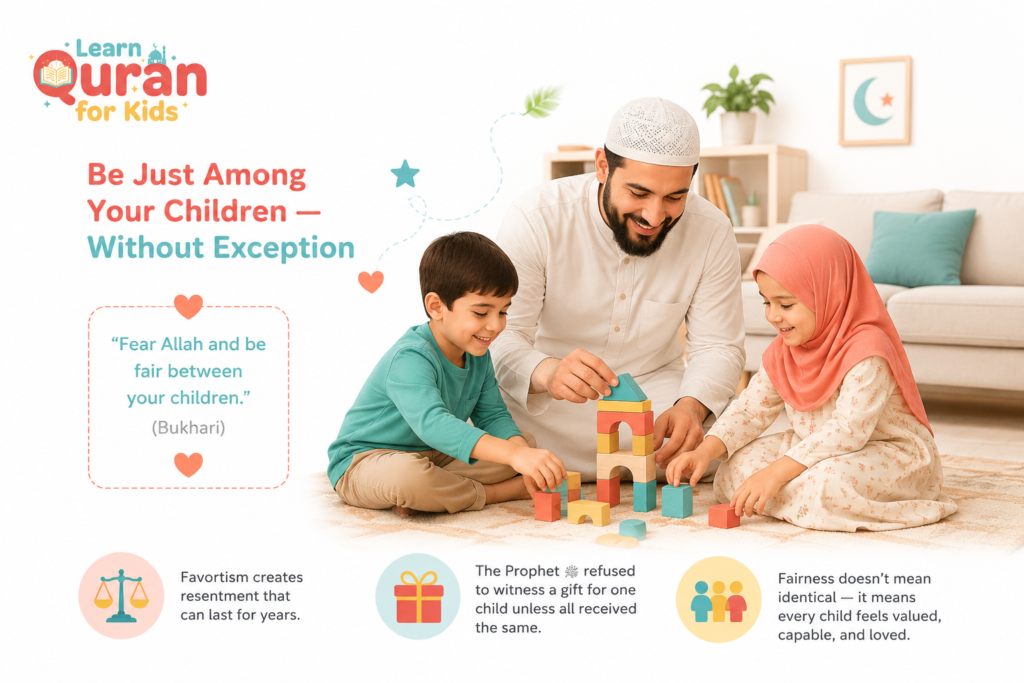
5. Be Just Among Your Children — Without Exception
“Fear Allah and be fair between your children.“ (Bukhari)
Favoritism, even subtle and unintentional, plants the seeds of resentment that can last decades. The Prophet ﷺ was so particular about this that when a man asked him to witness a special gift given to one child, he refused to serve as a witness unless the same was given to every child.
Fairness does not mean identical — different children have different needs. It means no child should feel consistently seen as less valuable, less capable, or less loved.
6. Pray for Your Children Constantly
The Prophet ﷺ said: “Do not curse yourselves, and do not curse your children, and do not curse your wealth.“ (Muslim)
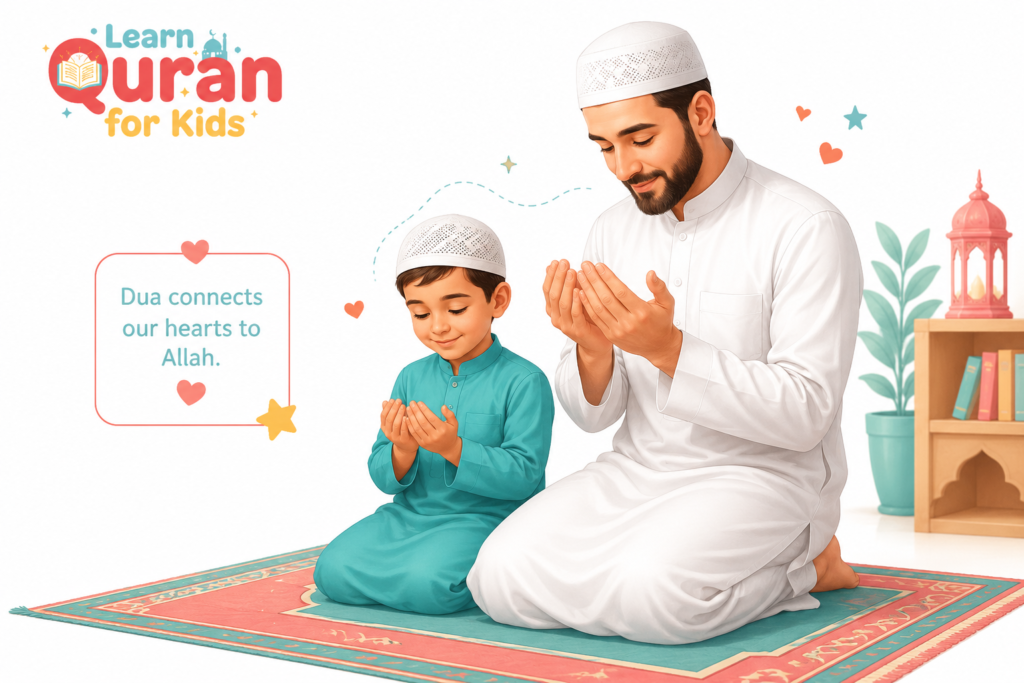
Dua is the hidden pillar of Islamic parenting. The prayer that Allah makes one’s child a source of righteous continuity (walad salih yad’u lah) is itself Quranic — Allah describes the believers as those who say:
“Our Lord, grant us from among our wives and offspring comfort to our eyes, and make us an example for the righteous.“ (Al-Furqan: 74)
A parent who prays for their child’s guidance every single day is doing something no curriculum, school, or course can replicate.
Read also: Dua for Child Protection in Arabic
How the Prophet ﷺ Actually Treated Children
The Islamic methodology is not abstract — it has a human model. The Prophet ﷺ interacted with children constantly, and those interactions are some of the most detailed in the entire Sunnah.
Anas ibn Malik served the Prophet ﷺ for ten years.
Anas said: “He never once said ‘uff’ to me, never asked me why I did something, and never asked me why I left something undone.” (Muslim)
This is a practitioner-level insight that modern parenting literature consistently rediscovers: children who are not constantly criticized for small mistakes develop more resilience and self-correction ability than those who are. The Prophet ﷺ understood this fourteen centuries ago.
When a young boy at the table was letting his hand wander across the dish, the Prophet ﷺ did not scold him publicly.
He simply said: “Young man, say Bismillah, eat with your right hand, and eat from what is nearest to you.” (Bukhari)
— correction delivered privately, warmly, and with practical instruction.
He also asked a young boy’s permission before giving a senior companion priority at drinking: “Young man, do you allow me to give it to the elders?“ The boy said: “I would not prefer anyone over my share from you, O Messenger of Allah,“ — and the Prophet honored that right. (Muslim) Children in the Prophet’s presence were not invisible or interchangeable with adults — their rights, their opinions, and their feelings were acknowledged.
Read also: Manners in Islam for Kids
How to Teach Without Breaking the Child
The source materials caution against one common parenting error: using commands and prohibitions as the primary tool. This can produce compliance — or it can produce rebellion. The more durable approach has four components.
1. Dialogue before discipline
When a child makes a mistake, ask them to explain their thinking. Understanding the why behind the behavior is the only way to address it at the root. The Prophet ﷺ did this with the young man who came asking permission for a sin — rather than rebuking him, He asked a series of questions that led the young man to condemn his own desire. (Ahmad)
2. Modeling before instructing
A father who prays with full presence will produce a child who wants to pray. A mother who reads the Quran daily will produce a child who sees reading as natural. Children replicate behavior before they internalize instruction.
3. Age-appropriate accountability
Holding a six-year-old to the standard of a twelve-year-old produces shame, not learning. Build the standard gradually, as the Prophet ﷺ built prayer over three years.
Read Also: How to Teach a Child to Pray in Islam?
4. Emotional security is the foundation
The Prophet ﷺ described the qualities of the best women as those who are
“most tender with their children in their young age.” (Bukhari)
An emotionally secure child — held, heard, and loved — accepts guidance far more readily than one who is anxious and uncertain of their standing.
Structured Islamic studies, delivered by patient-qualified instructors, reinforce everything you teach at home. Learn Quran for Kids offers age-appropriate online sessions that support your child’s Islamic foundation.
Read Also: The Best Islamic Gifts for Kids – 6 Types
A Common Mistake: Separating Religious Education from Daily Life
One of the clearest gaps in how many Muslim families approach Islamic parenting today is the compartmentalization of religion — prayer at prayer time, Quran at Quran time, everything else as normal. This is precisely what the Islamic way of raising a child does not teach.
Luqman’s counsel to his son in Surah Luqman is entirely embedded in daily situations, such as walking, speaking, eating, and interacting with people. He does not give his son a timetable for religion — he explains how the same consciousness of Allah should govern all of those moments.
The practical implication: Islamic education happens in the car, at the table, during a walk, and during disagreements — not only in formal lessons. The lessons are most powerful when they arise from real situations your child is already in.
Read Also: Islamic Worksheets for Kids
Our Students Reviews
Start Your Child’s Quran Learning Journey Today!
Join Kids Learning Quran Academy and help your child read the Quran with confidence through fun and guided lessons.
Book a Free Trial ClassRead also: Islamic Lessons For Kids
Give Your Child the Islamic Foundation They Deserve
Islamic parenting requires consistency, patience, and support. What you build at home is powerful — and it becomes even stronger when supported by qualified, structured teaching.
Learn Quran for Kids offers online Quran and Islamic studies classes tailored specifically for children, taught by experienced instructors who understand the unique needs and interests of young learners.
Give your child the gift of learning Islam the right way — with the care, structure, and warmth the Prophet ﷺ himself modeled.
Our Courses Include:
- Tajweed for Kids
- Quran Memorization for Kids
- Quran Recitation Course for Kids
- Quran Classes for Toddlers
- Quran Tafseer for Kids
- Qaida for Kids
- Quran Reading Course for Kids
- Online Arabic Classes for Kids
- Quranic Arabic for Kids
- Islamic Studies Courses for Kids
- Islamic Studies for Kindergarten
- 5 Pillars of Islam for Kids
- Islamic Education for Kids
Conclusion
The Islamic way of raising a child is a complete, time-tested system that builds belief, character, and practice together — not in isolation. It begins with Tawheed, advances through the Quran and prayer, and is sustained by parental example and continuous dua.
What makes the Islamic parenting model distinctive is not its strictness — it is its precision about sequence and method. Belief before practice. Example before the command. Encouragement before accountability. Mercy as the baseline, discipline as the occasional tool.
Every family has the capacity to raise a child who becomes a source of pride in this life and a continuing reward in the next. The Prophet ﷺ told us exactly how. The responsibility — and the reward — now rests with the parents.
Frequently Asked Questions
What Is The Islamic Way Of Raising A Child?
The Islamic way of raising a child is a holistic methodology drawn from the Quran and Sunnah that builds a child’s belief in Allah, their moral character, and their daily practice of worship. It prioritizes parental example, gradual teaching, gentle dialogue, and consistent dua over commands and punishment alone.
At What Age Should Islamic Education Begin?
Islamic education begins from birth. The Prophet ﷺ instructed parents to instill belief, manners, and daily supplications (adhkar) from the earliest years. Formal prayer instruction begins at age seven, with accountability introduced at age ten, as per the hadith in Abu Dawud.
How Do I Teach My Child To Love Islam Rather Than Fear It?
Connect every Islamic practice to a positive relationship with Allah first. Teach Allah’s Merciful Names before His commands. Pray with your child rather than sending them to pray alone. Use stories of the Prophet ﷺ and his warmth toward children. When a child feels loved by their parent and by Allah, they approach religion with desire, not dread.
Is It Harmful To Be Strict With Children In Islamic Parenting?
Strictness is not inherently harmful, but it must be proportionate, age-appropriate, and delivered with love. The Prophet ﷺ delayed accountability for prayer until age ten, giving the child three years of gentle introduction first. Consistent, disproportionate harshness without warmth breaks the child’s trust and can generate rejection of religion in the teenage years.
What Role Does The Quran Play In Islamic Child-Rearing?
The Quran is the foundation of Islamic upbringing. It shapes a child’s worldview, their ethics, their language, and their direct connection to Allah. The Prophet ﷺ said the best of people are those who learn and teach the Quran (Bukhari). Children raised with the Quran as a daily practice — not just a memorization exercise — develop a moral compass that holds steady under external pressure.
How Can I Raise Children Islamically If I’m Not Perfect Myself?
The Sunnah does not require perfection from parents — it requires sincerity and consistency. The Prophet ﷺ’s model is one of constant, gentle teaching combined with visible personal practice. When parents acknowledge their own mistakes honestly and continue striving, they teach their children one of the most important Islamic values: humility and perseverance. Begin with the six pillars above, choose one to strengthen each month, and make dua daily for both yourself and your child.
Related Articles
Learn Islam