 Learn Islam
Every Muslim parent reaches a moment when their child watches them bow in Sujood and asks, “Can I do that too?” That moment is your opening — and how you handle it will shape your child’s relationship with Salah for life.
Teaching a child to pray in Islam is not just about correcting posture or drilling Arabic phrases. It is about building a bond between a young heart and Allah that grows stronger with every year. Done right, Salah stops being something your child does because you told them to — and starts being something they genuinely miss when they skip it.
This guide gives you a step-by-step, age-by-stage approach to teaching your child Salah: from the first time they stand beside you at age three, through to the point where they pray independently at ten without being asked.
1. Start Teaching Your Child to Pray Early
The Prophet Muhammad ﷺ gave parents a clear timeline: “Command your children to pray when they are seven years old, and discipline them for it when they are ten, and separate them in their beds.” (Abu Dawud)
This hadith does not mean you wait silently until age seven and then suddenly issue commands. It describes the deadline for structured teaching — not the starting line. The emotional groundwork should begin years earlier, through observation, imitation, and positive association.
A useful framework for parents:
| Age | Focus |
| 2–4 years | Passive exposure — let them watch, imitate freely, feel included |
| 5–6 years | Active participation — stand beside you, copy movements, learn Bismillah |
| 7–9 years | Structured teaching — Wudu steps, pillars of Salah, regular practice |
| 10+ years | Accountability — gentle consistency, mosque attendance, independent habit |
Starting this early is not about burdening a toddler. It is about making Salah feel like the most natural thing in the world by the time the obligation approaches.
Read also: Islamic Topics for Children
2. Build Love Before You Build Routine
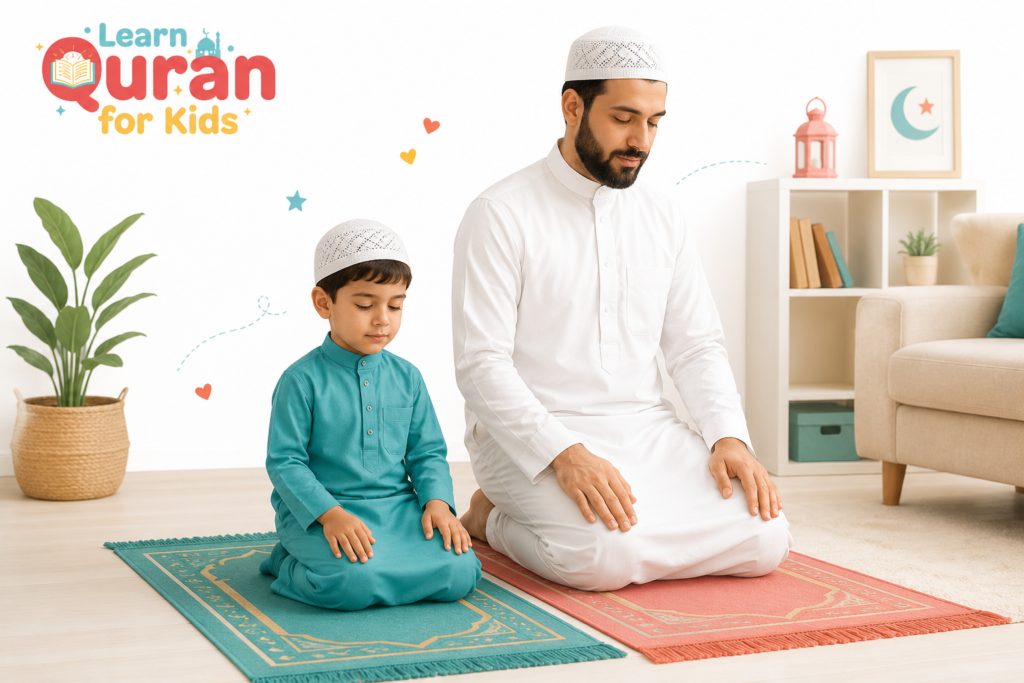
One of the most common mistakes parents make is jumping straight to instruction before their child has any emotional connection to Salah. When a four-year-old is told “you must pray,” Salah becomes a rule. When a four-year-old has spent a year watching their mother pray calmly, and their father leave for Fajr before sunrise, Salah becomes a mystery they want in on.
The Arabic sources describe this well: children are born with fitra — a natural disposition toward Allah. Your job in the early years is not to install that connection, but to nurture the one already there.
Concrete ways to build that emotional connection before formal teaching begins:
- Let your child stand beside you on their own small prayer mat and copy your movements — no correction needed, no pressure applied
- Tie enjoyable family events to prayer times naturally: “We’ll go to the park after Dhuhr” — so Salah becomes associated with good things, not interruptions
- Talk about Salah with warmth: “This is how I talk to Allah. Would you like to learn?”
- Share short stories of the Prophet ﷺ and his companions and their love for prayer — not as lectures, but as bedtime conversations
When the emotional foundation is solid, every later step of teaching becomes easier.
Start Your Child’s Quran Learning Journey Today!
Join Kids Learning Quran Academy and help your child read the Quran with confidence through fun and guided lessons.
Book a Free Trial Class3. How to Teach Wudu to Children Step by Step
Wudu is the gateway to Salah. A child who understands Wudu properly — and feels good performing it — approaches prayer with the right mindset. A child who sees Wudu as a chore approaches prayer as a chore.
Make Wudu enjoyable from the first introduction. Very young children love water and ritual — Wudu has both.
Practical teaching approach:
- Perform Wudu yourself with your child watching, narrating each step out loud in simple language
- Post illustrated Wudu steps near the sink so the child can self-check without waiting for you
- Teach it as a song or rhyme — short chants that name each step stick in a young child’s memory far more reliably than verbal instructions
- Praise every completed Wudu, especially early on, regardless of whether it was perfect
The sequence of Wudu to teach:
- Intention (Niyyah) — in the heart, not spoken aloud
- Say Bismillah
- Wash both hands three times
- Rinse the mouth three times
- Rinse the nose three times
- Wash the face three times
- Wash the right arm to the elbow three times, then the left
- Wipe the head once
- Wipe the ears once
- Wash the right foot to the ankle three times, then the left
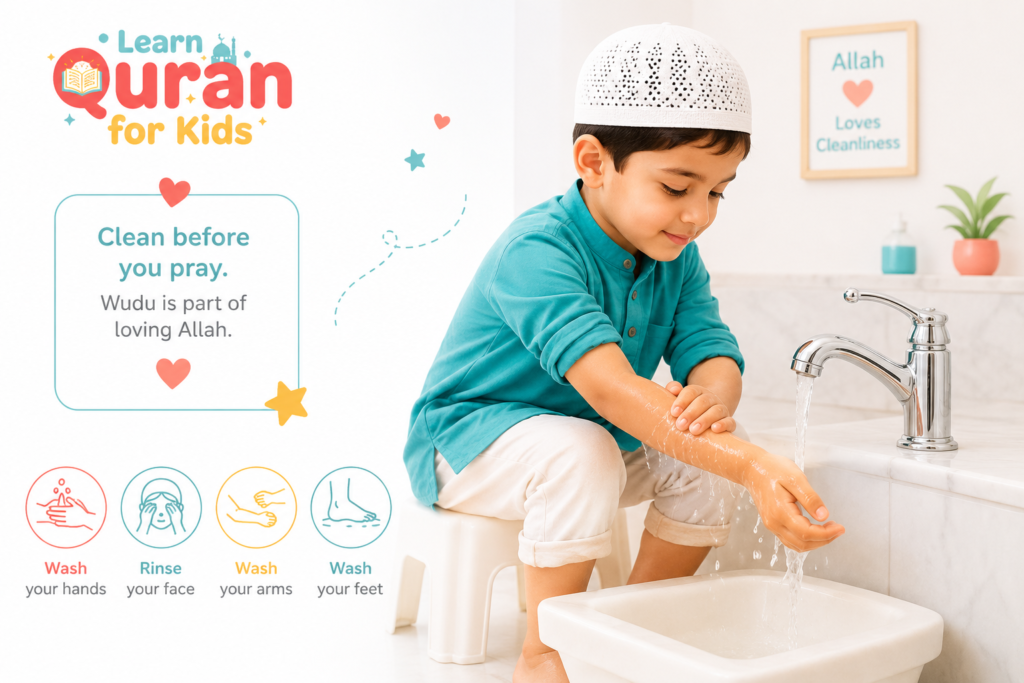
A child aged 5–6 can learn and retain this sequence within a few weeks of consistent, low-pressure daily practice. The key is doing it together, not instructing them to do it alone.
4. How to Teach the Pillars of Salah to Children
Once Wudu is comfortable, begin teaching the physical postures and basic recitations of Salah. The most important principle here: teach one piece at a time, and celebrate every small win.
Educators and Islamic scholars both recommend a graduated approach — the source material from this article makes this explicit. On day one, one Rak’ah is enough. On day two, add another. Expecting a child to master all five daily prayers in full from the beginning creates overwhelm that kills motivation.
Steps for teaching Salah progressively:
- Begin with the opening Takbeer: “Allahu Akbar” — teach the words, the raised hands, and what it means
- Add standing (Qiyam) and Surah Al-Fatiha — short, rhythmic, and memorizable within a week for most children
- Teach Ruku (bowing) with its supplication, then return to standing
- Teach Sujood (prostration) — children often love this posture and find it natural
- Teach Tashahhud and Tasleem to complete the unit
Use visual aids throughout: illustrated prayer step cards, wall posters in the prayer area, and, for older children, simple printed charts they can follow. A child who can check their own steps against a visual guide builds independence faster than one who relies entirely on a parent’s instructions.
Read Also: The Islamic Way of Raising a Child
See Our Classes in Action!
Wondering what a typical lesson looks like? Take a peek inside our virtual classrooms below to see how our patient teachers keep students smiling, engaged, and learning every step of the way.
Start Your Child’s Quran Learning Journey Today!
Join Kids Learning Quran Academy and help your child read the Quran with confidence through fun and guided lessons.
Book a Free Trial ClassRead also: Islamic Lessons for Kids
5. Create a Prayer Corner That Makes Your Child Want to Pray
The environment shapes behavior — especially for children. A dedicated, beautiful prayer space inside the home gives Salah a physical address in a child’s world.
Let your child choose their own prayer mat. Personalizing that choice creates ownership. A seven-year-old who picked their own mat — one with a color or pattern they love — will treat that mat differently than one that was handed to them.
Decorate the prayer corner together with:
- Their name is written in Arabic or English above the space
- Small illustrated cards of Duas and Adhkar, they are learning
- A visual chart of the five prayer times
- A simple prayer step poster at their eye level
This corner becomes their relationship with Allah — a private, special space. Children who have such a space show stronger prayer consistency than those who are simply told to go and pray.
Read also: Islamic Vocabulary For Kids
6. The Responsibility Transfer: One of the Most Effective Techniques Most Parents Miss
Here is a technique that rarely appears in standard advice on this topic, yet it works remarkably well: give your child the responsibility of reminding you when prayer time comes.
Tell them: “I’m counting on you to let me know when the Adhan plays. You’re my prayer reminder today.”
When a child is trusted with responsibility, they take it seriously. A child who reminds their parent to pray does not then skip their own prayer. This reversal — child as reminder, not just recipient of reminders — builds ownership and internal motivation in a way that repetitive parental prompting never can.
Use this from around age six or seven. It works especially well with children who resist being told what to do, because it reframes the dynamic entirely.
Read Also: The Best Islamic Gifts for Kids – 6 Types
7. Rewards, Praise, and Dealing with Resistance
Islamic educators agree that rewards for prayer are not only acceptable — they are recommended, especially in early stages. The Prophet ﷺ himself used reward and encouragement as core teaching tools.
Praise and recognition:
- Mention their prayer in front of family members positively: “Yusuf prayed Asr all by himself today.” The pride a child feels in that moment is a powerful reinforcer.
- Praise effort and consistency, not just correct form. A seven-year-old who prays every day with imperfect Arabic is doing something extraordinary.
Reward tracking:
- A simple weekly prayer chart where children mark off each Salah they complete gives a visual sense of progress and accomplishment
- Small rewards tied to completed charts — a favourite activity, a special outing, a book they wanted — reinforce the habit without making prayer feel transactional in a harmful way
Read Also: 10 Best Kids Islamic Poems
When resistance appears:
- Patience is non-negotiable. Shouting or shaming produces the opposite of the result you want — children who associate prayer with conflict avoid it.
- If a child refuses one day, do not escalate. Gently note it, keep your own prayer visible and calm, and try again the next time.
- Between ages seven and ten, gentle consistency is appropriate. After ten, the hadith permits firmer accountability — but the manner should remain respectful, never harsh.
Read Also: Islamic Worksheets for Kids
Experience the Magic Firsthand
Watch these short clips from our live classes to see our interactive teaching tools, vibrant student-teacher interactions, and the fun, stress-free ways we make learning easy for kids!
Start Your Child’s Quran Learning Journey Today!
Join Kids Learning Quran Academy and help your child read the Quran with confidence through fun and guided lessons.
Book a Free Trial ClassRead also: How to Keep Islamic Identity for Kids
8. Take Your Child to the Masjid
The Masjid gives Salah a communal dimension that home practice cannot fully replicate. A child who prays in rows with other Muslims experiences the collective spiritual weight of Jama’ah — something that stays with them.
Take your child to the Masjid for Jumu’ah, for Tarawih during Ramadan, and for regular prayers whenever circumstances allow. Boys especially benefit from attending the Masjid regularly from a young age, as the Prophet ﷺ encouraged this strongly.
At the Masjid, children observe adults who are not their parents taking prayer seriously. They find peers who are also learning. They encounter teachers and scholars whose knowledge and devotion inspire in ways a parent alone sometimes cannot.

Enroll Your Child in Islamic Studies
The most effective approach combines home teaching with structured guidance from experienced instructors who understand how children learn.
At Learn Quran for Kids, our courses for kids are designed specifically for children aged 4–15, led by experienced instructors teaching non-Arabic-speaking children. Every lesson weaves Salah, manners, and faith concepts into age-appropriate, engaging sessions — reinforcing exactly what you are building at home, with specialists who know how to make it stick.
Start your child’s Quran learning journey today with Learn Quran for Kids and help them grow with faith, knowledge, and confidence.
Our Courses Include:
- Tajweed for Kids
- Quran Memorization for Kids
- Quran Recitation Course for Kids
- Quran Classes for Toddlers
- Quran Tafseer for Kids
- Qaida for Kids
- Quran Reading Course for Kids
- Online Arabic Classes for Kids
- Quranic Arabic for Kids
- Islamic Studies Courses for Kids
- Islamic Studies for Kindergarten
- 5 Pillars of Islam for Kids
- Islamic Education for Kids
Conclusion
Teaching a child to pray in Islam is a long, beautiful project — not a one-week curriculum. It begins with letting a toddler copy your movements in Sujood, moves through patient Wudu teaching and progressive Salah instruction, and matures into a ten-year-old who prays independently because they genuinely love Allah.
The single most important thing this guide asks you to carry forward: build the love before you enforce the habit. A child whose heart is connected to Allah does not need to be commanded to stand for Salah — they miss it when they don’t.
Frequently Asked Questions
At What Age Should I Start Teaching My Child To Pray In Islam?
Begin passive exposure — letting your child watch and imitate — from age two or three. Move into structured teaching of Wudu and Salah steps between five and seven. By seven, begin establishing regular prayer as a consistent expectation, in line with the Prophet’s ﷺ guidance.
How Do I Teach My Child Wudu Before Salah?
Teach Wudu by performing it yourself with your child watching and narrating each step. Post illustrated steps near the sink for self-checking. Practise daily together and praise every completion, especially early on, without focusing on mistakes.
What If My Child Refuses To Pray?
Refusal is normal, especially in the early stages. Respond with patience and avoid associating Salah with conflict or punishment. Keep your own prayer visible and calm. Use gentle reminders, encouragement, and rewards. Shouting or shaming will create long-term resistance — gentle persistence is always more effective.
How Many Prayers Should I Start With When Teaching A Child?
Begin with a single prayer — ideally Maghrib, which is short and falls when the family is typically together. Add prayers gradually over weeks until the child is consistently performing all five. A child who masters one prayer confidently is better positioned than one overwhelmed by all five at once.
Can Rewards Be Used To Encourage Children To Pray?
Yes — Islamic educators and scholars support using age-appropriate rewards for children beginning to pray. Praise in front of family, prayer charts, and small tangible rewards all reinforce the habit without undermining its spiritual value. As the child matures and love for Salah develops internally, external rewards naturally become less necessary.
Is It Better To Teach My Child To Pray At Home Or At The Masjid?
Both, where possible. Home teaching builds the daily habit and emotional connection. Masjid attendance adds a communal dimension, role models beyond the immediate family, and the spiritual weight of Jama’ah. Combining both produces the strongest long-term results.