 Learn Quran
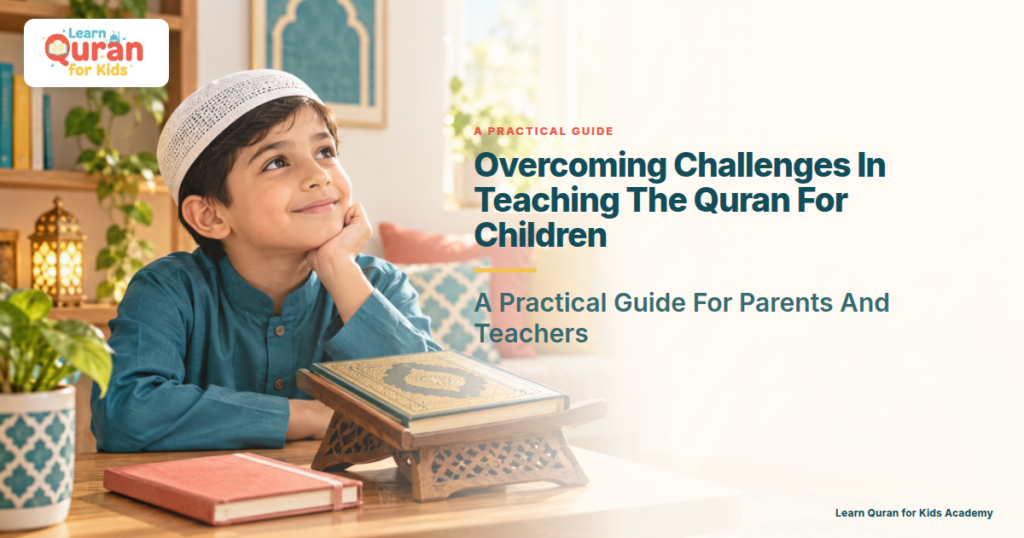
Overcoming challenges in teaching the Quran for children starts with one simple truth: every child learns differently. Some children struggle to sit still, others find Arabic letters confusing, and many forget verses soon after memorizing them. These challenges are normal, and with the right methods, patience, and support, each one can be solved step by step.
In this guide, parents and teachers will discover the most common obstacles children face when learning to read, recite, and memorize the Quran, why these obstacles happen, and the practical, Sunnah-inspired solutions that turn Quran time into a calm, consistent, and joyful habit for the whole family.
What You Will Learn
- The most common challenges children face when learning the Quran, from short attention spans to forgetting memorized verses.
- Practical, age-appropriate solutions such as short daily sessions, small memorization portions, and a structured revision cycle.
- What the Quran and authentic Hadith teach about learning the Quran, gentle teaching, and consistency.
- How to correct Tajweed and pronunciation mistakes gently without discouraging your child.
- When a qualified Quran teacher makes the biggest difference in your child’s progress.
Overcoming Challenges in Teaching the Quran for Children: What It Means
Overcoming challenges in teaching the Quran for children means identifying the specific obstacles that slow a child’s progress in reading, reciting, or memorizing the Quran, then responding with methods suited to the child’s age and abilities. These obstacles usually include boredom, weak focus, difficulty with Arabic letters, pronunciation mistakes, forgetting, and inconsistent practice at home.
The encouraging news for parents is that Allah has made the Quran easy to remember and learn. When a child struggles, the problem is rarely the Quran itself; it is usually the teaching method, the pace, or the learning environment.
وَلَقَدْ يَسَّرْنَا الْقُرْآنَ لِلذِّكْرِ فَهَلْ مِن مُّدَّكِرٍ
“And We have certainly made the Qur’an easy for remembrance, so is there any who will remember?”
The Most Common Challenges Children Face When Learning the Quran
Overcoming challenges in teaching the Quran for children starts with understanding the difficulties they commonly face. Young learners may have short attention spans, struggle to remember verses, or find Arabic letters and unfamiliar sounds difficult at first.
They may also make Tajweed and pronunciation mistakes or lose motivation when lessons feel repetitive. Parents can face challenges too, especially with busy schedules or limited knowledge of Tajweed.
These difficulties can be managed through short and consistent Quran sessions, regular revision, flashcards, listening and repetition, simple explanations of meanings, and plenty of encouragement.
Recognizing these challenges early helps parents stay patient and create a supportive learning environment where children can gradually build confidence and enjoy their Quran journey.
How to Overcome Boredom and Short Attention Span in Quran Lessons
Boredom and a short attention span are among the most common challenges in teaching the Quran to children, especially those under the age of eight. A young child’s ability to focus on a single task is naturally limited, so long lessons often end in restlessness. This is a normal stage of development, not a sign that the child dislikes the Quran.
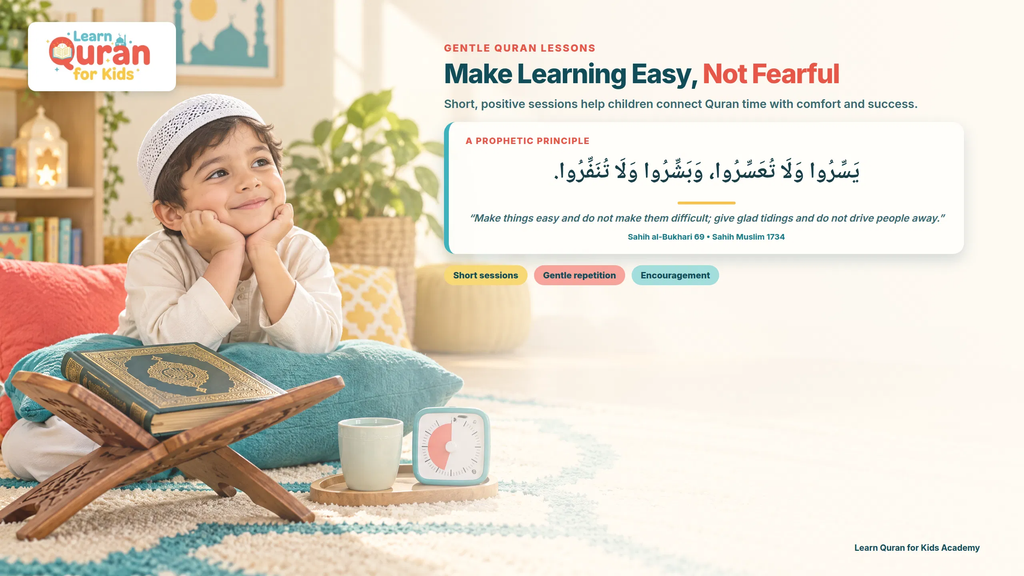
The Prophet Muhammad ﷺ taught Muslims to make religious matters easy and to avoid driving people away. Applying this principle to children’s Quran lessons means designing sessions that are light, positive, and encouraging, so that a child associates the Quran with comfort and success rather than with pressure, fatigue, or fear of making mistakes.
«يَسِّرُوا وَلاَ تُعَسِّرُوا، وَبَشِّرُوا وَلاَ تُنَفِّرُوا»
“Facilitate things to people (concerning religious matters), and do not make it hard for them and give them good tidings and do not make them run away (from Islam).”
1. Keep Quran Sessions Short and Focused
Short Quran sessions of 10 to 15 minutes work better for most young children than a single long lesson. Young learners have limited attention spans, so keeping lessons brief helps them stay focused without feeling tired or overwhelmed. A focused session can include a quick review of the previous lesson, learning a few new lines, and ending with sincere praise for their effort and progress.
Ending the session while the child is still engaged can leave them feeling excited about the next lesson. This approach also makes it easier to establish a consistent daily routine and helps children build a positive, lasting relationship with Quran learning.
2. Make Quran Learning Interactive and Rewarding
Interactive Quran learning keeps children engaged by involving their eyes, ears, and hands. Parents can use colorful letter cards, Quran stickers, progress charts, and simple educational games.
Small rewards, such as choosing a favorite story of the Prophets after finishing a lesson, give children a clear goal, while a cheerful, distraction-free space helps them concentrate.
See Our Classes in Action!
Wondering what a typical lesson looks like? Take a peek inside our virtual classrooms below to see how our patient teachers keep students smiling, engaged, and learning every step of the way.
Start Your Child’s Quran Learning Journey Today!
Join Kids Learning Quran Academy and help your child read the Quran with confidence through fun and guided lessons.
Book a Free Trial ClassHow to Help Children Who Struggle With Reading Arabic Letters
Difficulty reading Arabic letters is a common challenge for children who are new to the Quran, particularly those raised in non-Arabic-speaking homes. Many Arabic letters look similar and differ only in the number or position of their dots, such as ب, ت, and ث, which can easily confuse beginners and slow their reading progress.
Reading the Quran confidently depends on mastering the letters and their sounds before moving on to words and full verses. Following a clear, gradual sequence prevents children from feeling overwhelmed.
This guide to the Quran learning steps for kids explains how children can progress from the alphabet to fluent reading in an organized way.

1. Teach One Arabic Letter at a Time
Teaching one Arabic letter at a time helps children master each shape and sound before learning the next. Visual flashcards, tracing activities, and letter songs make every letter memorable.
Once a child recognizes a letter in its different positions at the beginning, middle, and end of a word, parents can introduce simple two-letter and three-letter combinations.
2. Use Repetition and Listening (Talqeen)
Talqeen is the traditional method of teaching the Quran in which the teacher recites and the child repeats. It is one of the most effective ways to help children imitate the correct sound of each letter and word.
Listening to a skilled reciter several times before reading also trains the child’s ear and builds natural, accurate pronunciation over time.
Help Your Child Read the Quran FluentlyOur Quran Recitation course guides children from the Arabic alphabet to confident, accurate Quran reading with patient one-on-one teachers. Explore the Recitation Course
How to Stop Children From Forgetting Memorized Quran Verses
Forgetting previously memorized verses is one of the biggest challenges in overcoming challenges in teaching the Quran for children, and it can affect adult memorizers as well. Memorization naturally fades when it is not reviewed regularly, so parents should make revision a consistent part of the child’s Quran routine.
A child who reviews a small amount every day is more likely to retain what they have learned than one who memorizes large portions but rarely revises them. Ibn Hajar al-Asqalani noted in Fath al-Bari, his commentary on Sahih al-Bukhari, that the camel was mentioned because it is among the animals most likely to run away, highlighting the importance of constantly maintaining what has been memorized. The Prophet ﷺ said:
«إِنَّمَا مَثَلُ صَاحِبِ الْقُرْآنِ كَمَثَلِ صَاحِبِ الإِبِلِ الْمُعَقَّلَةِ، إِنْ عَاهَدَ عَلَيْهَا أَمْسَكَهَا، وَإِنْ أَطْلَقَهَا ذَهَبَتْ»
“The example of the person who knows the Qur’an by heart is like the owner of tied camels. If he keeps them tied, he will control them, but if he releases them, they will run away.”
Sahih al-Bukhari 5031

1. Memorize Small Portions at a Time
Memorizing small portions, such as one line or one short verse at a time, helps children learn the Quran without feeling overwhelmed.
Short surahs from Juz Amma, like Al-Fatihah, Al-Ikhlas, Al-Falaq, and An-Nas, are ideal starting points. A child should repeat each portion until it is fluent before joining it to the next portion of the surah.
2. Follow a Daily, Weekly, and Monthly Revision Cycle
A structured revision cycle keeps memorized Quran fresh in a child’s mind. Each new lesson should begin with a quick review of the last portion memorized, which links old memorization to the new. Parents can then add a weekly review of larger sections and a monthly review of complete surahs, as shown in the simple plan below.
| Revision Level | What to Review | Purpose |
| Daily | The last lesson or page memorized | Strengthens new memorization |
| Weekly | Surahs memorized in recent weeks | Connects new and older portions |
| Monthly | All previously memorized surahs | Prevents long-term forgetting |
How to Correct Tajweed and Pronunciation Mistakes in Children
Tajweed is the set of rules that governs the correct recitation of the Quran, including how each letter is articulated and when sounds are lengthened, merged, or softened. Children may make Tajweed mistakes because some Arabic sounds do not exist in their native language, making certain letters and pronunciation rules more difficult to master at first.
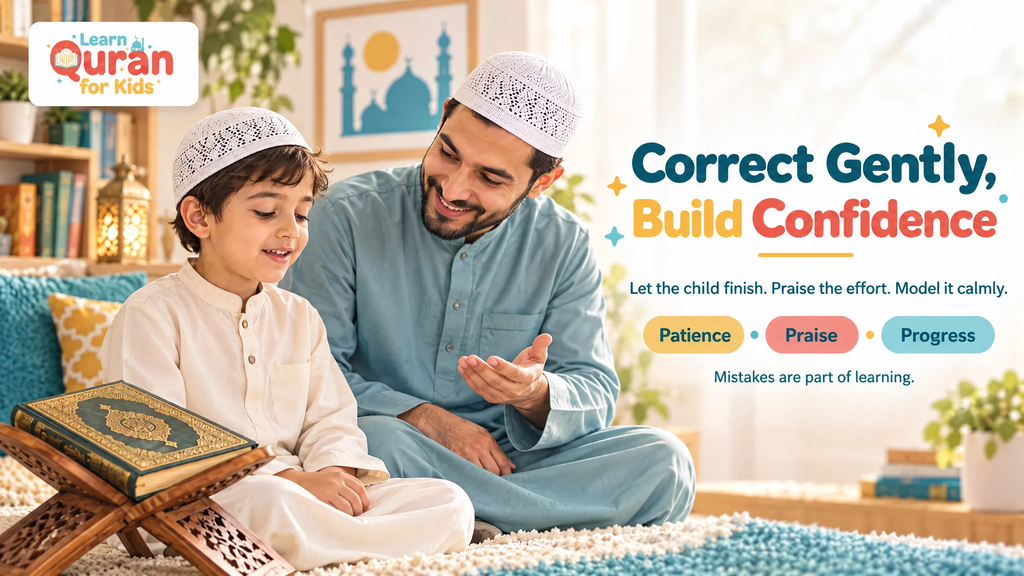
These mistakes are a natural part of learning, and children should never be made to feel ashamed or discouraged when they struggle. Instead, parents and teachers can correct them gently, demonstrate the correct pronunciation, and give them enough time to practice and improve.
The Quran itself emphasizes the importance of careful and measured recitation:
أَوْ زِد عَلَيْهِ وَرَتِّلِ الْقُرْآنَ تَرْتِيلًا
“Or add to it, and recite the Qur’an with measured recitation.”
1. Correct Mistakes Gently and Patiently
Gentle correction protects a child’s confidence while improving their recitation. Instead of interrupting every error, parents can let the child finish the verse, praise the effort, and then model the correct pronunciation once or twice. Showing anger or frustration over mistakes often makes children anxious about reciting, which tends to cause even more errors over time.
2. Introduce Tajweed Rules Gradually
Tajweed rules are best introduced gradually, starting with correct letter articulation (makharij al-huruf) before moving to rules such as noon sakinah, meem sakinah, and madd. Simple explanations and age-appropriate examples make each rule easier to remember. This guide to Tajweed rules for kids explains the basics in clear, child-friendly language.
Give Your Child Beautiful, Accurate RecitationOur Tajweed course teaches children the rules of Quran recitation step by step, with live correction from qualified, caring teachers. Discover the Tajweed Course

How to Build Consistency When Family Schedules Are Busy
Inconsistent practice is a major reason children lose progress in Quran learning. School, homework, activities, and family commitments can easily push Quran time aside. Long gaps between lessons cause children to forget what they learned and make restarting feel harder, while steady daily practice builds both the skill of reading and the habit of returning to the Quran.
The authentic Sunnah emphasizes that consistent deeds are beloved to Allah even when they are small. For Quran learning, this means ten focused minutes every day can achieve more than one long, irregular session each week. Parents who protect a small daily Quran time give their children the steady, lasting progress that occasional effort cannot match.
«أَحَبُّ الأَعْمَالِ إِلَى اللَّهِ تَعَالَى أَدْوَمُهَا وَإِنْ قَلَّ»
“The acts most pleasing to Allah are those which are done most continuously, even if they amount to little.”
Sahih Muslim 783a (part of the narration)
1. Set a Fixed Daily Quran Time
A fixed daily Quran time turns learning into a natural part of a child’s routine. Many families link Quran practice to a prayer, such as after Fajr or Maghrib, so the habit is easy to remember. Morning is often ideal because the child’s mind is fresh, while times of hunger, tiredness, or sleepiness are best avoided for new memorization.
2. Use Audio Recordings to Support Practice
Audio recordings support consistent Quran practice, especially on days when parents cannot sit with the child. Children can listen to a skilled reciter during car rides or before bed, which reinforces correct pronunciation. Recording the child’s own recitation is also helpful, because hearing their progress builds confidence and helps parents spot mistakes to correct later.
Experience the Magic Firsthand
Watch these short clips from our live classes to see our interactive teaching tools, vibrant student-teacher interactions, and the fun, stress-free ways we make learning easy for kids!
Start Your Child’s Quran Learning Journey Today!
Join Kids Learning Quran Academy and help your child read the Quran with confidence through fun and guided lessons.
Book a Free Trial ClassHow to Keep Children Motivated to Learn the Quran
Loss of motivation can happen to any child learning the Quran, especially after weeks of hard work or a difficult surah. Children respond strongly to encouragement and to the attitude of the adults around them. A parent’s genuine interest in their child’s Quran progress is often reflected directly in the child’s enthusiasm and willingness to keep going.
Children also stay motivated when they understand the honor of learning the Quran. The Prophet ﷺ described those who learn the Quran and teach it as the best among Muslims. Explaining this in simple words helps a child see Quran learning as something truly special, and it reminds parents that their patient teaching is also a great reward.
«خَيْرُكُمْ مَنْ تَعَلَّمَ الْقُرْآنَ وَعَلَّمَهُ»
“The best among you (Muslims) are those who learn the Qur’an and teach it.”
1. Celebrate Small Wins
Celebrating small wins builds a child’s confidence and love for the Quran. Finishing a short surah, reading a new line without mistakes, or completing a full week of daily practice all deserve recognition. A progress chart, a small gift, or reciting proudly to grandparents can make the child feel valued and eager to reach the next goal.
2. Renew the Intention Together
Renewing the intention, known in Arabic as niyyah, reminds children why they are learning the Quran. Parents can begin each session with a short dua asking Allah for help and explain in simple words that learning the Quran is done to please Allah. This habit keeps the focus on sincerity and reward rather than on competition or pressure.
Why a Qualified Quran Teacher Makes a Difference
A qualified Quran teacher helps children overcome challenges that parents may find difficult to address alone, particularly Tajweed accuracy and structured memorization. Without proper guidance, children can repeat pronunciation mistakes for years before anyone notices. A skilled teacher provides immediate correction, a clear plan, and steady accountability that keep progress moving forward.
Online learning has made qualified teachers accessible to families everywhere, with flexible schedules and one-on-one attention. Parents comparing options can learn what to look for in this guide to choosing an online Quran teacher for kids, including teaching style, qualifications, and how lessons adapt to each child’s age.
| Area | With Proper Guidance | Without Guidance |
| Recitation | Accurate pronunciation and Tajweed | Repeated, uncorrected mistakes |
| Progress | A steady, structured plan | Irregular improvement |
| Motivation | Encouragement and accountability | Higher risk of frustration |
| Revision | A planned review schedule | Forgotten surahs over time |
Start Your Child’s Quran Learning Journey Today!
Join Kids Learning Quran Academy and help your child read the Quran with confidence through fun and guided lessons.
Book a Free Trial ClassStart Your Child’s Quran Journey With Kids Learning Quran Academy
Kids Learning Quran Academy offers online Quran classes designed specifically for children, with patient teachers who understand how young learners think and feel. Every lesson is adapted to your child’s age and level, whether they are learning the Arabic alphabet, improving their Tajweed, or memorizing their very first surahs.
Your child will receive one-on-one attention, gentle correction, a personalized memorization and revision plan, and regular encouragement that keeps them motivated.
Book a free trial class today and see how a structured, caring approach can turn Quran learning into one of the most anticipated parts of your child’s day.
Our Courses Include:
- Tajweed Course for Kids
- Quran Memorization Course for Kids
- Quran Recitation Course for Kids
- Quran Classes for Toddlers
- Quran Tafseer Course for Kids
- Qaida Course for Kids
- Quran Reading Course for Kids
- Online Arabic Classes for Kids
- Quranic Arabic Course for Kids
Don’t wait to invest in your child’s Akhirah and future. Enroll today and watch your child grow with confidence, knowledge, and love for the Quran.
Join Kids Learning Quran Academy now and start your child’s learning journey today!

Conclusion: Overcoming Challenges in Teaching the Quran for Children
Overcoming challenges in teaching the Quran for children is possible for every family with patience, structure, and the right support. Boredom, difficulty recognizing Arabic letters, forgetting memorized verses, making Tajweed mistakes, and maintaining consistent practice are all common challenges. However, each can be addressed with practical strategies that suit the child’s age, learning pace, and individual needs.
The most effective approach combines short daily sessions, small memorization portions, regular revision, simple explanations of Quranic meanings, and gentle encouragement. Parents should celebrate small achievements and avoid putting pressure on children when they struggle.
By following the guidance of the Quran and Sunnah and seeking help from qualified teachers when needed, families can make learning more enjoyable and help children build a strong, lasting relationship with the Book of Allah.
Frequently Asked Questions
How long should a child’s daily Quran lesson be?
For most young children, 10 to 15 minutes of focused Quran practice per day is enough. Older children can gradually extend sessions to 20–30 minutes with short breaks. Consistency matters more than the length of each session.
Why does my child keep forgetting memorized surahs?
Children usually forget memorized surahs because of irregular revision. The Prophet ﷺ compared memorized Quran to tied camels that run away when left untied. A daily, weekly, and monthly revision cycle solves most forgetting problems.
Should I correct every Tajweed mistake my child makes?
No, correcting every mistake immediately can discourage young learners. It is better to let the child finish the verse, praise the effort, gently correct the most important mistakes, and introduce Tajweed rules gradually.
Can children learn the Quran effectively online?
Yes, children can learn the Quran effectively online when lessons are one-on-one, interactive, and led by qualified teachers. Online classes offer flexible scheduling and immediate correction, which help children stay consistent.
What is the best age to start teaching the Quran to children?
There is no single fixed age, but many children begin learning Arabic letters and short surahs between the ages of 3 and 5. The right time depends on the child’s readiness, attention span, and interest. Starting gently with listening and repetition is often the best beginning.