 Learn Islam
Every Muslim parent wants their child to love Prophet Muhammad (peace be upon him) deeply and genuinely. Yet so many children grow up knowing his name without knowing his story. They recite blessings upon him without understanding who he was, what he endured, and what values he embodied in every moment of his life.
Teaching seerah for kids closes this gap. The Seerah, which is the complete biography of the Prophet (peace be upon him), is not a history lesson. It is a living guide to faith, character, and identity. When your child learns how the Prophet responded to hardship, treated others, and carried the message of Allah with patience and love, those lessons do not stay in the past. They travel directly into your child’s daily life.
This guide gives you everything you need to teach the seerah of Prophet Muhammad for kids at every age, with methods that actually work.
Teaching Seerah for Kids Fulfills a Quranic Command
“لَّقَدْ كَانَ لَكُمْ فِي رَسُولِ اللَّهِ أُسْوَةٌ حَسَنَةٌ لِّمَن كَانَ يَرْجُو اللَّهَ وَالْيَوْمَ الْآخِرَ وَذَكَرَ اللَّهَ كَثِيرًا ﴿٢١﴾ ”
Laqad kāna lakum fī rasūlillāhi uswatun ḥasanatun li-man kāna yarjū allāha wal-yawma al-ākhira wa dhakara allāha kathīrā
“There has certainly been for you in the Messenger of Allah an excellent pattern for anyone whose hope is in Allah and the Last Day and [who] remembers Allah often. (21)”
This verse makes the Prophet (peace be upon him) the direct model for every Muslim’s life. Teaching your child his story is not optional enrichment. It is a direct response to what Allah commands in the Quran. A child who knows the Seerah knows what the Uswatun Hasanah, the excellent example, actually looks like in real life. A child who does not is left to find their role models elsewhere.
The Arabic word Seerah literally means “a way” or “a path.” When scholars say Seerah of Prophet Muhammad, they mean the comprehensive record of his entire life: his birth, his noble character before prophethood, his mission, his struggles, his migration, his governance of Madinah, and his farewell sermon. It is the living explanation of the Quran in human form.
Teaching seerah for kids moves Islam from a set of abstract rules into a relatable way of life. Children do not connect with doctrine alone. They connect with people, with stories, and with emotions. The Seerah gives them all three.
Children who love the Prophet (peace be upon him) need structured Islamic education that teaches his life authentically. The Islamic Studies Courses for Kids at Kids Learning Quran Academy covers the Seerah, Islamic values, and Prophetic character in a structured curriculum delivered by certified native Arab tutors.
Start your child’s journey today and give him a true connection to their Prophet.
The Key Milestones of Seerah of Prophet Muhammad for Kids
Before teaching any milestone in detail, every child needs a clear timeline of the Prophet’s life. Presenting the Seerah as a structured journey helps children understand where each event fits. The table below gives parents a complete age-appropriate overview:
| Milestone | Year | What Children Learn From It |
| Birth in Makkah | 570 CE | Allah protects His chosen ones from before birth. |
| Orphaned and raised by family | 570 to 583 CE | Loss does not prevent greatness. Resilience is built early. |
| Known as Al-Amin | Early adulthood | Honesty and trustworthiness are built over years, not moments. |
| First revelation in Cave Hira | 610 CE | Allah chooses whom He wills and prepares them for great missions. |
| Migration to Madinah (Hijrah) | 622 CE | Trusting Allah in the face of danger is the mark of true faith. |
| Peaceful conquest of Makkah | 630 CE | Forgiveness is strength, not weakness. |
| Farewell Sermon and passing | 632 CE | Every great mission has a completion, and Islam was completed through him. |
The Prophet (peace be upon him) was born in Makkah in 570 CE into the noble Quraysh tribe. His father Abdullah passed away before his birth, and his mother Aminah passed away when he was only six years old. His grandfather Abdul-Muttalib then cared for him, followed by his uncle Abu Talib. This early experience of loss is itself a lesson for children: Allah prepares those He chooses through difficulty, not despite it.
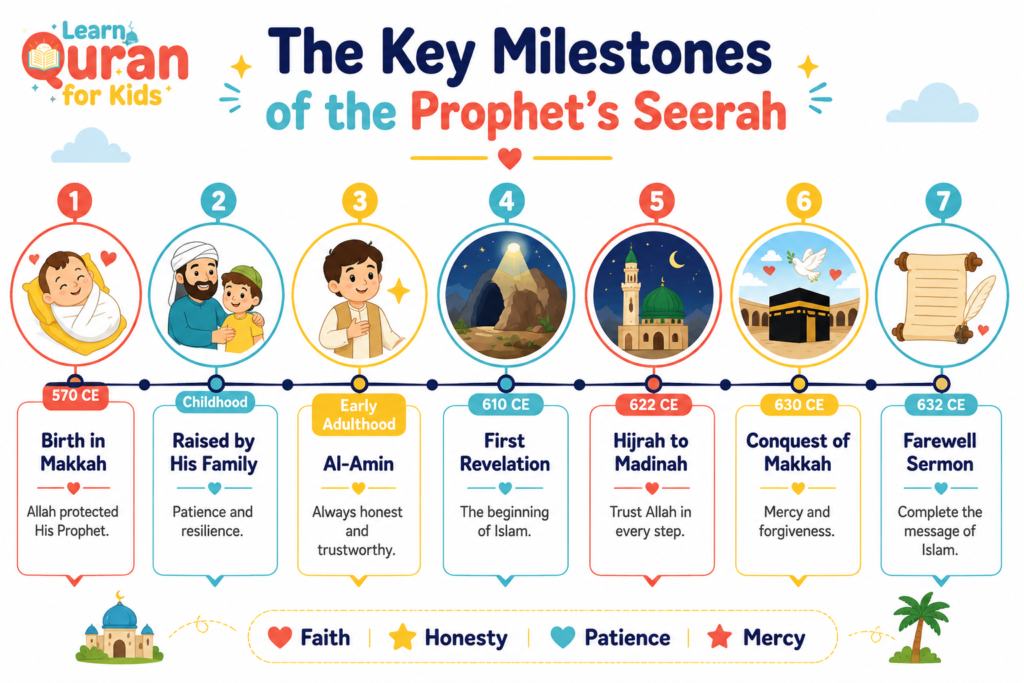
At age 40, he received the first divine revelation through Angel Jibreel in the Cave of Hira in 610 CE. His 23-year prophetic mission followed, culminating in the peaceful conquest of Makkah in 630 CE and his farewell sermon at Arafat in 632 CE. He passed away on the 12th of Rabi al-Awwal, 11 AH, in Madinah, having completed the delivery of Islam to all of humanity.
See Our Classes in Action!
Wondering what a typical lesson looks like? Take a peek inside our virtual classrooms below to see how our patient teachers keep students smiling, engaged, and learning every step of the way.
Start Your Child’s Quran Learning Journey Today!
Join Kids Learning Quran Academy and help your child read the Quran with confidence through fun and guided lessons.
Book a Free Trial ClassThe Character of the Prophet Gives Seerah for Kids Its Real Power
The Seerah is not valuable because of dates and events alone. Its true power lies in the character of the man at its center. Every trait the Prophet (peace be upon him) demonstrated is a lesson children can apply to their own lives right now.
The Core Character Traits Children Learn from the Seerah
The following traits define the Prophet’s character and form the moral backbone of seerah for kids:
- Honesty (As-Sadiq): He never told a lie, even before prophethood. The people of Makkah trusted him completely with their most valuable possessions.
- Trustworthiness (Al-Amin): The entire city gave him this title. Even his enemies, who opposed his message fiercely, still left their property with him for safekeeping.
- Mercy (Rahmah): He was described by Allah as a mercy to all of mankind. He forbade harming women, children, and the elderly even in the most difficult battles.
- Patience (Sabr): He endured the loss of his parents, children, and closest companions, and met every difficulty with steadfast patience that never broke his mission.
- Generosity (Jud): He gave freely and consistently preferred others over himself, even in times of personal scarcity.
- Humility (Tawadu): He fixed his own clothes, helped with household chores, and never elevated himself above those around him.
Read also: Explaining Religion to a Child – The Complete Islamic Parent’s Guide
The Story of Al-Amin That Every Child Needs to Hear
Long before prophethood, the tribes of Makkah nearly came to blows over who would place the Black Stone back into the wall of the Kaaba during its reconstruction. They agreed to accept the judgment of the next man to enter. That man was Muhammad (peace be upon him).
He placed the stone in the center of a cloth and asked a leader from each tribe to lift a corner together. Every tribe received the honor. Every conflict was resolved. This single moment teaches children that being trusted is something you build through small, consistent, honest choices over years. It is not a title you claim. It is a reputation you earn.
The Conquest of Makkah Teaches Forgiveness as Strength
In 630 CE, the Prophet (peace be upon him) returned to Makkah with ten thousand Muslims, the same city that had driven him out, harmed his companions, and buried those he loved. The Quraysh expected punishment. He asked them: “What do you think I will do to you?” They said: “A generous brother and the son of a generous brother.” He replied: “Go, for you are free.”
This moment must be told to every Muslim child slowly and clearly. The man who had every reason and every power to take revenge chose forgiveness. Children who hear this story carry something into every conflict of their own lives: that true strength is choosing mercy when you have the power to choose otherwise.
Younger children need a teacher who knows exactly how to present the Seerah at their level. The Islamic Studies Course for Kindergarten at Kids Learning Quran Academy introduces the Prophet’s life and values to the youngest learners through gentle, age-appropriate one-on-one live sessions.
Read also: 10 Best Kids Islamic Poems
Build your child’s love for the Prophet now and give him the right start.
Age-Appropriate Methods to Teach Seerah of Prophet Muhammad for Kids
No single method works for every age. The table below shows which approach produces results at each stage of a child’s development:
| Age Group | Focus of Seerah Teaching | Best Method |
| 3 to 5 years | The Prophet’s kindness, gentleness, and love for children | Short illustrated stories, songs, simple repetition |
| 6 to 9 years | Key events: Al-Amin, first revelation, Hijrah | Storytelling with reflection questions, timelines |
| 10 years and above | Full Seerah sequence, character analysis, lessons applied to life | Structured study, discussion, written reflection |
Teaching Seerah to Children Aged Three to Five
Children at this age do not need dates, geography, or detailed events. They need to know that Prophet Muhammad (peace be upon him) was kind, honest, and loving, and that Allah chose him to teach people how to worship and treat others well.
At this stage, the most effective method is to tell one short story at a time using simple words. Repeat the main lesson after each story. Ask one easy question. Connect the lesson directly to the child’s daily life. For example, after telling the story of how the Prophet loved and played with children, ask: “How do you think the Prophet would want you to treat your little brother today?”
Teaching Seerah to Children Aged Six to Nine
Children aged 6 to 9 can follow a sequence of events and understand cause and effect. This is the ideal time to introduce the main phases of the Prophet’s life in order. Use a simple visual timeline that the child can see and refer to across multiple sessions.
The following seerah events are most impactful for this age group:
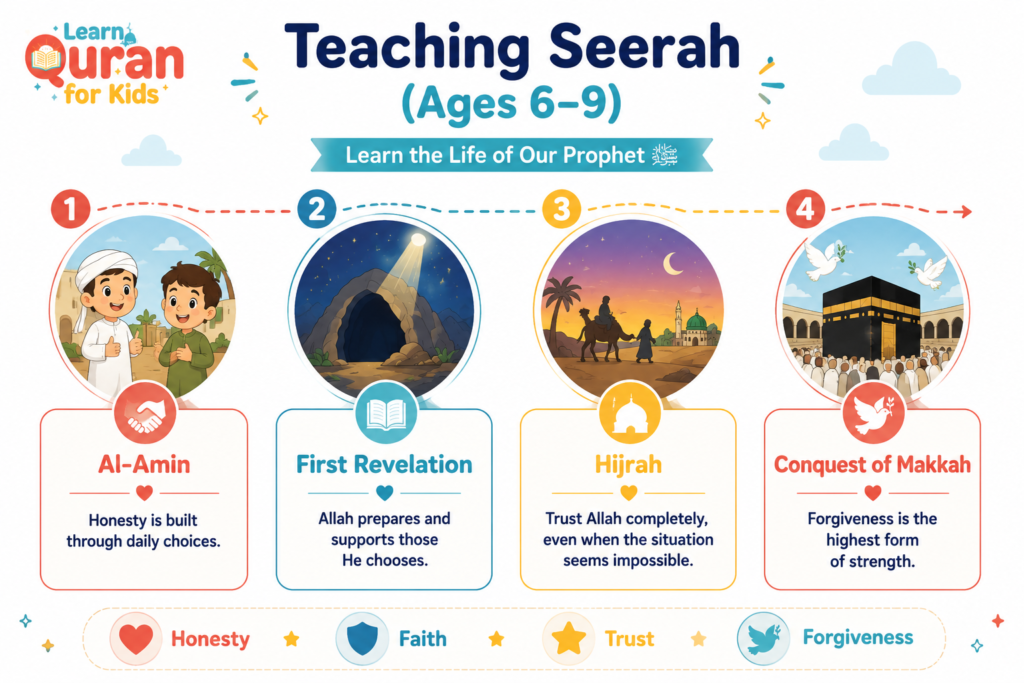
- The story of how the Prophet received his title Al-Amin teaches that honesty is built through daily choices.
- The story of the first revelation in Cave Hira teaches that Allah prepares and supports those He chooses.
- The story of the Hijrah teaches tawakkul, complete trust in Allah, even when the situation appears impossible.
- The story of the conquest of Makkah teaches forgiveness as the highest form of strength.
Teaching Seerah to Children Aged Ten and Above
Children aged 10 and above can engage with the Seerah as a complete narrative. Introduce the full timeline from birth to the farewell sermon. Encourage your child to ask: “What would I have done in this situation?” Discuss how the Prophet’s responses to hardship apply directly to situations children face in school, friendships, and family life.
At this stage, introduce the concept of the Seerah as the living explanation of the Quran. Show your child how specific events in the Prophet’s life correspond to specific verses Allah revealed. This connection deepens both Quranic understanding and love for the Prophet simultaneously.
The Most Powerful Seerah Stories to Teach Children First
Not every event in the Seerah carries the same weight for children. The following stories are the most impactful starting points because each one delivers a clear, memorable, and immediately applicable lesson:
Stories from the Prophet’s Childhood That Build Core Values
The Prophet’s childhood is filled with moments that prepare children to understand his greatness and to build their own character. The following childhood stories each target a specific value:
- The Year of the Elephant (570 CE): Allah sent birds to destroy the army of Abraha, which had come to demolish the Kaaba. This happened the same year the Prophet was born. Children learn that Allah protects what is sacred and that the Prophet’s birth was itself a sign of a new light coming to the world.
- The chest-opening by Angel Jibreel: Even as a young child, Allah purified the Prophet’s heart and prepared him for his mission. Children learn that Allah prepares those He loves from the very beginning of their lives.
- His work as a shepherd: The Prophet worked tending sheep in his youth. This humble work taught him patience, responsibility, and care for those depending on him. Children learn that simple, honest work builds the strongest character.
- Earning the title Al-Amin: Through years of consistent honesty in business and fairness in disputes, the people of Makkah gave him a title no one else held. Children learn that a true reputation is earned silently, through actions, not claimed through words.
Stories from Prophethood That Teach Resilience and Faith
The following events from the prophetic period teach children how to remain firm in their faith when facing difficulty:
- The first revelation in Cave Hira: The Prophet was alone and afraid when Angel Jibreel first appeared. His wife Khadijah (may Allah be pleased with her) comforted and supported him. Children learn that even the greatest people feel fear, and that love and support from family are blessings from Allah.
- The persecution in Makkah: The early Muslims were mocked, tortured, and driven from their homes. Despite all of this, the Prophet continued his mission with patience and steadfastness. Children learn that holding to the truth when it is difficult is the definition of real courage.
- The Night Journey and Ascension (Isra wal-Miraj): Allah took His Prophet on a miraculous journey through the heavens in a single night. Children learn that Allah’s power has no limits, and that the five daily prayers were a direct gift from this journey.
- The Hijrah to Madinah (622 CE): The Prophet and Abu Bakr (may Allah be pleased with him) hid in a cave while those who wished to harm them searched outside. A spider’s web and a dove’s nest appeared miraculously at the cave entrance. Children learn that when a person trusts Allah completely, Allah’s protection arrives in the most unexpected ways.
The Prophet’s life shows children how the Five Pillars of Islam were lived, not just taught. The 5 Pillars of Islam for Kids Course at Kids Learning Quran Academy connects Islamic practice directly to the Prophet’s example through certified teachers and structured lessons.
Connect your child to the Sunnah today
Practical Ways to Bring Seerah for Kids Into Daily Home Life
The Seerah becomes most powerful when it is not confined to a single weekly lesson. The following practices embed the Prophet’s example into your child’s everyday experience.
Connecting the Prophet’s Sunnah to Daily Routines
Every daily action the Prophet (peace be upon him) performed is documented in the Sunnah. Teaching children the duas and manners of the Prophet for daily activities directly connects the Seerah to lived experience:
- Teach the dua for entering and leaving the home, and explain that the Prophet taught us to begin every journey with Allah’s name.
- Teach the etiquette of eating from the Seerah: using the right hand, saying Bismillah, and thanking Allah after meals.
- Teach children to say Assalamu Alaikum when greeting others and explain that the Prophet spread this greeting wherever he went.
- When your child faces difficulty, recall a Seerah moment together: “Remember how patient the Prophet was when the people of Ta’if hurt him? Let’s make dua the way he did.”
Read Also: Explaining Religion to a Child
Using Creative Activities to Make Seerah Memorable
Hands-on activities transform Seerah from a story children hear into an experience they participate in. The following activities produce the strongest retention:
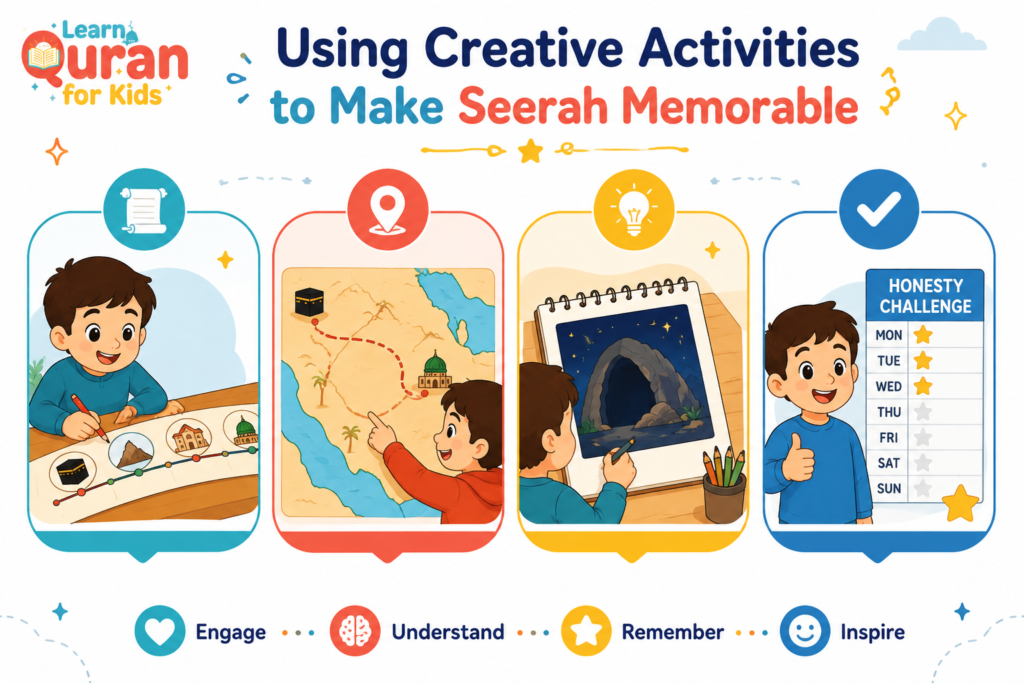
- Create a simple Seerah timeline on a long paper strip and let your child illustrate each key event as they learn it.
- Use a map of the Arabian Peninsula to trace the Prophet’s journeys from Makkah to Madinah, helping children visualize the Hijrah route.
- Ask your child to draw what they would have seen if they were in the Cave of Hira the night of the first revelation.
- Run an “Honesty Challenge” at home: “Can you go one full day without telling a single lie, like Al-Amin?” Mark progress on a chart and reflect together at the end of the day.
Read Also: Who Is Allah for Kids?
Reading Seerah Books Together as a Family
Reading the Seerah together as a family creates shared memories connected to the Prophet’s life. For children under 7, focus on picture books with simple language and single-lesson stories. For children aged 7 to 10, move to chapter-based Seerah books that cover key events with short, clear narratives. For children aged 10 and above, introduce more detailed biographies that include the Prophet’s character, governance, and lasting legacy.
The most important habit is reading and discussing together, not reading alone. Ask your child after every session: “What is one thing from the Prophet’s life that you want to try this week?”
Read Also: Hadith About Children
Experience the Magic Firsthand
Watch these short clips from our live classes to see our interactive teaching tools, vibrant student-teacher interactions, and the fun, stress-free ways we make learning easy for kids!
Start Your Child’s Quran Learning Journey Today!
Join Kids Learning Quran Academy and help your child read the Quran with confidence through fun and guided lessons.
Book a Free Trial ClassKids Learning Quran Academy Gives Your Child a Complete Islamic Education
Your child deserves certified teachers, structured learning, and real results. Kids Learning Quran Academy provides one-on-one live sessions with certified native Arab tutors trained specifically to teach children. Every session is tailored to your child’s pace, level, and individual learning needs.
Kids Learning Quran Academy offers every enrolled family the following:
- Real-time Tajweed and Makharij correction using audio-visual feedback during every session.
- Flexible scheduling covering all global time zones: EST, PST, GMT, CET, IST, GST, and MYT.
- Female teacher options available for families who prefer them.
- Monthly progress reports sent directly to parents after every session.
- A free trial class available with no commitment required.
Our Courses Include:
- Tajweed Course for Kids
- Quran Memorization Course for Kids
- Quran Recitation Course for Kids
- Quran Classes for Toddlers
- Quran Tafseer Course for Kids
- Qaida Course for Kids
- Quran Reading Course for Kids
- Online Arabic Classes for Kids
- Quranic Arabic Course for Kids
- Islamic Studies Courses for Kids
- Islamic Studies Course for Kindergarten
- 5 Pillars of Islam Course for Kids
- Islamic Education Course for Kids
Don’t wait to invest in your child’s Akhirah and future. Enroll today and watch your child grow with confidence, knowledge, and love for the Quran.
Join Kids Learning Quran Academy now and start your child’s learning journey today!
Enroll today at Kids Learning Quran Academy and give your child a complete Islamic education.
Start Your Child’s Quran Learning Journey Today!
Join Kids Learning Quran Academy and help your child read the Quran with confidence through fun and guided lessons.
Book a Free Trial ClassConclusion
Teaching seerah for kids is one of the most impactful investments you will ever make in your child’s faith and character. When your child knows who Prophet Muhammad (peace be upon him) truly was, they gain a role model who answers every question life will ever ask them. They gain the courage to be honest when it is hard, the patience to endure difficulty, the generosity to give even when it costs them, and the forgiveness to rise above every provocation.
Start with one story. Build the timeline one event at a time. Make the Prophet real in your home every single day. Kids Learning Quran Academy is here to support you with expert teachers, structured curriculum, and one-on-one sessions your child will love.
Frequently Asked Questions About Seerah for Kids
What is the seerah of Prophet Muhammad for kids?
The Seerah is the complete biography of Prophet Muhammad (peace be upon him), covering his birth, character, prophethood, migration, and passing. It is the living explanation of the Quran.
At what age should I start teaching seerah for kids?
Begin at age 3 to 5 with simple stories about the Prophet’s kindness. Introduce the full timeline and key events from age 6 to 9. Deeper study begins at age 10 and above.
Why is teaching seerah of Prophet Muhammad for kids important?
The Seerah moves Islam from abstract rules to a relatable way of life. Children connect with real stories and real people, and the Prophet is the best role model Allah has given them.
What are the best seerah stories to teach young children first?
Begin with the Prophet’s childhood, his title Al-Amin, the first revelation, the Hijrah, and the conquest of Makkah. Each story delivers one clear, memorable lesson.
How do I make seerah for kids engaging and not boring?
Use storytelling with dramatic pauses, reflection questions, hands-on activities, timelines, and maps. Connect each story directly to something your child faces in their own daily life.
What is the difference between seerah and hadith for kids?
The Seerah is the complete biography of the Prophet’s life as a narrative. Hadiths are individual recorded sayings and actions of the Prophet. Both come from the same source and are taught together.
Related Articles
Learn Islam