 Learn Islam
Does your child groan when it’s time for Islamic studies — but light up the moment you turn it into a game? You’re not alone. Parents and teachers around the world have discovered that an Islamic quiz game for kids does something a textbook simply cannot: it makes children want to learn.
When knowledge is wrapped in play, children stop memorizing and start understanding. Whether you’re looking for quick dinner-table questions, classroom competitions, or a full game night for the whole family, this guide gives you everything you need — ready-to-use questions sorted by age, formats that actually work, and the key principles that make Islamic quiz games a hit for children.
What You’ll Learn in This Article
- Why Islamic quiz games build deeper Islamic knowledge than passive instruction
- Ready-to-use Islamic question-and-answer sets for ages 4 through 12
- The best Islamic quiz game formats for children and adults
- How to adapt these games for home, classroom, and Ramadan gatherings
- What to do after the quiz to keep that curiosity alive
Islamic Quiz Questions for Kids Ages 4 to 6
These questions introduce the most foundational concepts — the ones children will encounter in Salah, at home, and in Islamic community life every day. Keep answers short, celebrate every attempt, and repeat favorites often.
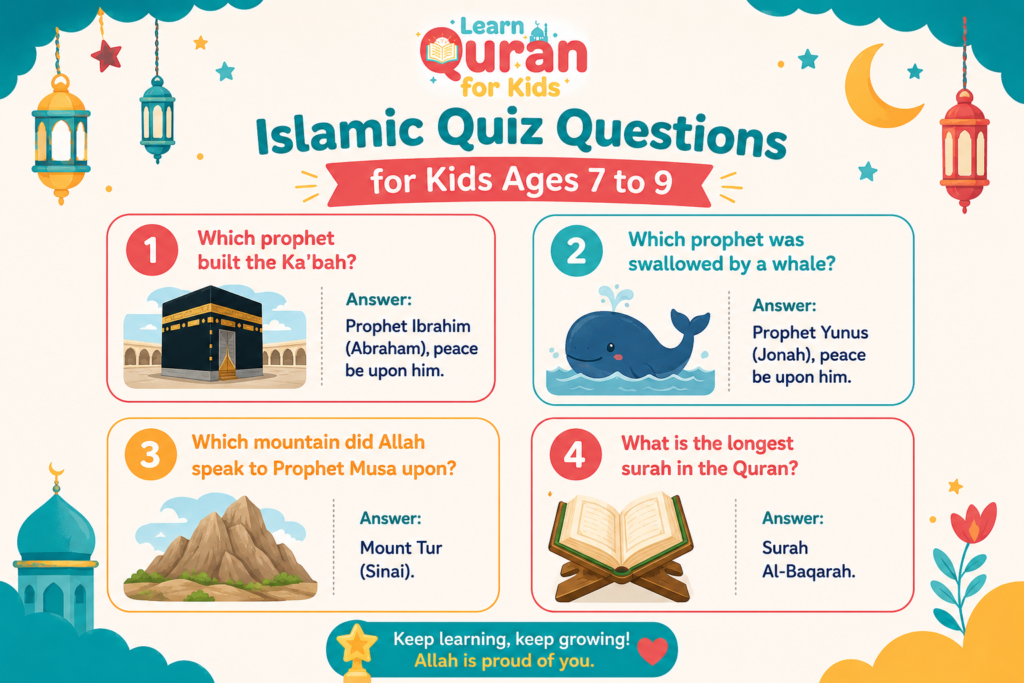
1. What is the name of our Prophet?
Answer: Prophet Muhammad, peace be upon him.
2. How many daily prayers do Muslims perform?
Answer: Five prayers.
3. What is the name of Allah’s holy book?
Answer: The Quran.
4. What is the name of Allah’s house?
Answer: The Ka’bah.
5. Which month do Muslims fast in?
Answer: Ramadan.
6. How many pillars does Islam have?
Answer: Five pillars.
7. What is the prayer we pray at sunset called?
Answer: Maghrib.
8. How many rak’ahs does Fajr prayer have?
Answer: Two rak’ahs.
For this age group, the “Answer and Clap” format works brilliantly — the child answers, everyone claps regardless, then you add one extra fun fact. It builds confidence without any pressure.
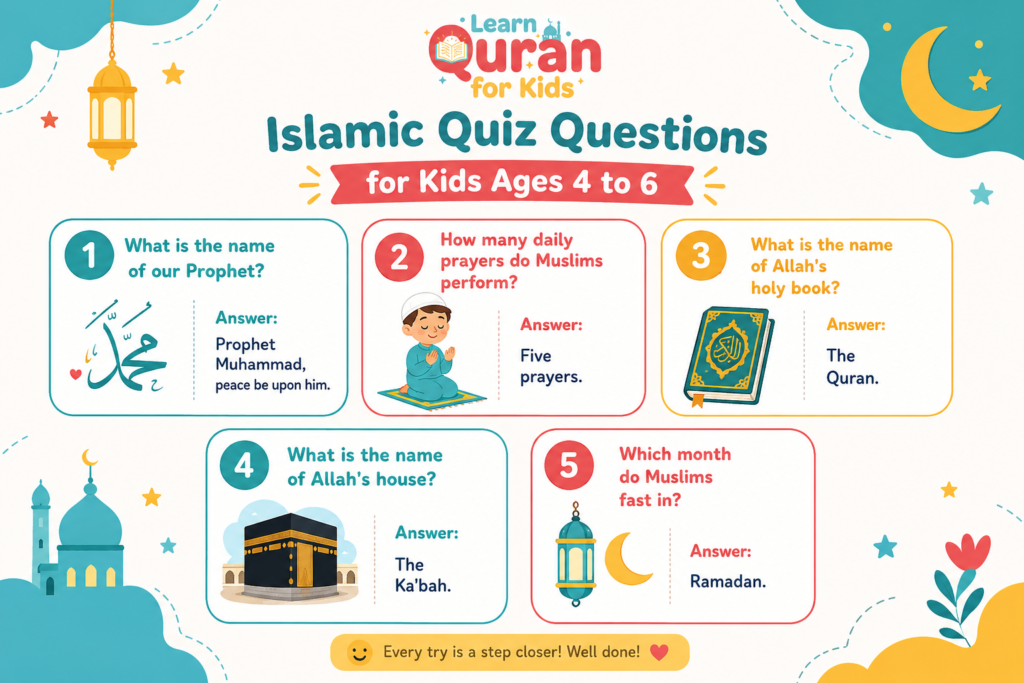
Islamic Quiz Questions for Kids Ages 7 to 9
By this age, children can handle questions about specific prophets, Islamic geography, and Quranic structure. These questions reward children who have been building their knowledge and gently stretch those who haven’t yet.
1. Which prophet built the Ka’bah?
Answer: Prophet Ibrahim (Abraham), peace be upon him.
2. Which prophet was swallowed by a whale?
Answer: Prophet Yunus (Jonah), peace be upon him.
3. Which mountain did Allah speak to Prophet Musa upon?
Answer: Mount Tur (Sinai).
4. What is the longest surah in the Quran?
Answer: Surah Al-Baqarah.
5. What is the last surah in the Quran?
Answer: Surah An-Nas.
6. Which surah is called the “heart of the Quran”?
Answer: Surah Yasin.
7. Who was the companion who slept in the Prophet’s bed on the night of the Hijrah?
Answer: Ali ibn Abi Talib, may Allah be pleased with him.
8. What is the name of the Prophet’s mother?
Answer: Aminah bint Wahb.
At this age, point-based formats work well. A simple whiteboard score tally turns even two siblings into an engaged competition.
Shots Videos from Our Courses
Start Your Child’s Quran Learning Journey Today!
Join Kids Learning Quran Academy and help your child read the Quran with confidence through fun and guided lessons.
Book a Free Trial ClassRead also: Quran Activities for Kids
Read Also: Teaching Children Islam
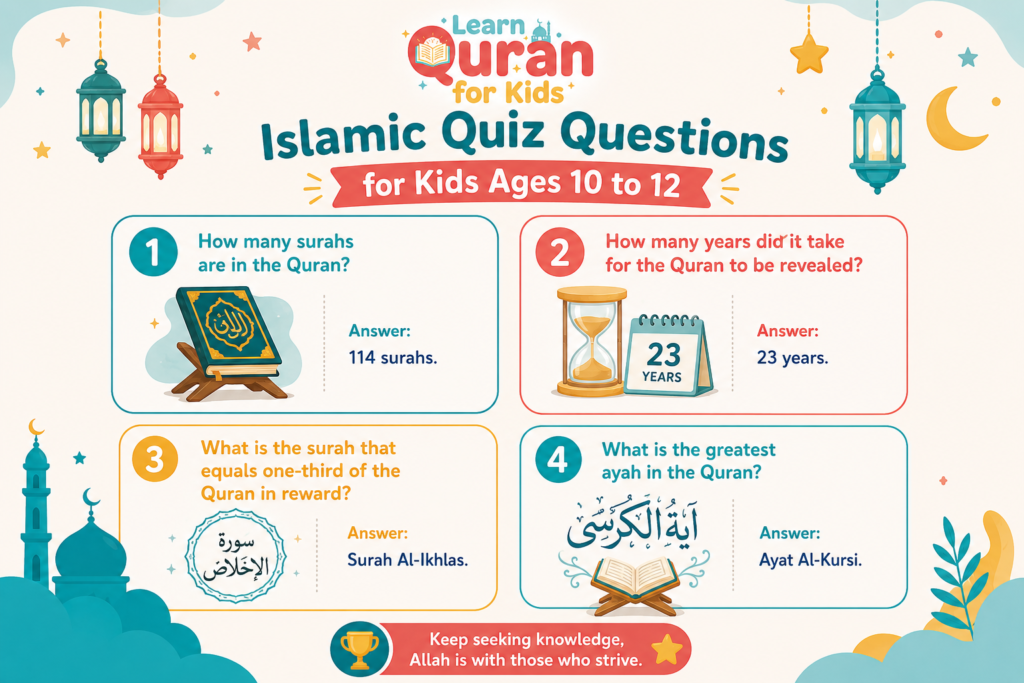
Islamic Quiz Questions for Kids Ages 10 to 12
Older children can engage with nuance, numbers, and historical context. These questions also make excellent Islamic quiz games for adults when used in family settings — parents and children competing together on fair terms.
1. How many surahs are in the Quran?
Answer: 114 surahs.
2. How many years did it take for the Quran to be revealed?
Answer: 23 years.
3. What is the surah that equals one-third of the Quran in reward?
Answer: Surah Al-Ikhlas.
4. What is the greatest ayah in the Quran?
Answer: Ayat Al-Kursi (2:255).
5. Who are the five Prophets known as Ulul Azm (Prophets of Firm Will)?
Answer: Muhammad, Isa, Musa, Nuh, and Ibrahim — peace be upon them all.
6. How long did Prophet Nuh call his people?
Answer: 950 years (as stated in Surah Al-Ankabut, 29:14).
7. Which companion was called “Amin (the Trustworthy) of this Ummah”?
Answer: Abu Ubaydah ibn al-Jarrah.
8. Which battle took place in Ramadan and ended in the Muslims’ victory?
Answer: The Battle of Badr.
9. What was the Prophet doing before he received his first revelation?
Answer: He would retreat to the Cave of Hira for worship and reflection.
10. Which prophet could speak to animals?
Answer: Prophet Sulayman (Solomon), peace be upon him.
Read Also: Best 10 Islamic Topics for Kids and Youth
The Best Islamic Quiz Game Formats for Children
Knowing the questions is only half the challenge. The format determines whether children are engaged or just enduring the session. Here are the formats that consistently produce the best results.
The Buzzer-Round Format
One parent reads a question aloud. The first child to raise their hand (or press a buzzer, ring a bell, or clap) answers. Correct answer earns a point; wrong answer passes to the next child. This format suits ages 8 and up and works brilliantly for groups of 3 or more children. The physical action of buzzing-in keeps energy high.
Read Also: Best Islamic 11 Games for Kids
The Islamic Snakes and Ladders Adaptation
Use a standard board game grid. Before any player moves, they must answer an Islamic quiz question correctly. Wrong answer: stay in place. Right answer: roll and move. This is one of the most effective Islamic quiz game formats for children aged 6 to 10 because the game provides stakes without the pressure of feeling academic.
The Ramadan Question Box
Write 30 questions on cards and place them in a decorated box. Each night after Iftar, one family member draws a card, and the family discusses the answer together. This format is especially valuable because it ties Islamic learning to a positive, warm family ritual rather than a test environment. Children who associate Islamic knowledge with family belonging carry that association into adulthood.
Read also: Ramadan Books for Kids
The Team Format for Islamic Quiz Games for Adults and Mixed Ages
Split into two teams — adults vs. children, or mixed. Harder questions go to adults; easier ones to younger children. Teams confer before answering. This format works particularly well for school events, Eid gatherings, and mosque community nights, because it removes individual performance pressure while keeping everyone involved.
Read Also: Best 6 Islamic Ebooks for Kids
How to Run Islamic Quiz Games for Children Without Turning Them into Tests
The most important design principle for an Islamic quiz game for kids is this: the child who answers incorrectly should leave the game knowing something new and feeling good about having tried.
Concretely, this means three things. First, never let silence sit — if a child doesn’t know the answer, offer a choice between two options rather than waiting. “Was it Prophet Musa or Prophet Yunus?” removes the blank-page anxiety and still requires the child to think. Second, reward effort publicly and correct answers privately when possible — praise the attempt out loud and gently correct the error without drawing attention to it. Third, rotate difficulty so every child has roughly equal moments of success across the session.
A common mistake in classroom quiz settings is applying the same difficulty level to every child in the group. A 6-year-old and a 10-year-old in the same quiz room need different questions, but they can still be in the same game if the question cards are color-coded by age group.
Our Students Reviews
Start Your Child’s Quran Learning Journey Today!
Join Kids Learning Quran Academy and help your child read the Quran with confidence through fun and guided lessons.
Book a Free Trial ClassMake Islamic Learning a Daily Habit with Expert Guidance
Fun quiz games are a wonderful way to spark your child’s interest in Islam—but lasting knowledge comes from consistent learning with qualified teachers. At Learn Quran for Kids Academy, we combine engaging lessons, experienced instructors, and interactive teaching methods to help children build a strong foundation in the Quran, Islamic studies, Arabic, and good Islamic character.
Whether your child is just beginning or wants to deepen their understanding, our personalized online classes make learning enjoyable, structured, and effective from the comfort of your home.
Our Courses Include:
- Tajweed for Kids
- Quran Memorization for Kids
- Quran Recitation Course for Kids
- Quran Classes for Toddlers
- Quran Tafseer for Kids
- Qaida for Kids
- Quran Reading Course for Kids
- Online Arabic Classes for Kids
- Quranic Arabic for Kids
- Islamic Studies Courses for Kids
- Islamic Studies for Kindergarten
- 5 Pillars of Islam for Kids
- Islamic Education for Kids
Don’t let your child’s Islamic education wait. Book a FREE trial class today and discover how our expert teachers can help your child grow in faith, confidence, and love for Islam—one enjoyable lesson at a time.
Conclusion
An Islamic quiz game for kids is more than entertainment — it’s one of the most effective tools available for building genuine Islamic knowledge in children. When questions are matched to the child’s age, the format is warm and low-pressure, and incorrect answers are treated as learning moments rather than failures, children stop associating Islamic knowledge with obligation and start associating it with curiosity and confidence.
The questions in this guide cover the core pillars every Muslim child needs — the Quran, the Prophets, the pillars of Islam, the companions, and Islamic history — organized by age so you can start where your child is and grow from there. Use the formats, adapt them for your home or classroom, and watch what happens when learning becomes a game.
Frequently Asked Questions
What is an Islamic quiz game for kids?
An Islamic quiz game for kids is an interactive question-and-answer activity built around Islamic knowledge — covering topics like the Quran, the Prophets, pillars of Islam, and Islamic history — delivered in a game format to make learning engaging and memorable for children.
Why an Islamic Quiz Game for Kids Works Better Than Traditional Teaching
An Islamic quiz game for kids turns learning into an interactive experience by encouraging children to recall what they know about the Quran, the Prophets, the pillars of Islam, and Islamic history. This active recall strengthens memory more effectively than simply reading or listening.
Quiz games also spark curiosity, inspiring children to ask questions and explore Islamic topics more deeply. To keep learning enjoyable, avoid treating quizzes like tests. Praise every effort, gently explain incorrect answers, and focus on making Islamic learning fun and engaging.
What age can children start Islamic quiz games?
Children as young as 4 can participate in simple Islamic quiz games using questions about basic concepts like the five daily prayers, the name of our Prophet, and the month of Ramadan. Questions should be matched to the child’s level, with multiple-choice options used for the youngest players to remove the pressure of blank recall.
What topics should an Islamic quiz for children cover?
A well-rounded Islamic quiz for children should cover the five pillars of Islam, the six pillars of Iman (faith), stories of the Prophets, Quranic facts (number of surahs, key surahs by name), companions of the Prophet, and Islamic celebrations like Eid Al-Fitr and Eid Al-Adha.
How do I keep Islamic quiz games fun and not stressful for kids?
Frame every wrong answer as a learning moment rather than a failure. Offer multiple-choice options to younger children, use team formats to distribute pressure, rotate difficulty by age, and reward participation as warmly as correct answers. The goal is curiosity — not scores.
Can Islamic quiz games work for adults too?
Yes. Mixed-age quiz formats work especially well for family gatherings, Ramadan nights, and mosque events. Adults take harder questions on Islamic history, Hadith, and Fiqh while children answer the foundational questions — and teams compete together, making it genuinely fun for everyone present.
What is the best format for an Islamic quiz game at home?
The Ramadan Question Box — one card drawn each night after Iftar, answered and discussed as a family — is consistently the most effective home format because it attaches Islamic learning to a warm, regular family ritual rather than a performance moment.
Related Articles
Learn Islam