 Learn Islam
The 5 pillars of Islam for kids are the five core practices every Muslim child needs to understand — not just memorize — to build a genuine connection with their faith from an early age.
The Prophet Muhammad (peace be upon him) described these pillars clearly: “Islam is built on five: testifying that there is no god but Allah and that Muhammad is His messenger, establishing prayer, paying zakah, fasting Ramadan, and making pilgrimage to the House.” (Bukhari)
That one hadith contains a complete roadmap. This guide walks through each pillar in plain language, with practical ways to help children understand and live each one — not just recite it.
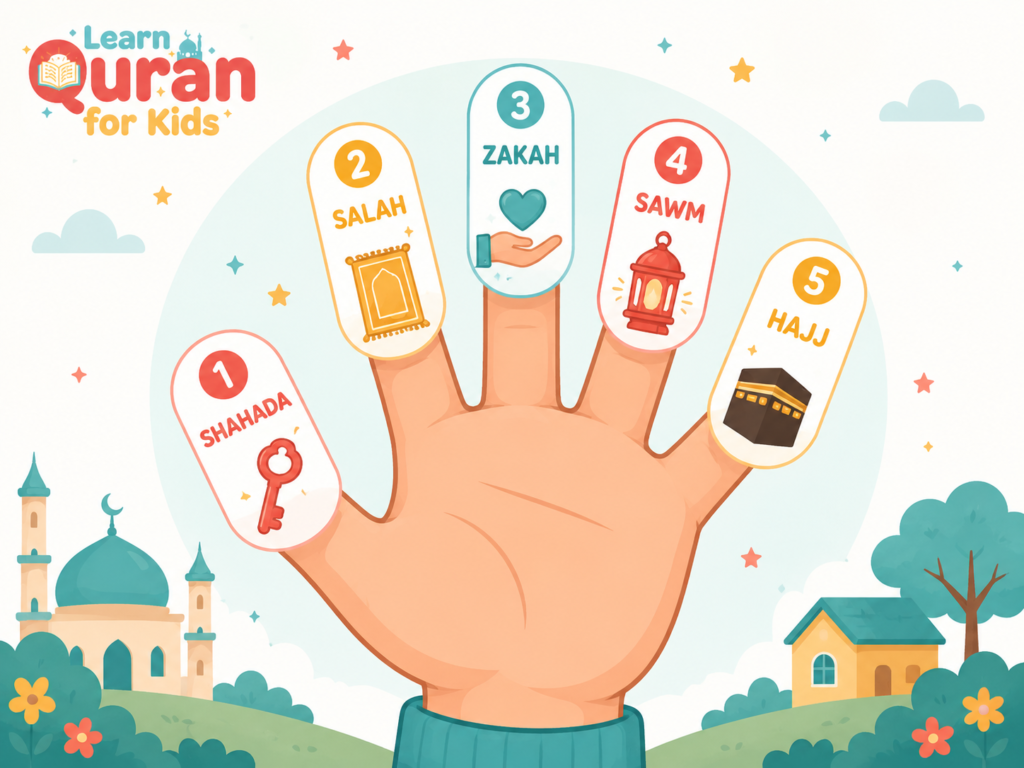
For children, the easiest entry point is physical: the five fingers of one hand. Each finger represents one pillar, in order:
- Thumb → Shahada (the declaration of faith — the key that opens everything)
- Index finger → Salah (prayer — the pillar of the religion)
- Middle finger → Zakah (charity — sharing wealth)
- Ring finger → Sawm (fasting — training the self)
- Pinky → Hajj (pilgrimage — the journey of a lifetime)
Every time a child holds up their hand, they hold the entire structure of Islam. This is the “Five Fingers Framework” — and it works because it ties abstract concepts to something the child already knows and owns.
1. The First Pillar: Shahada (Declaration of Faith)
The Shahada is the declaration that “there is no god but Allah, and Muhammad is His messenger.” It is the entry point into Islam — the first pillar a child encounters, and the one that gives all the others their meaning.
For younger children, the Shahada is best explained as a “key” or a “password.” It is not just words to repeat — it is a statement of what a Muslim believes at their core: that God is one, that He created everything, and that the Prophet Muhammad (peace be upon him) was sent to teach us how to live.
How to teach the Shahada to children
Start with the meaning, not the pronunciation. Ask the child: “Who made the sun? Who made you? Who takes care of everything?” The answer — Allah, alone — is the heart of the first part of the Shahada.
Then introduce the second part: we follow the Prophet (peace be upon him) because Allah chose him to show us the way. When children understand that following the Prophet is itself part of loving God, the Shahada becomes a living belief rather than a phrase.
Read also: Islamic Vocabulary for Kids
2. The Second Pillar: Salah (Prayer)
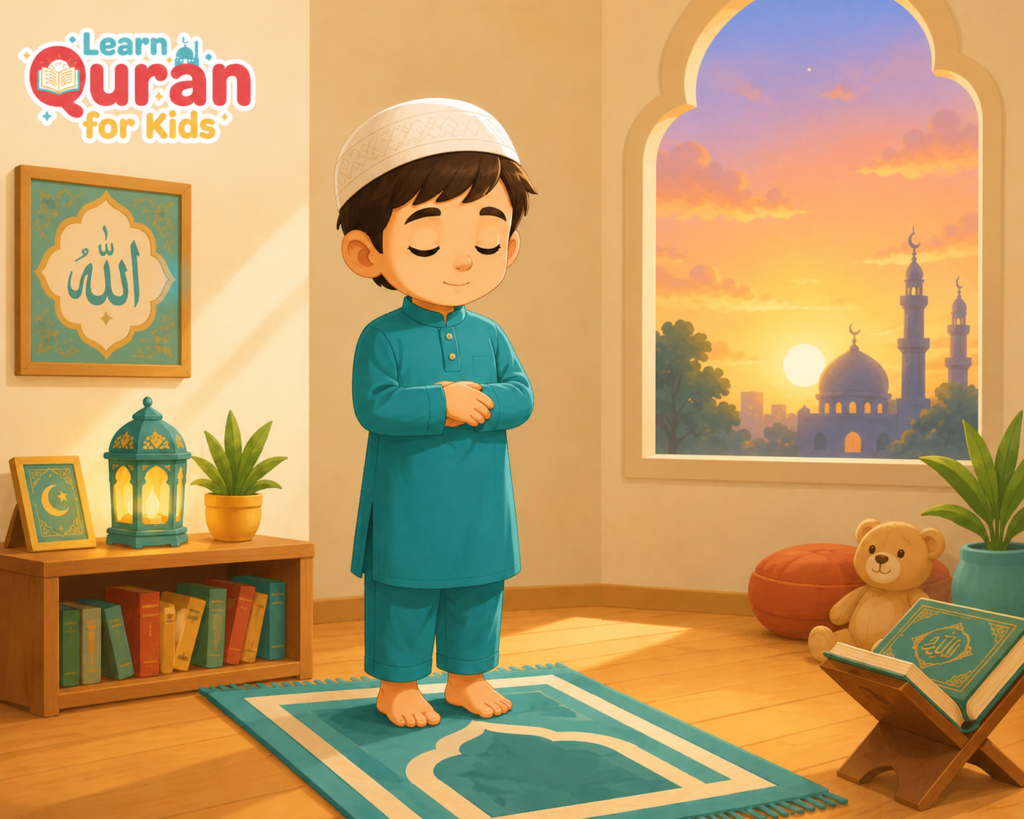
Salah is the five daily prayers that every Muslim performs — Fajr (dawn), Dhuhr (midday), Asr (afternoon), Maghrib (sunset), and Isha (night). Prayer is the most consistent act of worship in a Muslim’s life and the one most directly tied to spiritual health. The Prophet (peace be upon him) described it as the pillar of the religion: if it stands, the whole structure stands.
For children, the most useful framing is a direct conversation with God — five times a day, every day. Not a formal ritual, but a moment to say thank you, to ask for help, and to remember who is in charge of everything.
Read Also: The Islamic Way to Boost Children’s Brain
Building the prayer habit in children
Children can begin observing prayer from the age of three, learning the motions before they fully understand every word. By the age of seven, Islamic tradition recommends actively encouraging prayer. By age ten, it becomes expected.
The key mistake many parents make is introducing prayer through obligation before introducing it through love. Children who first experience Salah as beautiful — a calm pause, a special time with God — are far more likely to maintain it into adulthood than children who first experience it as a duty to discharge.
At Learn Quran for Kids, qualified instructors guide children through the correct pronunciation and meaning of Salah step by step, so the prayer feels like an achievement, not a performance. [Explore our online Quran and Islamic studies programs for children.]
Shots Videos from Our Courses
Start Your Child’s Quran Learning Journey Today!
Join Kids Learning Quran Academy and help your child read the Quran with confidence through fun and guided lessons.
Book a Free Trial ClassRead also: Wudu Steps for Kids
3. The Third Pillar: Zakah (Charity)
Zakah is the annual obligation on Muslims who own wealth above a minimum threshold (nisab — equivalent to approximately 85 grams of gold) to give 2.5% of that wealth to those in need. The Quran describes it clearly:
“Take from their wealth a charity to purify them and cleanse them.” (At-Tawbah: 103)
For children, Zakah is best introduced not as a tax but as a purification — the idea that holding onto everything we have can make the heart heavy, and that giving makes both the giver and the receiver lighter.
Read Also: Islamic Motivation for Kids
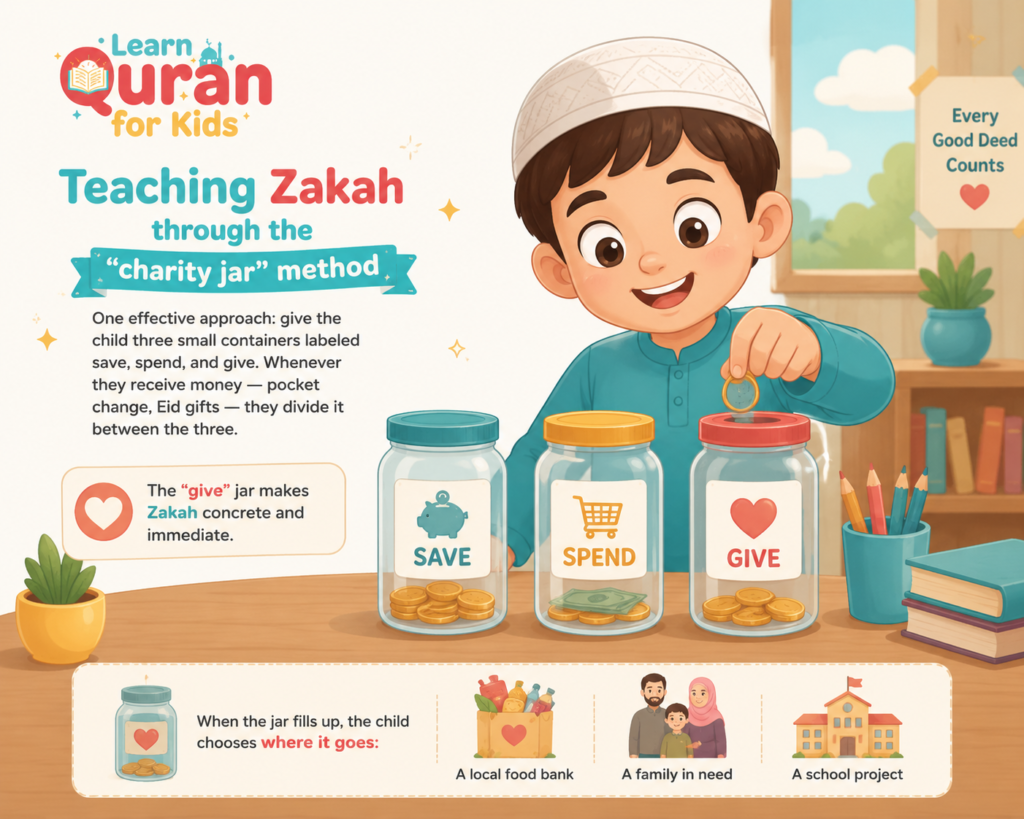
Teaching Zakah through the “charity jar” method
One effective approach: give the child three small containers labeled save, spend, and give. Whenever they receive money — pocket change, Eid gifts — they divide it between the three. The “give” jar makes Zakah concrete and immediate. When the jar fills up, the child chooses where it goes: a local food bank, a family in need, or a school project.
This is not just a financial lesson. Research in developmental psychology consistently shows that children who practice giving early develop stronger empathy and lower rates of anxiety — outcomes that align directly with what Islamic tradition has always said about the inner effect of Zakah.
Read Also: Islamic Questions for Kids
4. The Fourth Pillar: Sawm (Fasting)
Sawm is the fast of Ramadan — abstaining from food, drink, and other specified things from dawn to sunset throughout the ninth month of the Islamic calendar. Allah commands it in the Quran:
“O you who have believed, decreed upon you is fasting as it was decreed upon those before you, that you may become righteous.” (Al-Baqarah: 183)
The word taqwa (righteousness/God-consciousness) in that verse is the key: fasting is not primarily a physical challenge. It is a training of the inner self — patience, gratitude, empathy for those who go hungry by necessity rather than choice.
Introducing fasting to children by age
Children under seven should never be required to fast, but can begin participating at the edges: staying up for Suhoor, breaking fast with the family at Iftar, and understanding why the family isn’t eating during the day. These early experiences make Ramadan a time of belonging, not deprivation.
From age seven onward, many children choose to try a half-day fast — stopping at Dhuhr — as a way to participate more fully. The instinct to join should be encouraged; the insistence on completing a full fast before the child is ready should not.
One practical tip: connect fasting to a cause the child cares about. “When we feel hungry today, we remember children who feel this way every day — and that’s why we give Zakah.” The two pillars reinforce each other, and the child experiences faith as a coherent system rather than a list of separate rules.
Read also: Can Kids Fast?
5. The Fifth Pillar: Hajj (Pilgrimage)
Hajj is the pilgrimage to Makkah that every Muslim who is physically and financially able must perform at least once in their lifetime. It takes place annually in the month of Dhul-Hijjah and includes standing at Mount Arafat, circling the Kaabah, and completing specific rites that trace the history of Ibrahim (peace be upon him) and his family.
Allah commands it directly: “Pilgrimage to the House is a duty owed to Allah by people who can undertake it.” (Aal Imran: 97)
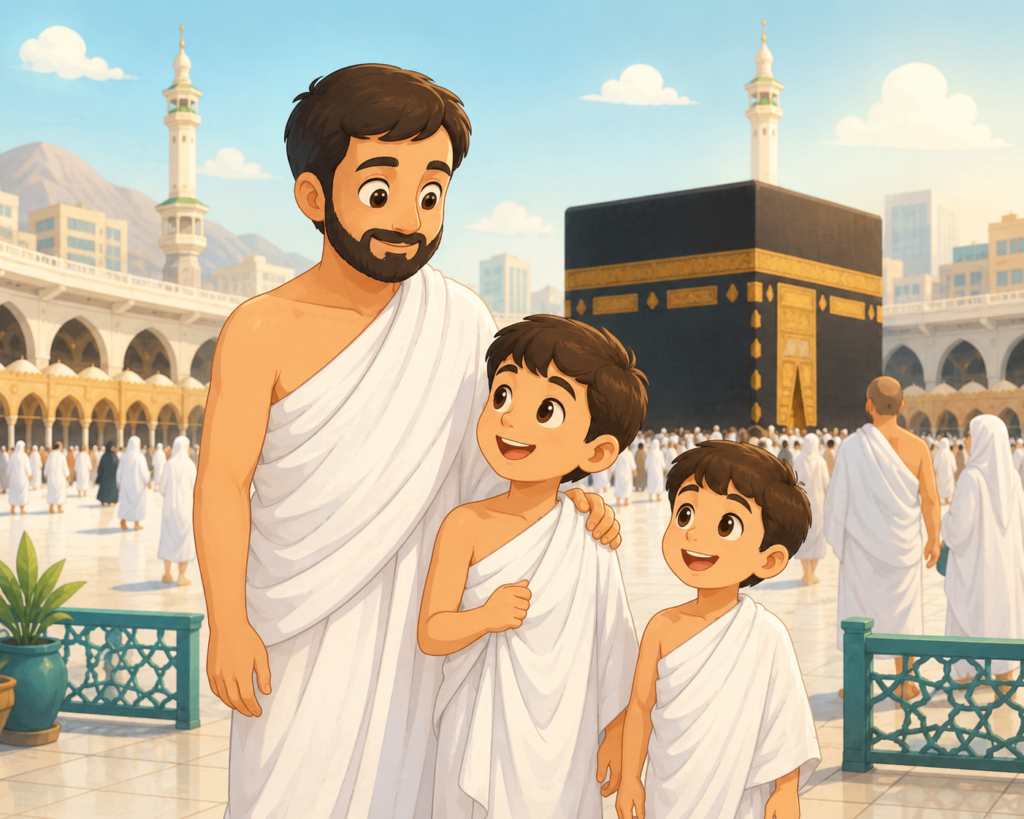
For children, Hajj introduces a genuinely profound concept: equality before God. At Hajj, a king and a farmer wear the same two white cloths. No rank, no nationality, no wealth can be displayed. Everyone is the same.
Teaching Hajj before the child can go
The most effective approach is visual and narrative. Show children images or videos of Hajj — the ocean of white at Arafat, the circling of the Kaabah — and explain that this is a gathering of Muslims from every country on earth, all saying the same words at the same time. That image, for a child, is both beautiful and clarifying: Islam is not a private belief; it is a global community.
Craft activities — building a simple model of the Kaabah from cardboard, drawing the Hajj routes — give the child a physical connection to a pillar they won’t experience for years. The goal is not to simulate Hajj but to make it feel real and worth looking forward to.
Read Also: Best 6 Islamic Ebooks for Kids
Our Students Reviews
Start Your Child’s Quran Learning Journey Today!
Join Kids Learning Quran Academy and help your child read the Quran with confidence through fun and guided lessons.
Book a Free Trial ClassRead also: Eid-Al-Adha for Kids
Start Your Child’s Quran and Islamic Studies Journey Today
Your child understands stories, conversations, and experiences — not lectures. The 5 pillars of Islam for kids land deepest when they’re taught by someone who knows how to meet a child where they are.
At Learn Quran for Kids, our certified instructors combine Quranic recitation with foundational Islamic knowledge — including the five pillars — in structured, age-appropriate lessons delivered online, one-to-one or in small groups.
Every session is designed to build knowledge and love of the faith simultaneously.
[Book a free trial lesson today, and ask for more details about our courses]
Our Courses Include:
- Tajweed for Kids
- Quran Memorization for Kids
- Quran Recitation Course for Kids
- Quran Classes for Toddlers
- Quran Tafseer for Kids
- Qaida for Kids
- Quran Reading Course for Kids
- Online Arabic Classes for Kids
- Quranic Arabic for Kids
- Islamic Studies Courses for Kids
- Islamic Studies for Kindergarten
- 5 Pillars of Islam for Kids
- Islamic Education for Kids
Conclusion
The 5 pillars of Islam for kids are not five separate lessons to teach once and test on. There are five interlocking practices that, taken together, shape how a child relates to God, to other people, and to themselves.
Shahada plants the belief. Salah nurtures it daily. Zakah expresses it through generosity. Sawm deepens it through discipline. Hajj connects the child to the global Muslim community across time and space.
The most important thing a parent or teacher can do is ensure that each pillar is introduced through love first — because a child who learns that Islam is something beautiful will carry it far more naturally than a child who learns it as a set of obligations.
Frequently Asked Questions
At What Age Should Children Start Learning The 5 Pillars Of Islam?
Children can begin learning about the 5 pillars from age three through simple picture books and stories. By age seven, children should understand all five pillars and begin practicing Salah regularly. Each pillar can be introduced gradually, with the depth of explanation increasing as the child grows.
How Do You Explain The 5 Pillars Of Islam To A Child In Simple Terms?
Use the five fingers of one hand: the thumb is Shahada (the key to faith), the index finger is Salah (daily prayer), the middle finger is Zakah (sharing with those in need), the ring finger is Sawm (fasting in Ramadan), and the pinky is Hajj (the pilgrimage to Makkah). Each finger supports the whole hand — remove one, and the structure is incomplete.
Do Children Have To Fast During Ramadan?
Fasting is obligatory for adults who are healthy and able. Children are not required to fast but are encouraged to participate in Ramadan in age-appropriate ways — waking for Suhoor, breaking the fast with family, and optionally trying a half-day fast from around age seven onward if they choose to.
What Is The Easiest Pillar To Teach Children First?
The Shahada is the natural starting point because it is the foundation on which everything else rests. Once a child understands that Allah is one and that the Prophet (peace be upon him) is His messenger, the other four pillars have a clear reason to exist — they are ways of living out that belief.
How Can Interactive Activities Help Children Remember The 5 Pillars?
Research from Carnegie Mellon University found that interactive learning produces results six times better than passive instruction. For the 5 pillars, effective activities include finger puppet crafts (one puppet per pillar), cut-and-paste sequencing activities, pillar coloring worksheets, and the three-jar Zakah method. Each activity gives the child a physical experience of the concept, which strengthens long-term retention significantly more than listening or reading alone.
Related Articles
Learn Islam