 Learn Islam
Many parents invest heavily in academic tutoring and enrichment programs for their children — and rightly so. But the Islamic tradition holds something uniquely powerful that modern neuroscience is only beginning to catch up with: a complete, integrated system for developing children’s minds that addresses cognitive growth, emotional stability, moral clarity, and spiritual grounding all at once.
The Islamic way to boost children’s brains is not a single technique. It is a holistic framework that connects Quranic memorization, reflective thinking, purposeful nutrition, physical activity, and intentional parenting — each pillar reinforcing the others in ways that isolated brain-training apps simply cannot replicate.
This guide walks Muslim parents through that framework, with practical steps they can start this week.
What Islam Says About the Child’s Mind
The Islamic way to boost children’s brains begins with a foundational belief: every child arrives with innate intellectual gifts from Allah. Allah (SWT) says in the Quran:
“Indeed, in the creation of the heavens and the earth and the alternation of the night and the day are signs for those of understanding” (Āl-ʿImrān: 190).
The Quran does not merely encourage learning — it frames the use of the intellect as an act of worship. This is a crucial distinction. In the Islamic framework, a child who thinks carefully, asks questions, and reflects on the natural world is not just intellectually developing — they are fulfilling a divine purpose.
Islamic scholars have historically identified three components of sound intellectual development for children: the educational duty (al-wājib al-taʿlīmī), intellectual awareness (al-tawʿiya al-fikriyya), and cognitive health (al-ṣiḥḥa al-ʿaqliyya).
Together, these three pillars cover everything from choosing the right school to protecting children from content that dulls the mind. Parents who understand this framework stop treating “brain development” as a separate task — it becomes woven into the whole of their child’s upbringing.
1. The Quran as the Primary Engine of Cognitive Growth
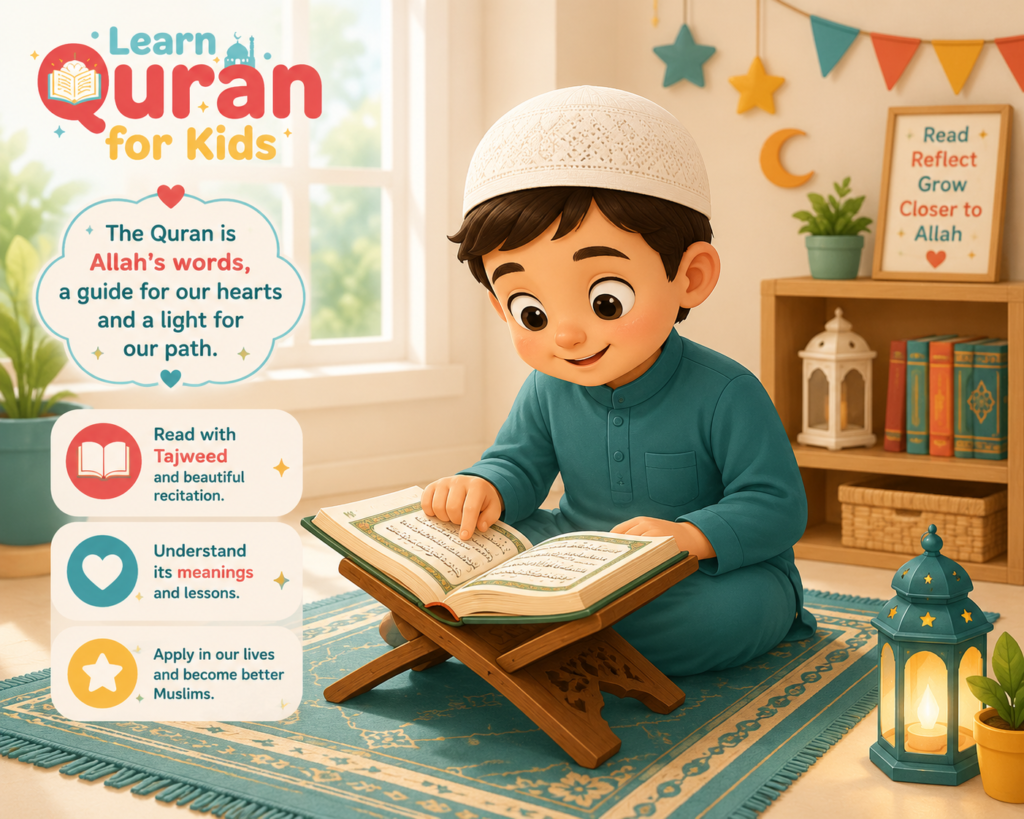
Quran memorization (Hifz) is one of the most cognitively demanding activities a child can undertake — and one of the most rewarding. Educational studies have consistently found a direct connection between Quran memorization and academic excellence, as well as significant improvements in working memory and concentration among children who practice it consistently.
The mechanism is straightforward: memorizing long passages of complex, rhythmically structured Arabic text forces the brain to build and maintain strong neural pathways for retention, sequencing, and recall. Children who memorize the Quran develop what Ibn Abbas described as al-ḥikma — a kind of cultivated wisdom-intelligence — from an early age. Even short, consistent sessions of 10–15 minutes daily produce compounding memory gains over weeks and months.
At Learn Quran for Kids, structured Hifz programs for children aged 4–15 are designed to make this process engaging and age-appropriate — never a memorization grind, but a steady, rewarding climb guided by qualified instructors.
2. Tadabbur Builds Critical and Analytical Thinking
Memorization is only part of the picture. The Quran repeatedly calls believers not just to recite but to reflect — tatafakkarūn, ya’qilūn, yatadabbarūn. When parents encourage children to pause after an ayah and ask “What does this tell us about Allah? What can we learn from this for our lives?”, they are training the exact higher-order thinking skills — analysis, inference, synthesis — that schools spend years trying to develop.
A practical method: after a child finishes their Quran session, ask one open question. Not “what does this mean?” but “why do you think Allah described it this way?” This single habit, sustained over months, builds a child who thinks rather than a child who merely memorizes.
Shots Videos from Our Courses
Start Your Child’s Quran Learning Journey Today!
Join Kids Learning Quran Academy and help your child read the Quran with confidence through fun and guided lessons.
Book a Free Trial ClassRead also: The Benefits Of Reading Quran For Kids
3. The Prophet’s Nutritional Blueprint for the Brain
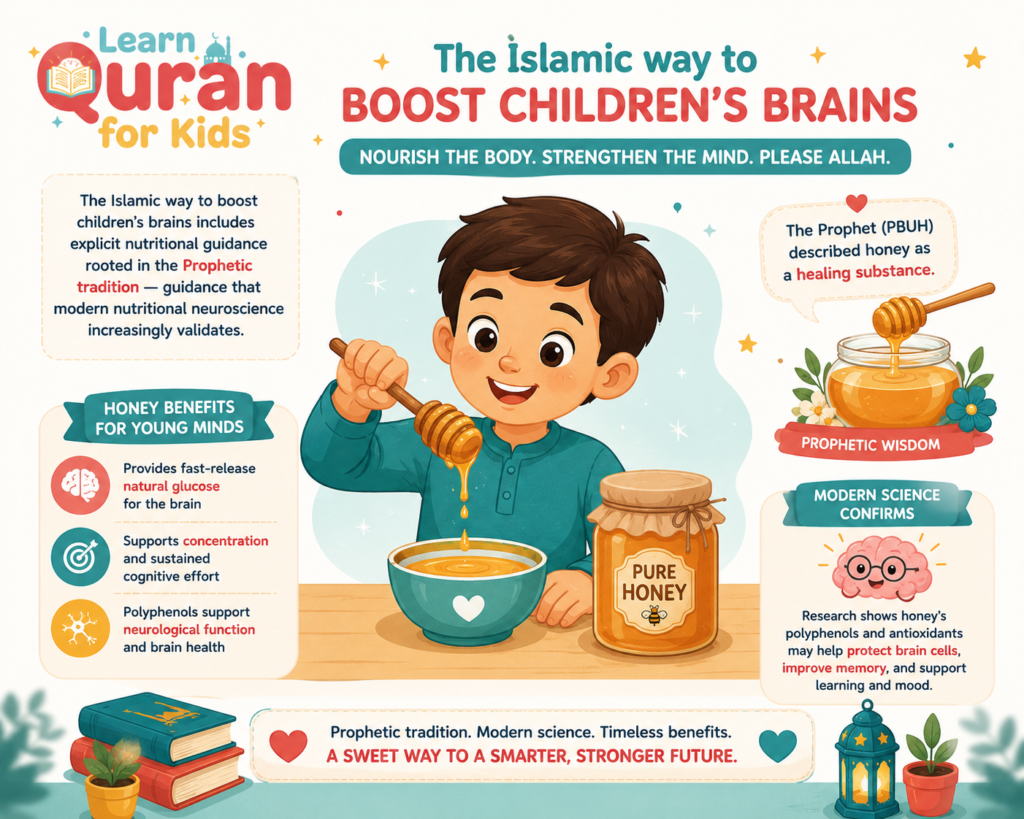
The Islamic way to boost children’s brains includes explicit nutritional guidance rooted in the Prophetic tradition — guidance that modern nutritional neuroscience increasingly validates.
Honey provides the brain with fast-release natural glucose, supporting concentration and sustained cognitive effort. The Prophet (PBUH) described honey as a healing substance, and its polyphenol content genuinely supports neurological function. Dates are dense in potassium, magnesium, and natural sugars — critical minerals for healthy nerve transmission and brain signaling. Frankincense (luban al-dhakar) has been used in the Islamic tradition specifically for memory enhancement and is now being studied for its neuroprotective compounds.
Alongside these, modern nutritional science affirms the importance of omega-3 fatty acids (found in fish and walnuts), protein-rich foods for neurotransmitter production, and B vitamins for nerve health. All of these are consistent with the balanced, whole-food diet the Islamic tradition has always promoted.
One often-overlooked point: breastfeeding, where possible, remains the strongest nutritional start a mother can give a child’s developing brain — something Islamic scholars have emphasized for over 1,400 years.
The Hidden Brain Disruptors to Avoid
Islamic scholars were clear that cognitive health requires protection, not just development. Smoking, intoxicants, and chronic exposure to sensational or sexualized media all impair the brain’s ability to focus and think clearly. Contemporary neuroscience explains the mechanism: dopamine-disrupting content creates a mental fog that makes deep concentration — the kind needed for Quran, study, and meaningful conversation — increasingly difficult. Protecting your child’s cognitive environment is as important as enriching it.
Read also: Islamic Science for Kids
4. Teach Contemplation of the Natural World
The Quran asks: “Do they not look at the camels — how they are created? And the sky — how it is raised?” (Al-Ghāshiya: 17–18).
Parents can bring this verse to life simply by walking in nature and asking observational questions. “Why do you think birds fly in a V formation?” “What keeps the clouds up?” This habit of wondering — of seeking causes, connections, and patterns — is exactly the reasoning capacity Islam considers central to knowing Allah.
Start with short, 5-minute observation stops during walks. Over time, children begin asking these questions themselves without prompting.
5. Encourage Questions Without Mockery
One of the most damaging mistakes a parent can make is dismissing a child’s question — however simple or repetitive — with sarcasm or impatience. The Prophet (PBUH) welcomed questions from companions of all ages and never shamed curiosity. A child who learns that questions are welcomed becomes intellectually courageous. A child who is mocked for asking becomes intellectually passive.
Receive every question with “That’s a good thought — what do you think?” before answering. This one change transforms question-and-answer from knowledge transfer into a genuine dialogue that builds thinking skills.
Read Also: Islamic Motivation for Kids
6. Use Prophet Stories to Develop Moral Reasoning
Stories of the Prophets — Yusuf, Musa, Ibrahim, Yunus (peace be upon them all) — are not just historical accounts. They are case studies in decision-making under pressure, patience under injustice, and trust in Allah when the outcome is unclear. When a parent tells the story of Prophet Yunus and then asks “What would you have done?” or “Why do you think he made that choice?”, they are developing the child’s capacity for moral reasoning, perspective-taking, and emotional intelligence — all at once.
Learn Quran for Kids integrates exactly this storytelling approach into its Quran lessons, ensuring children understand the context behind the verses they memorize.
Read also: Prophet Stories for Kids
7. Purposeful Play and Educational Games
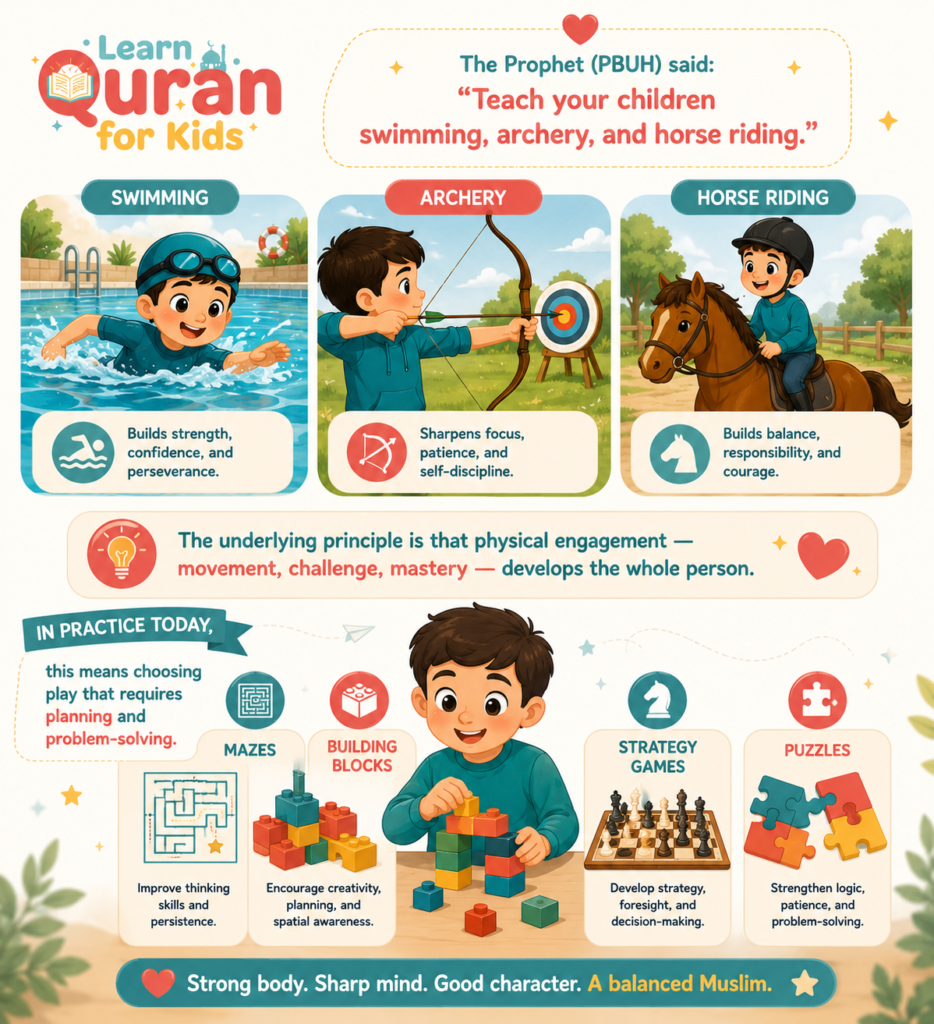
The Prophet (PBUH) said: “Teach your children swimming, archery, and horse riding.”
The underlying principle is that physical engagement — movement, challenge, mastery — develops the whole person. In practice today, this means choosing play that requires planning and problem-solving: mazes, building blocks, strategy games, and puzzles that require the child to think through multiple steps before acting.
Screen time is not automatically harmful, but content matters enormously. A carefully chosen game that requires strategic choices is cognitively very different from passive video consumption. The rule of thumb: if the child is making decisions during play, the brain is being trained. If the child is only watching, it is not.
Read Also: Islamic Questions for Kids
8. Structured Journaling and Organized Thinking
A habit that almost no competing article mentions — and one rooted directly in the Islamic emphasis on reflection — is teaching children to write down what they think. Even young children who cannot write fluently can dictate to a parent. The act of externalizing thoughts onto paper forces the mind to organize, sequence, and evaluate ideas. Children who practice this regularly develop analytical clarity that extends into every academic subject.
Start with one question per week after a Quran lesson: “What did we learn today and why does it matter?” The child’s answers, accumulated over a year, become a personal reflection journal that also reinforces Quranic learning.
Read Also: The 5 Pillars of Islam for Kids
9. Respecting Individual Differences Among Children
Allah created children with varying gifts, speeds, and temperaments. This is not a problem to be solved — it is a reality to be respected. A child who struggles with memorization may have exceptional analytical ability. A child who is slow to read may have extraordinary spatial reasoning. Islam’s approach to this is explicit: meet the child where they are, strengthen what they have, and never compare siblings in a way that shames the slower learner.
The most damaging words a parent can say are “Your brother didn’t have this problem.” The most productive question is: “How can I adjust my approach to fit how this child learns best?”
Read also: Islamic Manners for Kids
10. Emotional Safety Enables Cognitive Growth
Neuroscience confirms what Islamic scholars taught for centuries: a child who feels emotionally safe — loved, seen, and secure — learns more easily than an anxious child. When a child feels afraid of failure, the brain’s threat response overrides its learning circuits. Warmth, patience, and specific praise (“You worked so hard on that ayah, MashaAllah”) create the neurological conditions for deeper learning. Criticism, shame, and comparison do the opposite.
Our Students Reviews
Start Your Child’s Quran Learning Journey Today!
Join Kids Learning Quran Academy and help your child read the Quran with confidence through fun and guided lessons.
Book a Free Trial ClassStart Your Child’s Islamic Learning Journey with Expert Guidance
Home habits and parental attention are irreplaceable — but structured, qualified guidance is what turns a love of learning into mastery. At Learn Quran for Kids, your child learns from qualified instructors trained in child-appropriate pedagogy, using methods that engage rather than pressure.
- Expert instructors with proven experience teaching children aged 4–15
- Hifz, Tajweed, Quranic Arabic, and Islamic Studies courses for every stage
- Short 20–30 minute sessions designed for children’s natural attention spans
- Gamification, storytelling, and interactive activities — never dry repetition
- Flexible scheduling that works around your family’s routine
Your child’s mind is a trust from Allah. Give it the best start.
Our Courses Include:
- Tajweed for Kids
- Quran Memorization for Kids
- Quran Recitation Course for Kids
- Quran Classes for Toddlers
- Quran Tafseer for Kids
- Qaida for Kids
- Quran Reading Course for Kids
- Online Arabic Classes for Kids
- Quranic Arabic for Kids
- Islamic Studies Courses for Kids
- Islamic Studies for Kindergarten
- 5 Pillars of Islam for Kids
- Islamic Education for Kids
Conclusion
The Islamic way to boost children’s brains is not a single hack or supplement — it is a complete, integrated approach that has been refined over fourteen centuries of scholarship and practice. Quran memorization builds memory. Tadabbur builds analytical thinking. Prophetic nutrition supports brain health. Purposeful play develops strategic reasoning. Emotional safety enables all of it.
What makes this framework distinct from generic brain-training advice is its coherence: every element connects to the others, and every element ultimately points back to knowing Allah more deeply. A child raised within this framework does not just become academically capable — they become wise, reflective, and grounded in a way that serves them through every challenge life presents.
Start with one practice this week. Pick one verse to reflect on together. Ask one open question after dinner. Serve dates and honey at breakfast. The small, consistent actions are where the transformation begins.
Frequently Asked Questions
What Is The Islamic Way To Boost Children’s Brains?
The Islamic way to boost children’s brains is a holistic approach combining Quran memorization (Hifz), reflective thinking (Tadabbur), Prophetic nutritional guidance (including honey, dates, and balanced whole foods), purposeful physical activity, and intentional parenting through dialogue and storytelling. Together, these elements develop memory, critical thinking, emotional stability, and moral reasoning simultaneously.
Does Quran Memorization Really Improve A Child’s Memory?
Yes. Educational research consistently shows that children engaged in regular Quran memorization demonstrate stronger working memory, better academic performance, and improved concentration compared to peers. The cognitive demand of memorizing structured, rhythmically complex Arabic text builds neural pathways for retention and recall that transfer across all subjects.
At What Age Should I Start Developing My Child’s Brain Islamically?
From birth, and in earnest from age 3–4. The early years are neurologically the most sensitive period for cognitive development — neural connections form at extraordinary speed before age 7. Simple practices like Quran listening during daily routines, saying Bismillah before activities, and asking reflective questions during walks are all effective and age-appropriate from toddlerhood onward.
What Prophetic Foods Support Children’s Brain Development?
Honey provides fast-release natural energy that fuels brain activity and contains polyphenols beneficial for neurological health. Dates are rich in minerals — especially potassium and magnesium — that support healthy nerve signaling. Frankincense (luban al-dhakar) has been used in Islamic tradition for memory support and is now being studied for its neuroprotective properties. Alongside these, a balanced diet with omega-3s, protein, and B vitamins aligns closely with what both Islamic tradition and modern nutrition recommend.
How Do I Encourage Critical Thinking In A Muslim Child?
Ask open questions rather than closed ones. After Quran lessons or Prophet stories, ask “Why do you think this happened?” rather than “What happened?” Encourage contemplation of the natural world — birds, weather, plants — and connect observations to Allah’s design. Welcome every question without mockery. The child who learns to ask “why” and “how” in an environment of safety becomes a lifelong thinker.
Can Screen Time And Games Be Part Of The Islamic Approach To Brain Development?
Yes, with careful selection. The Prophetic principle of teaching children physical skill and strategic challenge applies directly: games that require the child to plan, solve problems, and make decisions actively train the brain. Passive content consumption does not. Prioritize games with genuine decision-making over games that only reward reflexes or watching. Set clear time boundaries, and always balance screen time with physical play, reading, and direct conversation.
Related Articles
Learn Islam