 Learn Islam
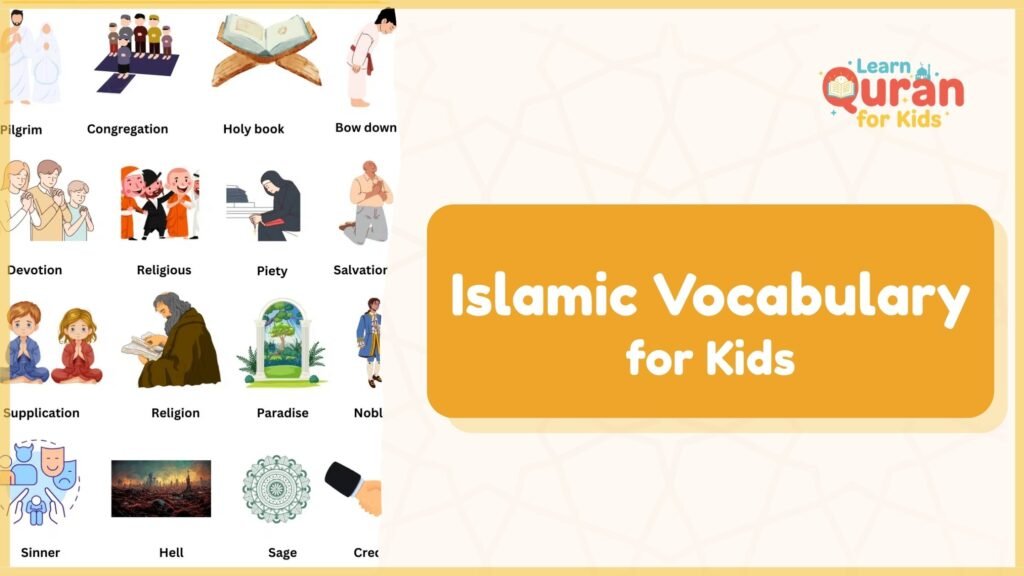
Teaching children Islamic vocabulary is one of the best ways to help them build a strong connection with Islam from an early age. When children understand words like salah, dua, Qur’an, sadaqah, and taqwa, they begin to understand the meaning behind worship, kindness, and Islamic values in everyday life.
Many Muslim parents want their children to grow up loving Islam, but teaching Islamic terms can sometimes feel overwhelming. That is why introducing Islamic vocabulary for kids through stories, conversations, games, and daily routines works much better than simple memorization.
Studies on vocabulary learning in Islamic education show that repetition, storytelling, visual learning, and interactive reading help children remember Islamic words more naturally and confidently.
This guide includes important Islamic words for kids, easy explanations, pronunciation-friendly meanings, and practical activities parents can use at home.
Why Teaching Islamic Vocabulary to Kids Matters?
Children hear Islamic words every day at home, in the masjid, during Ramadan, and while listening to Qur’an recitation. However, many children repeat these words without fully understanding their meanings.
When kids learn Islamic words meaning in a simple and practical way, they begin connecting Islamic teachings to daily life.
For example:
- A child who learns amanah understands trustworthiness.
- A child who learns sadaqah understands generosity.
- A child who learns sabr understands patience.
- A child who learns salah understands discipline and worship.
Learning Islamic vocabulary also strengthens Muslim identity. Children become comfortable using words like Bismillah, Alhamdulillah, Adhan, and Qiblah naturally in conversations.
Even teaching one Islamic word during dinner time can help children remember it for years.
How to Teach Islamic Vocabulary for Kids Effectively?
Teaching Islamic vocabulary becomes much easier when children learn words naturally through stories, daily conversations, and fun activities instead of memorization alone. Simple and consistent learning methods help kids understand Islamic meanings deeply while building a stronger connection with their faith.
1. Use Stories Instead of Memorization
Children remember words better when they hear them inside stories.
For example:
- Teach amanah through a story about honesty.
- Teach sadaqah through a story about sharing food.
- Teach taqwa through real-life examples.
Story-based Islamic learning makes vocabulary meaningful and enjoyable.
2. Repeat Words Daily
Children learn through repetition.
Use Islamic words naturally throughout the day:
- Say Bismillah before eating.
- Say Alhamdulillah after sneezing.
- Say Assalamu Alaikum when greeting family.
The more children hear Islamic words, the more confident they become using them.
3. Make Learning Visual
Visual learning helps children remember Islamic vocabulary more easily and makes the learning process more enjoyable. Parents can use flashcards, drawing activities, storybooks, word journals, coloring pages, and interactive Islamic e-books to introduce new Islamic words in a fun and engaging way. Children who learn through visual activities often understand Quranic words and simple Islamic expressions faster while staying excited about learning.
4. Keep Lessons Short
Young children learn better when lessons are short, simple, and consistent, because long learning sessions can quickly make them lose focus. Teaching only 3–5 Islamic words each week is often more effective than introducing many words at once, as it gives children enough time to understand the meanings, remember the pronunciation, and use the words naturally in their daily conversations and activities.
5. Connect Words to Daily Life
Islamic vocabulary becomes more meaningful and memorable when children see these words used in real-life situations every day. Returning borrowed items can teach amanah, helping siblings can teach akhlaq, and waiting calmly for something can teach sabr, allowing children to connect Islamic values with their daily actions and behavior.
Shots Videos from Our Courses
Start Your Child’s Quran Learning Journey Today!
Join Kids Learning Quran Academy and help your child read the Quran with confidence through fun and guided lessons.
Book a Free Trial ClassFoundations of Islamic Belief
Teaching children the foundations of Islamic belief helps them understand the core values of Islam from an early age. Simple Islamic concepts like Iman, Tawheed, and Taqwa help children build a stronger connection with Allah while learning how to apply Islamic values in their daily lives.
Islam
Islam means submission to Allah with peace, sincerity, and obedience.
Kid Example: Islam teaches us to pray, help others, and tell the truth.
Iman
Iman means faith and belief in Allah, His angels, His books, His messengers, the Last Day, and destiny.
Kid Example: We trust Allah even when we cannot see everything.
Ihsan
Ihsan means doing things beautifully and sincerely for Allah.
Kid Example: I clean my room properly even when nobody is watching.
Tawheed
Tawheed means believing Allah is One and deserves worship alone.
Kid Example: Muslims worship only Allah.
Taqwa
Taqwa means being mindful of Allah and trying to please Him.
Kid Example: I tell the truth because Allah sees my actions.
Qadr
Qadr means Allah’s perfect knowledge and plan.
Kid Example: We try our best and trust Allah’s plan.
Build a Stronger Connection with the Qur’an Through Quranic Arabic
Children who begin learning Islamic vocabulary early often develop stronger Qur’an understanding skills as they grow. Programs like the Quranic Arabic Course for Kids help children move beyond memorization by teaching them the meanings of common Quranic words, simple Arabic grammar, and important Quranic expressions in an easy and engaging way.
At Learn Quran For Kids Academy, children learn Quranic Arabic through age-appropriate lessons that combine Quranic vocabulary, pronunciation, Tafseer basics, and interactive learning activities. This helps young learners understand Allah’s words more clearly while building confidence in Qur’an recitation, daily prayers, and Islamic learning overall.
Help your child understand the meanings behind Quranic words and verses through engaging Quranic Arabic lessons designed especially for young learners at Learn Quran For Kids Academy.
Quran Terms for Children
Learning Qur’an vocabulary helps children build a deeper connection with Islamic learning and understand the words they hear during recitation and prayer.
| Qur’an Term | Simple Meaning | Kid Example |
| Qur’an | Allah’s final revelation | We read Qur’an every day |
| Surah | A chapter of the Qur’an | Surah Al-Fatihah is recited in every prayer |
| Ayah | A verse from the Qur’an | Today we memorized one ayah |
| Juz | One of the 30 sections of the Qur’an | We finished part of a juz this week |
| Tafsir | Explanation of Qur’an meanings | Tafsir helps us understand Allah’s message |
| Tajweed | Correct Qur’an recitation | Tajweed teaches proper pronunciation |
| Hafiz | Someone who memorized the Qur’an | The hafiz led Taraweeh prayer |
| Qari | Skilled Qur’an reciter | The qari recites beautifully |
Read also: Eid-Al-Adha For Kids
Worship & Masjid Vocabulary
Learning worship-related Islamic words helps children understand daily prayers, the masjid environment, and important acts of worship in a simple and practical way.
Salah
Salah means the five daily prayers.
Kid Example: We pray Fajr before sunrise.
Wudu
Wudu is washing before prayer.
Kid Example: We wash our hands and face before salah.
Ghusl
Ghusl is a full body wash for purification.
Kid Example: Ghusl helps Muslims stay clean for worship.
Qiblah
Qiblah is the direction Muslims face during prayer.
Kid Example: We face the Ka’bah during salah.
Masjid
A masjid is a mosque or place of worship.
Kid Example: Families gather at the masjid on Fridays.
Adhan
Adhan is the call to prayer.
Kid Example: The adhan tells us prayer time has started.
Imam
An imam leads the prayer.
Kid Example: The imam recites the Qur’an aloud.
Dua
Dua means asking Allah for help or blessings.
Kid Example: We make dua before sleeping.
Dhikr
Dhikr means remembering Allah through words of praise.
Kid Example: We say SubhanAllah after prayer.
Sujood
Sujood means prostration during prayer.
Kid Example: Sujood is the closest position to Allah.
Start Your Child’s Quran Learning Journey Today!
Join Kids Learning Quran Academy and help your child read the Quran with confidence through fun and guided lessons.
Book a Free Trial ClassRamadan, Charity & Eid Vocabulary
Learning Ramadan and Eid vocabulary helps children understand the spiritual meaning of fasting, charity, worship, and Islamic celebrations in a simple and engaging way.
| Islamic Word | Simple Meaning | Kid Example |
| Ramadan | Month of fasting and worship | Families read more Qur’an during Ramadan |
| Sawm | Fasting from dawn until sunset | Older children sometimes practise short fasts |
| Suhoor | Meal before fasting starts | We wake up early for suhoor |
| Iftar | Breaking the fast at sunset | We eat dates during iftar |
| Zakah | Obligatory charity | Zakah helps poor families |
| Sadaqah | Voluntary charity | Sharing toys can be sadaqah |
| Laylat al-Qadr | Special night in Ramadan | Muslims pray extra prayers on this night |
| Eid al-Fitr | Celebration after Ramadan | Families wear new clothes and exchange gifts |
| Eid al-Adha | Festival of sacrifice | Families share food with relatives and neighbors |
Read also: How To Keep Islamic Identity For Kids?
Hajj & Umrah Words for Kids
Teaching children Hajj and Umrah vocabulary helps them understand important Islamic journeys, places, and acts of worship connected to Makkah and the pilgrimage experience.
Hajj
Hajj is the pilgrimage to Makkah.
Kid Example: Muslims save money to perform Hajj.
Umrah
Umrah is a smaller pilgrimage that can be done anytime.
Kid Example: Some families travel for Umrah during holidays.
Ka’bah
The Ka’bah is the sacred building in Makkah.
Kid Example: Muslims face the Ka’bah during prayer.
Ihram
Ihram is the special state of pilgrimage.
Kid Example: Pilgrims wear simple white clothing.
Tawaf
Tawaf means walking around the Ka’bah seven times.
Kid Example: Pilgrims make dua during tawaf.
Zamzam
Zamzam is blessed water in Makkah.
Kid Example: Pilgrims drink Zamzam water and thank Allah.
Help Your Child Connect Islamic Words to Real Islamic Learning
Children learn Islamic vocabulary more effectively when they can connect those words to real Islamic teachings and daily Muslim life. Studying topics like Seerah, Islamic manners, daily Duas, and the Five Pillars helps children understand the deeper meanings behind many of the Islamic terms they hear and use every day.
Through the Islamic Studies Courses for Kids at Learn Quran For Kids Academy, children explore essential Islamic beliefs and values using engaging lessons, storytelling, and interactive activities designed specifically for young learners. These courses help children strengthen their Islamic understanding while developing love for Islam in a positive and enjoyable learning environment.
Help your child learn Qur’an, Islamic values, and essential Islamic knowledge through engaging online classes at Learn Quran For Kids Academy.
Character & Manners Vocabulary
Teaching children Islamic manners and character vocabulary helps them understand how Islam encourages kindness, honesty, patience, and respectful behavior in everyday life. These important Islamic values help children build stronger personalities and develop positive habits from an early age.
- Akhlaq — Good character and kind behavior toward others.
Kid Example: Helping others is good akhlaq. - Adab — Good manners and respectful behavior.
Kid Example: We say thank you and speak politely. - Amanah — Being trustworthy and responsible.
Kid Example: We return borrowed things safely. - Sabr — Patience during difficult situations.
Kid Example: I wait calmly for my turn. - Barakah — Blessings and goodness from Allah.
Kid Example: We ask Allah to bless our home. - Sunnah — The teachings and example of Prophet Muhammad ﷺ.
Kid Example: Smiling is part of the Sunnah. - Seerah — The life story of Prophet Muhammad ﷺ.
Kid Example: We learn kindness from the Prophet’s seerah.
Fun Family Activities to Teach Islamic Vocabulary
Teaching Islamic vocabulary becomes much more enjoyable when children learn through games, creativity, and family interaction. Fun activities help children remember Islamic words naturally while creating positive memories connected to Islamic learning
Word Hunt
Ask children to search for Islamic words inside storybooks, Islamic e-books, or during family reading time. This activity helps children recognize Islamic vocabulary more quickly while improving reading skills.
Draw & Explain
Encourage children to draw pictures showing words like salah, sadaqah, or dua, then explain the meaning of their drawings. Creative activities make Islamic vocabulary easier to remember.
Role-Play Activities
Act out simple situations related to adab, amanah, kindness, or helping others. Role-playing helps children understand how Islamic values are used in real life.
Family Islamic Word Journal
Keep a notebook titled “Islamic Vocabulary for Kids” and add new Islamic words every week. Children can write meanings, draw pictures, or use the words in simple sentences.
Islamic Flashcards
Create colorful flashcards with Arabic words and simple meanings. Flashcards are useful for quick daily revision and vocabulary games.
Kindness Challenge
Create a reward system where children earn points whenever they practise akhlaq, sabr, or sadaqah. This encourages children to apply Islamic values in their everyday behavior.
Age Wise Guidance for Parents
Children learn Islamic vocabulary differently at each stage of development, so parents should adjust teaching methods based on the child’s age and understanding level. Using age-appropriate activities helps children stay engaged while learning Islamic words naturally and confidently.
Ages 4–6
Keep lessons simple, visual, and fun by using songs, pictures, repetition, and short daily activities. Young children learn best through playful learning and repeated exposure to Islamic words.
Ages 7–9
Introduce more Qur’an vocabulary and connect Islamic words to daily routines and worship habits. Children at this age also benefit from beginner Islamic Studies programs that combine stories, Quran memorization, and Islamic manners in a child-friendly learning environment.
Ages 10–12
Encourage children to explain Islamic words using full sentences and real-life examples. This helps improve understanding, communication skills, and confidence while discussing Islamic concepts.
Teens
Discuss deeper Islamic meanings such as taqwa, tawheed, and ihsan using practical real-life situations. Older children benefit from thoughtful conversations that help them connect Islamic values to their personal choices and daily experiences.
Our Students Reviews
Start Your Child’s Quran Learning Journey Today!
Join Kids Learning Quran Academy and help your child read the Quran with confidence through fun and guided lessons.
Book a Free Trial ClassRead also: Islamic Birthday Wishes For Kids
Help Your Child Learn Islamic Vocabulary with Learn Quran For Kids Academy
Building a strong Islamic foundation starts with understanding the words children hear every day in prayer, Qur’an recitation, and daily Muslim life. At Learn Quran For Kids Academy, children learn Islamic vocabulary naturally through engaging Qur’an lessons, storytelling, interactive activities, and age-appropriate Islamic education designed especially for young learners.
Whether your child is beginning to learn simple Islamic words or starting their Qur’an journey, Learn Quran For Kids Academy provides supportive online classes that help children build confidence, improve understanding, and develop a lifelong connection with Islam in a fun and encouraging learning environment.
Start your child’s Islamic learning journey today with Learn Quran For Kids Academy and help them build confidence in Qur’an reading, Islamic vocabulary, and daily Islamic values through engaging and child-friendly online classes.
Our Courses Include:
- Tajweed for Kids
- Quran Memorization for Kids
- Quran Recitation Course for Kids
- Quran Classes for Toddlers
- Quran Tafseer for Kids
- Qaida for Kids
- Quran Reading Course for Kids
- Online Arabic Classes for Kids
- Quranic Arabic for Kids
- Islamic Studies Courses for Kids
- Islamic Studies for Kindergarten
- 5 Pillars of Islam for Kids
- Islamic Education for Kids
Don’t wait to invest in your child’s Akhirah and future. Enroll today and watch your child grow with confidence, knowledge, and love for the Quran.
Join Kids Learning Quran Academy now and start your child’s learning journey today!
Start Your Child’s Quran Learning Journey Today!
Join Kids Learning Quran Academy and help your child read the Quran with confidence through fun and guided lessons.
Book a Free Trial ClassConclusion
Teaching Islamic vocabulary for kids is not simply about memorizing Arabic words, but about helping children understand Islam in a meaningful and practical way. When children learn Islamic terms through stories, activities, conversations, and daily family routines, they remember the meanings more naturally and confidently while building a stronger connection with their faith.
Small daily habits like saying Bismillah before meals, reading Qur’an together, practising dua before sleep, and learning one new Islamic word each week can make a huge difference over time. At Kids Learning Quran Academy, children learn Islamic vocabulary naturally through Qur’an recitation, storytelling, and age-appropriate Islamic education programs designed to make learning enjoyable for young Muslims.
Frequently Asked Questions
What is the best age to start teaching Islamic words?
Children can begin learning simple Islamic vocabulary around age four or five. Early learning helps children become more familiar with Islamic words in daily life.
Do children need to learn Arabic first?
No, children do not need to learn Arabic before learning Islamic vocabulary. Parents can explain Islamic words in English first and slowly introduce Arabic pronunciation over time.
How many Islamic words should kids learn weekly?
Teaching three to five Islamic words each week is usually enough for steady learning. This allows children to understand and remember the words more naturally.
What is the easiest way to teach Islamic words?
Stories, games, repetition, and daily practice are some of the most effective teaching methods. Fun activities help children stay interested and engaged while learning.
Why is Islamic vocabulary important?
Islamic vocabulary helps children understand worship, Islamic values, and Muslim identity more clearly. It also helps them connect Islamic teachings to everyday life.
How can parents make Islamic learning more enjoyable?
Parents can use storytelling, family reading time, flashcards, coloring activities, and interactive Quran learning resources. These activities make Islamic learning more fun and memorable for children.