 Quran Stories
Bedtime Quran stories for kids are a key factor in the healthy upbringing of children. The Quran, along with the authentic Sunnah, offers parents a trusted source for fostering a balanced and secure future for their kids.
In this article, we explore ten Quranic stories that provide valuable moral lessons for children and young youth. Additionally, the article includes verse numbers for those who wish to refer to authentic Tafseer resources for further exploration. Keep reading to discover more!
Which Quranic Stories Are Most Suitable for Young Children?
The most suitable Quranic stories for young children are those featuring clear heroes, recognizable moral lessons, and emotionally engaging moments — primarily the stories of Prophets Yusuf, Musa, Ibrahim, and Yunus. These narratives contain relatable emotional arcs: betrayal and forgiveness, fear and courage, loneliness and rescue. Children aged 4–8 respond powerfully to stories with a strong protagonist facing a visible challenge and emerging through faith in Allah.
Stories with high supernatural elements — such as the parting of the sea in the story of Musa ﷺ — tend to captivate children immediately. Stories built on emotional complexity, like the story of Prophet Yusuf, become more impactful for slightly older children aged 8 and above, when they can begin processing themes like jealousy, betrayal, and long-term reward for patience.
Instructors at Kids Learning Quran Academy often introduce the story of Prophet Yusuf in three sessions: the pit, the palace, and the reunion — giving children a narrative structure they can hold in memory.
Book a Free Session for Your Child in the Best Islamic Studies Courses for Kids

1. Story of Prophet Adam (PBUH)
The story of Prophet Adam represents the first sin committed ever by Satan out of arrogance compared to the sin of Prophet Adam committed out of weakness. The story is mentioned in seven Quranic chapters. Surah Al-Baqarah discusses the story in verses (2:30-39), Surah Al-A’raaf (7:11-25), Surah Al-Hijr (15:26-44), Surah Al-Israa (17:60-65), Surah Al-Kahf (18:50), Surah Taha (20:115-127), and Surah Saad (38:67-85). These chapters together address the following key events in the life of Prophet Adam:
A. Adam’s creation
Allah Almighty informs the angels about the creation of Adam, stating His intention
“to place a successive ˹human˺ authority on earth.”
The angels wonder about the wisdom behind this decision.
B. Adam’s superiority & Satan’s deception
Allah teaches Adam the names of everything and then asks the angels about these names, demonstrating their inability to respond, while Adam successfully provides the names.
Allah commands the angels to prostrate before Adam; all obey except for Satan, who disobeys out of arrogance. Satan then vows to mislead the misguided humans, though he acknowledges his inability to misguide the righteous ones.
Adam and his wife are placed in Jannah. They are allowed to eat from all the trees except for a specific one and are warned about Satan’s enmity. However, Satan deceives them, leading to their fall from the ˹blissful˺ state they were in.
C. Adam’s repentance
Adam and his wife admit their faults, and Allah teaches them how to repent. They repent, and Allah accepts their repentance. Then, Allah Almighty says to them,
“Descend from the heavens ˹to the earth˺ as enemies to each other [humans and Satan]. You will find on earth a residence and provision for your appointed stay.”
For more insights, refer to an authentic tafseer of the mentioned verses numbers including the story of Prophet Adam (PBUH).
Kids Learning Quran Academy’s Quran Tafseer for Kids course is specifically designed to introduce children to the meaning behind the Surahs they are learning to recite, so the words carry weight, not just sound.
Book a Free Trial for Your Child in Quran Tafseer Course for Kids

2. Story of Qabeel and Habeel
The story of the two sons of Adam Qbaeel and Habeel is mentioned in surat al Ma’idah (5:27-31). The story represents the first crime committed on earth out of envy.
It starts when the two sons disagree on something so they both offer a sacrifice for Allah. One’s offering was accepted since he was the true side while the other’s was not. Instead of repentance and turning to the truth, the wrong son escalates the problem and threatens his brother out of envy saying
“I will kill you!”
His brother replies in a calm and balanced way,
“Allah only accepts ˹the offering˺ of the sincerely devout.”
I will not treat you the same way you treat me, not out of fear of you or inability, but rather for my fear of my Lord.
He goes on to say to his brother if you kill me then you will
“bear your sin against me along with your other sins, then you will be one of those destined to the Fire. And that is the reward of the wrongdoers.”
unfortunately, the evil soul of Qabeel
“convinced himself to kill his own brother, so he killed him—becoming a loser.”
3. Story of Prophet Abraham & miraculous birds
Stories of Prophet Abraham are widespread in the Quran, and one of the most profound is the story of Prophet Abraham and the miraculous revival of dead birds. In verse 260 of Surah Al-Baqarah, Allah recounts the story of Abraham, who asks to witness how He brings the dead to life, not out of doubt, but to reassure his heart:
“And ˹remember˺ when Abraham said, “My Lord! Show me how You give life to the dead.” Allah responded, “Do you not believe?” Abraham replied, “Yes I do, but just so my heart can be reassured.” Allah said, “Then bring four birds, train them to come to you, ˹then cut them into pieces,˺ and scatter them on different hilltops. Then call them back, they will fly to you in haste. And ˹so you will˺ know that Allah is Almighty, All-Wise.” [2:260]
Read also: Islamic Activities for Kids
4. Story of Prophet Lot & his nation of homosexuality
The crime of homosexuality first emerged in the nation of Prophet Lot (PBUH). The Quran recounts their detailed story in eight distinct chapters, with brief mentions in other surahs. The surahs that provide a comprehensive account of Prophet Lot’s story are: Al-A’raaf (7:79-84), Hud (11:77-83), Al-Hijr (15:57-77), Ash-Shu’araa (26:150-175), An-Naml (27:45-58), Al-Ankabut (29:28-35), As-Saffat (37:133-138), and Al-Qamar (54:33-40).
These verses describe how the people of Lot were the first nation to engage in homosexuality. Prophet Lot (PBUH) opposed their immoral acts, urging them to maintain the natural bond of marriage between men and women. However, his people rejected his guidance, demanding his expulsion from their town, saying,
“Expel them from your land! They are a people who wish to remain chaste!”
In response, Allah Almighty sent angels in human form to visit Prophet Lot. The angels instructed Lot and his followers to leave the town as it was destined for destruction. Shortly after, Allah destroyed the town, sparing Prophet Lot and his family, except for his wife, who was among the doomed due to her disbelief. Allah then rained down a storm of brimstone upon the wicked.
The Quran describes the people of Lot with terms like “doomed,” “wicked,” and “transgressors” to emphasize their sinful state and to warn others against following their path.
Shots Videos from Our Courses
Start Your Child’s Quran Learning Journey Today!
Join Kids Learning Quran Academy and help your child read the Quran with confidence through fun and guided lessons.
Book a Free Trial Class5. Story of Prophet Noah’s call with only a few followers
The Quran presents Prophet Noah (PBUH) as one of the greatest Prophets, known for his immense patience in calling people to the path of Allah through various methods over several centuries. Despite his relentless efforts,
“But none believed with him except for a few.” [11:40]
The story of Prophet Noah in the Quran teaches us that success is not measured by numbers but by sincerity and effort. The Quran highlights the diverse approaches Prophet Noah used in calling his people to Allah, along with his enduring patience:
Noah cried out,
“My Lord! I have surely called my people day and night, but my calls only made them run farther away… Then I certainly called them openly, then I surely preached to them publicly and privately.” [71:5-9]
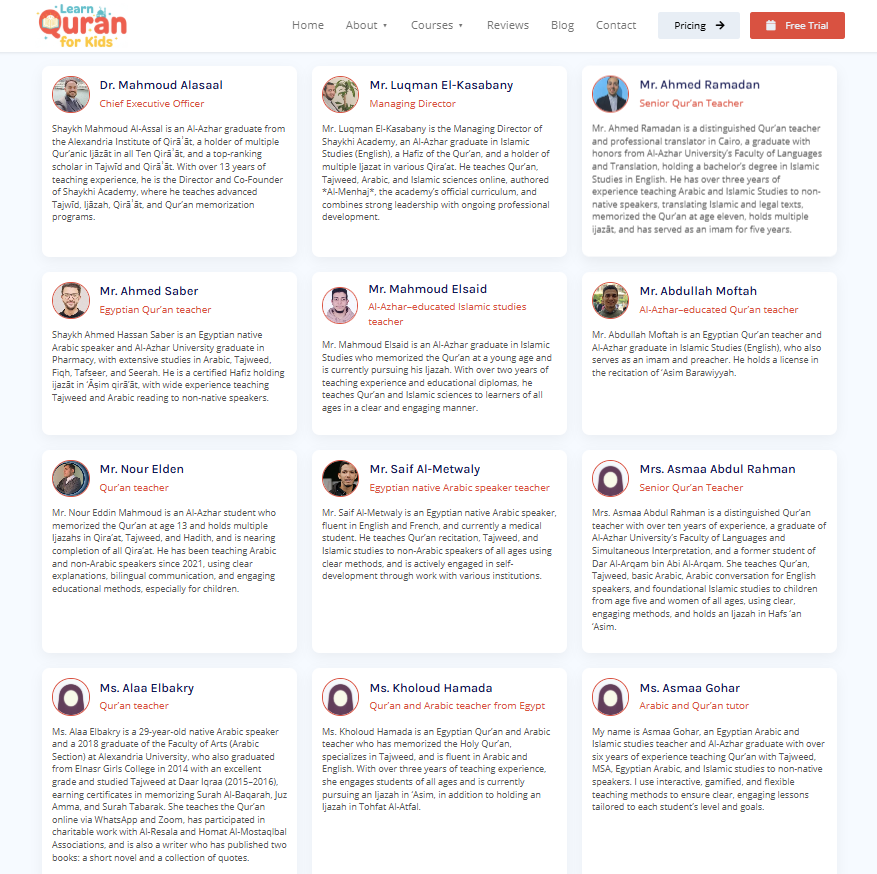
At Kids Learning Quran Academy, Ijazah-certified instructors working with younger students consistently observe that children who hear Quranic stories told expressively — with pacing, pauses, and emotional emphasis — retain the moral of the story far longer than children who receive it as a factual summary.
Book a FREE Trial session for your kid with one of our Ijazah-certified Quran teachers
6. Story of Prophet Moses and the bashful ladies of Midian
The story of Prophet Moses in Midian highlights the virtue of bashfulness in Muslim women and provides guidance for young people on how to interact with one another. This story is recounted in Surah Al-Qasas, verses 23-28:
When Moses arrived at the well of Midian, he found a group of people watering their herds. Apart from them, he noticed two women holding back their herd. He asked them,
“What is the matter?” They replied, “We cannot water our animals until the other shepherds are done, for our father is a very old man.”
Prophet Moses interacted with the women in a noble and chaste manner:
“So he watered their herd for them, then withdrew to the shade and prayed, ‘My Lord! I am truly in desperate need of whatever provision You may have in store for me.’”
Allah answered his supplication:
“Then one of the two women came to him, walking bashfully. She said, ‘My father is inviting you so he may reward you for watering our animals for us.’”
This verse beautifully illustrates the appropriate conduct of a Muslim woman in dealing with men, imparting a moral lesson to every young lady that chastity and bashfulness elevate her.
Finally, the father proposes,
“I wish to marry one of these two daughters of mine to you,” and the noble Moses accepts this marriage.
Read also: Quran Activities for Kids
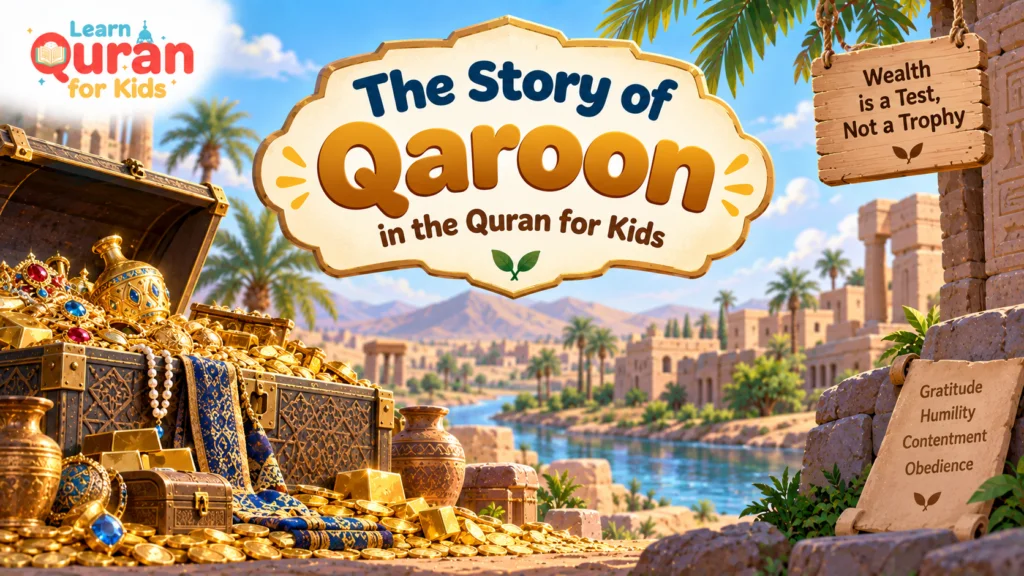
7. Story of the destruction of Korah the tyrant
The Quran narrates the detailed story of Korah’s destruction in Surah Al-Qasas, verses 76-82, with additional references to his name in three other surahs.
“Korah was from the people of Moses, but he behaved arrogantly towards them,”
flaunting his wealth and treasures. When advised to seek the reward of the Hereafter through what Allah had granted him, without neglecting his share of this world, Korah arrogantly responded,
“I have been granted all this because of the knowledge I possess, and Allah knows I deserve it.”
Ultimately, Allah punished Korah by causing
“the earth to swallow him up, along with his home. There was no one to help him against Allah.”
At that moment, the illusion of false glory disappeared.
“And those who had craved his position the previous day began to say, ‘Ah! It is certainly Allah Who gives abundant or limited provisions to whoever He wills of His servants. Had it not been for the grace of Allah, He could have surely caused the earth to swallow us up!’”
In our experience at Kids Learning Quran Academy, children who learn Quranic vocabulary through story context consistently recognize those words faster during recitation than children who study vocabulary in isolation. The emotional associations formed during storytelling create stronger memory anchors.
Enroll your child in Quranic Arabic Course for Kids with a free trial class

8. Story of Prophet Solomon and the ant
The Quran recounts the story of Prophet Solomon and his army encountering a valley of ants in Surah An-Naml (27:18-19). As the army approached, one ant warned the others,
“O ants! Enter your homes quickly, so Solomon and his armies do not crush you, unknowingly.”
Allah Almighty had blessed Solomon with the ability to understand the language of birds and ants, so he smiled in amusement at her words and prayed,
“My Lord! Inspire me to always be thankful for Your favors, which You have blessed me and my parents with.”
Through this story, Prophet Solomon demonstrates humility towards Allah’s favors, teaching us the importance of preserving Allah’s blessings by being grateful.
9. Story of trial and patience of Prophet Job (PBUH)
The trial of Prophet Job (Ayyub) is mentioned twice in the Quran, in Surah Al-Anbiya (21:83-84) and Surah Saad (38:41-44). Prophet Job stands as a noble example of patience through the loss of his health, wealth, and children. Despite his hardships, Job remains hopeful and continues to supplicate, crying out to Allah Almighty:
“I have been touched with adversity, and You are the Most Merciful of the merciful.”
Allah’s compensation for Job is equally profound:
“We answered his prayer, removed his adversity, and restored his family to him, along with twice as much.”
Finally, Allah provides a moral lesson, highlighting that Job’s compensation serves
“as a mercy from Us and a lesson for the ˹devoted˺ worshippers.”
10. Story of the miraculous speech of Jesus during infancy
The Quran narrates the story of Maryam (Mary) and the birth of Jesus, followed by the miracle of his speech as a newborn, in Surah Maryam— a Quranic chapter named after her—in verses 19:27-33. When the Jews accused the Virgin Mary of adultery upon seeing her carrying the baby Jesus (PBUH), Allah granted her a miracle as a defense:
“So she pointed to the baby. They exclaimed, ‘How can we talk to someone who is an infant in the cradle?’” Jesus then declared, “I am truly a servant of Allah.”
This story underscores the noble status of both Jesus and Mary in Islam, helping children understand the strengths of their faith, especially when living among Christians.
Our Students Reviews
Start Your Child’s Quran Learning Journey Today!
Join Kids Learning Quran Academy and help your child read the Quran with confidence through fun and guided lessons.
Book a Free Trial ClassEnroll Your Child at Kids Learning Quran Academy and Bring Quranic Stories to Life
Quranic stories are among the most powerful educational tools available to Muslim parents — but their full impact is realized when children connect those stories to the actual words of Allah through guided, age-appropriate instruction.
Kids Learning Quran Academy offers:
- Certified instructors specialized in teaching children ages 4–15
- 1-on-1 personalized sessions tailored to each child’s age and level
- Age-appropriate, story-integrated Quran and Tafseer for Kids programs
- Flexible scheduling designed for busy family routines
- Safe, monitored online learning environment
- Progress tracking shared with parents after every session
- A free trial session — so your child can experience the difference before you commit
Book your child’s free trial session today at Kids Learning Quran Academy and let qualified instructors turn Quranic stories into lifelong lessons.
Check out our top courses for children in Hifz Quran, Arabic language skills, and Islamic studies:
- Online Arabic Classes for Kids
- Noorani Qaida for Kids
- Tajweed for kids
- Quran Reading Course for Kids
- Quran Memorization Course for Kids
- Quran Tafseer for Kids
- Islamic Studies Courses for Kids
Book your child’s free trial session today.

Frequently Asked Questions About Quranic Stories for Kids
At What Age Should Children Start Learning Stories from the Quran?
Children can begin engaging with Quranic stories from as young as age 4 through simple oral storytelling. At this stage, short vivid stories like Surah Al-Fil work best. By age 7, children are ready for more emotionally complex narratives like the story of Musa ﷺ, with structured discussion and connection to actual Quranic verses.
Which Prophet’s Story Is Best to Teach First to Young Children?
The story of Prophet Ibrahim ﷺ or Prophet Yunus ﷺ are ideal starting points for children aged 5–8. Both stories are relatively short, contain clear and memorable events, and carry immediately understandable lessons — trust in Allah and the power of sincere repentance — that children can apply to their own lives quickly.
How Many Times Are Prophets’ Stories Mentioned in the Quran?
The story of Musa ﷺ is the most frequently referenced in the Quran, appearing across more than 30 Surahs. This repetition is deliberate — each mention highlights a different dimension of his story. For children, this can be taught as a feature: the same prophet teaches different lessons in different places in the Quran, making each encounter a new discovery.
Do Quranic Stories Help Children with Quran Memorization?
Yes, meaningfully. Children who understand the context and narrative behind a Surah memorize it faster and retain it longer. When a child knows that Surah Al-Fil describes real elephants and Allah’s miraculous birds, the verses carry vivid mental imagery that anchors memorization. Pairing story understanding with Tajweed rules for kids creates the strongest possible memorization foundation.
How Can Parents Tell Quranic Stories Without Inaccuracies?
Parents should rely on verified Islamic sources — books based directly on Tafseer literature rather than folk retellings. It is important to distinguish clearly between what the Quran states directly and what comes from supplementary narrations. When uncertain about a detail, framing it as “scholars have mentioned” rather than presenting it as Quranic fact protects both accuracy and a child’s trust.
Related Articles
Quran Stories