 Learn Islam
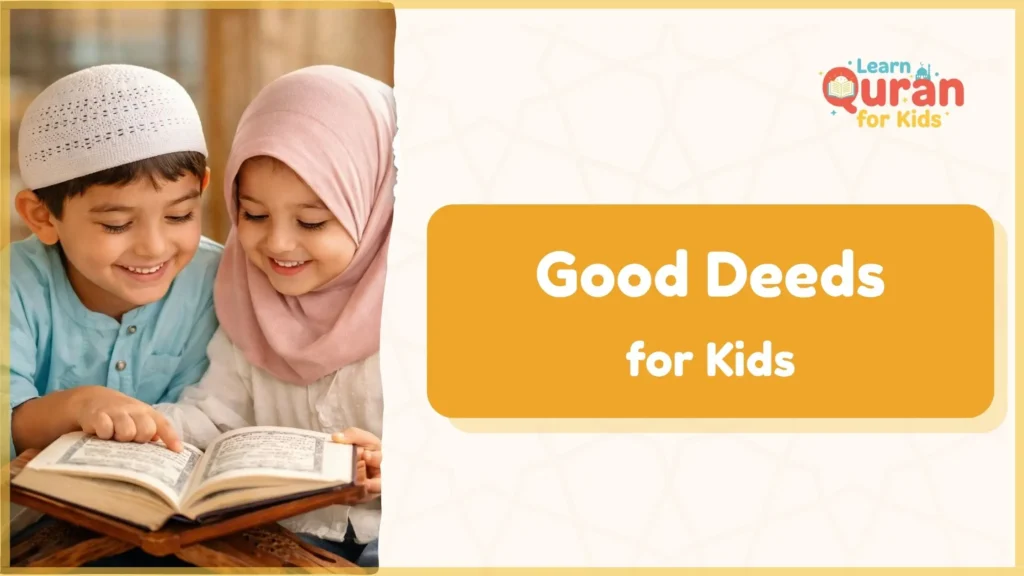
Instilling strong values in children begins with small daily actions that gradually shape their character and faith. When children learn that kindness, honesty, prayer, and gratitude are meaningful acts of worship, they begin to see everyday behavior as an opportunity to please Allah and grow spiritually.
Teaching good deeds for kids helps young Muslims understand that simple acts like praying, telling the truth, helping others, and remembering Allah carry great reward. These habits, practiced consistently, build a strong moral foundation that guides children throughout their lives.
1. Daily Salah
No good deed carries more consistent daily weight in a child’s Islamic formation than Salah. It is the first act of worship Allah will ask about on the Day of Judgment, and the habit formed in childhood determines the adult’s relationship with prayer for an entire lifetime.
The Prophet ﷺ said:
“مُرُوا أَوْلادَكُمْ بِالصَّلاةِ وَهُمْ أَبْنَاءُ سَبْعِ سِنِينَ، وَاضْرِبُوهُمْ عَلَيْهَا وَهُمْ أَبْنَاءُ عَشْرٍ، وَفَرِّقُوا بَيْنَهُمْ فِي الْمَضَاجِعِ”
Muroo awladakum bialssalati wahum abnao sabAAi sineena wadriboohum AAalayha wahum abnao AAashrin wafarriqoo baynahum fee almadajiAAi.
“Command your children to pray when they become seven years old, and beat them for it (prayer) when they become ten years old; and arrange their beds (to sleep) separately.”
Sunan Abi Dawud: 495
This instruction places Salah firmly at the center of a child’s Islamic upbringing, years before obligation arrives.
A child who grows up watching parents pray, joining them at the mosque, and owning their own prayer mat develops a felt sense of belonging to Salah that no external enforcement can replicate.
Salah is the pillar of Islam and one of the most important good deeds for kids because it builds a lifelong connection with worship and discipline.
Starting to teach a child about the importance of Salah from an early age, praying in front of them and encouraging them to join, builds the foundation of a praying Muslim from the earliest years.
– Praying Together as a Family Makes Salah a Joyful Shared Identity
Children who experience family prayer as a warm, consistent daily ritual associate Salah with belonging rather than obligation.
This emotional association is what sustains the prayer habit through adolescence, when social pressure and distraction reach their peak.
– Celebrating a Child’s First Complete Prayer Creates a Lasting Milestone Memory
Acknowledging the first time a child completes all five prayers independently, with a family gathering, a special meal, or a meaningful gift, gives the achievement a significance that the child carries forward. Milestones celebrated become milestones repeated.
– Teaching the Meaning Behind Each Prayer Position Deepens Genuine Engagement
A child who knows that Sujud is the closest position to Allah approaches prostration differently than one who sees it as a physical position to complete. Meaning transforms movement into worship, and worship into love.
2. Honesty in Every Situation Builds the Character Children Grow Up With
Truthfulness leads to righteousness, and righteousness leads to Paradise. Teaching honesty is one of the most essential good deeds for kids because it shapes their character and builds trust in every aspect of life.
This chain of consequence is one of the most important concepts in Islamic character education for children.
A child who grasps this chain understands that honesty is not just a rule but a pathway with a beautiful destination.
Children face honesty tests daily: admitting a mistake, telling an uncomfortable truth, resisting the temptation to exaggerate.
Each test is an opportunity to build or weaken the truthfulness habit, and parental response to these moments determines which direction the habit goes.
The Prophet ﷺ said:
“إِنَّ الصِّدْقَ يَهْدِي إِلَى الْبِرِّ، وَإِنَّ الْبِرَّ يَهْدِي إِلَى الْجَنَّةِ، وَإِنَّ الرَّجُلَ لَيَصْدُقُ حَتَّى يُكْتَبَ عِنْدَ اللَّهِ صِدِّيقًا”
Inna as-sidqa yahdee ilal-birri, wa innal-birra yahdee ilal-jannati, wa inna ar-rajula layasduqu hatta yuktaba AAindallahi siddeeqan.
“Truthfulness leads to righteousness, and righteousness leads to Paradise. And a man keeps on telling the truth until he becomes a truthful person.”
Sahih al-Bukhari: 6094
Encouraging children to speak the truth even when it is difficult, and praising them when they do, motivates them and builds the truthfulness habit consistently over time. Praise for honesty is more powerful than punishment for lying in building long-term truthful character.
Allah ﷻ commands the believers with precise clarity on the importance of truthful speech:
“يَا أَيُّهَا الَّذِينَ آمَنُوا اتَّقُوا اللَّهَ وَكُونُوا مَعَ الصَّادِقِينَ” {119}
Ya ayyuha allatheena amanoo ittaqoo Allaha wakoonoo maAAa alssadiqeena {119}
O you who have believed, fear Allah and be with those who are true. {119}
Surah At-Tawbah: 119
https://tanzil.net/#9:119Start Your Child’s Quran Learning Journey Today!
Join Kids Learning Quran Academy and help your child read the Quran with confidence through fun and guided lessons.
Book a Free Trial Class
3. Charity and Generosity
Charity is one of the best ways of helping the needy people of society. This deed is not only a source of getting blessings from Allah for children but will also get them rewards on the Day of Judgment.
Children who give from what they personally own develop a generosity that no parental instruction alone can produce. This is why charity is considered one of the most powerful good deeds for kids to practice from an early age.
The practical approach matters enormously here. Giving a child a small weekly allowance with a specific portion designated for charity gives them real ownership of the giving act.
A child who drops their own coins into a charity box has genuinely given Sadaqah, and that experience shapes character permanently.
The Prophet ﷺ said:
“اتَّقُوا النَّارَ وَلَوْ بِشِقِّ تَمْرَةٍ”
Ittaqoo al-nnara walaw bishiqqi tamratin.
“Save yourself from Hell-fire even by giving half a date-fruit in charity.”
Sahih al-Bukhari: 1417
This Hadith is particularly powerful for children because it demonstrates that the size of the gift is irrelevant.
Half a date, a small coin, a kind word: all of it counts. A child who understands this gives without the hesitation that comes from thinking their contribution is too small to matter.
| Age Group | Appropriate Charity Activity | Islamic Value Learned |
| 3 to 5 years | Helping pack food donation bags | Generosity and sharing |
| 6 to 8 years | Donating portion of Eid money | Personal ownership of giving |
| 9 to 11 years | Raising funds for a cause | Community responsibility |
| 12 to 14 years | Volunteering at charity events | Service and social awareness |
4. Respecting Parents is One of the Highest Values in Islam
Respect for parents holds a prominent position in Islam. Teaching children to treat their parents with kindness and obedience is vital, and sharing relevant stories and Hadiths can illustrate the importance of this virtue.
In the Quran, respect for parents is placed directly alongside the command to worship Allah alone, demonstrating its profound and non-negotiable status.
Allah ﷻ commands this respect with direct and unmistakable clarity:
“وَقَضَىٰ رَبُّكَ أَلَّا تَعْبُدُوا إِلَّا إِيَّاهُ وَبِالْوَالِدَيْنِ إِحْسَانًا”
Waqada rabbuka alla taAAbudoo illa iyyahu wabialwalidayni ihsanan.
“And your Lord has decreed that you not worship except Him, and to parents, good treatment.”
Surah Al-Isra: 23
Children who understand that kindness to parents is a divine command placed beside Tawhid itself approach their relationship with their parents with an entirely different level of intentionality.
This is not about obedience to a household rule. It is about fulfilling one of Allah’s most emphasized commands.
Practical expressions of respect that children can practice daily include responding without delay when called, speaking without raising the voice, greeting parents first upon entering the home, and asking before taking rather than assuming permission.
Read also: Can Kids Fast?
5. Reciting the Quran Daily
The Prophet Muhammad ﷺ said:
“مَنْ قَرَأَ حَرْفًا مِنْ كِتَابِ اللَّهِ فَلَهُ بِهِ حَسَنَةٌ، وَالْحَسَنَةُ بِعَشْرِ أَمْثَالِهَا”
Man qaraa harfan min kitabi Allahi falahu bihi hasanatun, walhasanatu biAAashri amthaliha.
“[Whoever recites a letter] from Allah’s Book, then he receives the reward from it, and the reward of ten the like of it.”
Jami` at-Tirmidhi: 2910
This Hadith gives every single letter of Quran recitation a specific, multiplied reward that makes even the shortest daily recitation enormously valuable.
A child who recites ten Ayahs correctly each day has earned hundreds of multiplied good deeds before breakfast.
Understanding this arithmetic of reward motivates children in a way that abstract discussions about the importance of the Quran never achieve.
Kids Learning Quran Academy’s Quran Recitation Course for Kids builds this daily recitation habit through structured one-on-one sessions with certified instructors, ensuring every letter earns its full reward through correct, Tajweed-accurate pronunciation from the very beginning.
Book a Free Trial Class for Your Child in the Best Quran Recitation Course for Kids
– Starting with Short Familiar Surahs Builds Recitation Confidence Immediately
Surah Al-Ikhlas, Surah Al-Kawthar, and Surah Al-Asr are short enough for even very young children to recite independently.
A child who can open the Quran and recite several Surahs alone experiences a sense of Quranic ownership that longer-term memorization goals alone cannot provide.
– Setting a Consistent Daily Recitation Time Removes the Decision Barrier
A child who recites Quran at the same time every day, after Fajr, before school, or before bed, removes the daily decision about whether to recite.
The habit slot does the work, and the child simply fills it. Consistency of timing is the single most reliable predictor of long-term recitation habits.
– Listening to Beautiful Recitation Between Sessions Trains the Ear Passively
Children who hear correct, melodious Quran recitation regularly develop an internal standard for how the Quran should sound.
This passive ear training makes their own recitation more accurate and more beautiful over time, complementing formal instruction in ways that study sessions alone cannot replicate.
6. Dhikr and Daily Remembrance
Remembering Allah through Dhikr brings peace to the heart and strengthens faith. Teaching children simple phrases like SubhanAllah, Alhamdulillah, and Allahu Akbar, and making it a habit for them to say Dhikr after Salah or when going to bed, explains how these words bring Barakah into their lives and protect them from harm.
The accessibility of Dhikr is one of its greatest gifts to children. No Wudu is required. No specific time or place is needed.
A child walking to school, eating breakfast, or falling asleep can be accumulating good deeds with every SubhanAllah, every Alhamdulillah, every Allahu Akbar.
The Prophet ﷺ said:
“كَلِمَتَانِ خَفِيفَتَانِ عَلَى اللِّسَانِ، ثَقِيلَتَانِ فِي الْمِيزَانِ، حَبِيبَتَانِ إِلَى الرَّحْمَنِ: سُبْحَانَ اللَّهِ وَبِحَمْدِهِ، سُبْحَانَ اللَّهِ الْعَظِيمِ”
Kalimatani khafeefatani AAala allisani, thaqeelatani fee almeezani, habeebatani ila alrrahmani: Subhana Allahi wabihamdihi, Subhana Allahi alAAatheem.
“(There are) two words which are dear to the Beneficent (Allah) and very light (easy) for the tongue (to say), but very heavy in weight in the balance. They are: ‘Subhan Allah wa-bi hamdihi’ and ‘Subhan Allah Al-`Azim’.”
Sahih al-Bukhari: 6682
Children who memorize this Hadith alongside the two phrases it mentions carry one of the most reward-dense acts of worship ever described. Light on the tongue, heavy on the scale: this description resonates immediately with young minds who grasp the contrast intuitively.
Start Your Child’s Quran Learning Journey Today!
Join Kids Learning Quran Academy and help your child read the Quran with confidence through fun and guided lessons.
Book a Free Trial Class7. Kindness to Family, Neighbors, and Friends
Teaching children about social responsibilities involves encouraging them to help others and care for the environment.
Explaining the importance of being helpful and kind to neighbors and community members, and involving children in community service activities such as volunteering at local events or helping those in need, helps children understand their role in contributing positively to society.
A kind word is also charity. It is also charity to utter a good word. This Hadith principle transforms every interaction a child has into a potential act of Sadaqah. A compliment given, an encouraging word offered, a greeting extended: all of these count.
The Prophet ﷺ said:
“لَا تَحْقِرَنَّ مِنَ الْمَعْرُوفِ شَيْئًا، وَلَوْ أَنْ تَلْقَى أَخَاكَ بِوَجْهٍ طَلْقٍ”
La tahqiranna mina al-maAAroofi shay-an, walaw an talqa akhaka bi-wajhin talqin.
“Do not underrate any good act, even if it is your meeting with your brother with a cheerful face.”
Sahih Muslim: 2626
A child who learns that smiling at a friend is a deed recorded in their favor approaches social interactions with a completely different awareness. Every smile becomes an intentional act of worship rather than an unconscious social reflex.
| Good Deed | Daily Opportunity | Hadith or Quranic Reference |
| Smiling at others | Every social interaction | Sahih Muslim 2626 |
| Speaking a kind word | Conversations daily | Sahih Bukhari 2989 |
| Greeting with Salam | Every encounter | Sahih Muslim 54 |
| Helping with chores | Every day at home | General Sunnah |
| Visiting the sick | Weekly family practice | Sahih Muslim 2162 |
| Removing harm from the path | Outdoors and school | Sahih Muslim 1009 |
Read also: Ramadan for Kids
8. Gratitude to Allah
Gratitude is one of the first good deeds to teach children. Islam teaches gratitude to Allah and to others. Teaching a child to say Alhamdulillah for every blessing, from food to toys, helps them recognize that everything comes from Allah.
Gratitude is not just an emotional state. In Islam it is an active practice with specific expressions, specific times, and specific rewards.
A child who says Alhamdulillah after eating, after waking, and after receiving any blessing is practicing a complete system of gratitude that the Quran repeatedly commands and rewards.
Allah ﷻ promises a remarkable response to genuine gratitude:
“لَئِن شَكَرْتُمْ لَأَزِيدَنَّكُمْ”
La-in shakartum laazeedannakum.
“If you are grateful, I will surely increase you [in favor].”
Surah Ibrahim: 7
This divine promise gives gratitude an immediate practical consequence that children can understand and anticipate.
A child who is grateful receives more. This is not a vague spiritual promise; it is a direct statement from Allah ﷻ that shapes a child’s entire orientation toward blessing and contentment.
Kids Learning Quran Academy’s Islamic Studies Courses for Kids weaves gratitude practice into every level of its curriculum, ensuring children develop Shukr as a lived daily habit through engaging one-on-one sessions with certified instructors who specialize in child-centered Islamic character education.
Book a Free Session for Your Child in the Best Islamic Studies Courses for Kids
9. Seeking Islamic Knowledge
A person who learns and teaches others ranks high in the sight of Allah. Seeking Islamic knowledge is among the major good deeds with significant weight and wide impact on individuals and communities.
The Prophet ﷺ said:
“طَلَبُ الْعِلْمِ فَرِيضَةٌ عَلَى كُلِّ مُسْلِمٍ”
Talabu al-AAilmi fareedatun AAala kulli muslimin.
“Seeking knowledge is a duty upon every Muslim.”
Sunan Ibn Majah: 224
Every Islamic lesson a child attends, every Surah they memorize, every Hadith they learn: all of it fulfills this obligation and accumulates reward.
A child who understands that attending their Quran class is fulfilling a direct Prophetic obligation approaches their studies with a completely different level of motivation and seriousness.
Kids Learning Quran Academy’s Quran Memorization for Kids, Tajweed for Kids, and Online Arabic Classes for Kids give children structured, certified pathways for fulfilling this obligation from an early age, with certified instructors who make Islamic knowledge acquisition genuinely enjoyable and age-appropriate.
Book a Free Trial for Your Child in the Best Hifz Course for Kids
– Reading Islamic Books and Stories Builds Knowledge Incrementally Through Narrative
A year-long approach pairing short Quran-inspired stories with simple good deed challenges, easy duas, and fun activity pages helps children learn faith through doing rather than passive instruction.
Knowledge absorbed through story is retained far longer than knowledge delivered through lecture.
– Asking Questions About Islam Deserves Celebration Not Discouragement
Children who ask “Why does Allah command this?” or “What does this Ayah mean?” are exhibiting the intellectual curiosity that Islamic scholarship has always celebrated.
A parent who answers these questions with patience and genuine engagement models the love of knowledge that the Islamic tradition holds in the highest regard.
10. Good Character in Every Interaction
Having good manners and character is a highly praised deed in Islam. Being patient, respectful, truthful, and forgiving are all ways a Muslim demonstrates good character. Islamic character education is not a separate subject from worship.
It is the lived expression of everything a child has learned about Allah, the Prophet ﷺ, and the Quran.
The Prophet ﷺ said:
“إِنَّ مِنْ خِيَارِكُمْ أَحْاسَنَكُمْ أَخْلَاقًا”
Inna min khiyarikum ahsanakum akhlaqan.
“The best among you are those who have the best manners and character.”
Sahih al-Bukhari: 6035
Good character encompasses honesty in speech, patience under frustration, forgiveness after being wronged, and kindness to every person regardless of their status or relationship to the child.
These qualities are not natural gifts some children are born with and others are not. They are learned, practiced, and gradually internalized through years of consistent guidance and modeling.
Islam teaches that good deeds must be accompanied by sincere intention. The value of any deed depends on the intention behind it, and Muslims are encouraged to perform deeds with a pure heart, seeking Allah’s pleasure alone.
| Character Quality | Islamic Source | Daily Practice Opportunity |
| Patience (Sabr) | Quran Al-Baqarah 2:153 | Waiting turns, accepting no |
| Honesty (Sidq) | Sahih Bukhari 6094 | Admitting mistakes immediately |
| Forgiveness (Afw) | Quran Al-Shura 42:40 | Sibling and peer conflicts |
| Humility (Tawadu) | Sahih Muslim 2588 | Winning and losing gracefully |
| Gratitude (Shukr) | Quran Ibrahim 14:7 | Thanking for every blessing |
| Kindness (Rahma) | Sahih Bukhari 6013 | Daily family interactions |
Our Students Reviews
Start Your Child’s Quran Learning Journey Today!
Join Kids Learning Quran Academy and help your child read the Quran with confidence through fun and guided lessons.
Book a Free Trial ClassGive Your Child a Structured Path to Good Deeds at Kids Learning Quran Academy
Every category of good deeds for kids in this guide reaches its full potential when supported by structured Islamic education from a certified instructor who understands how children learn, grow, and build lasting character.
Kids Learning Quran Academy offers:
- Certified instructors experienced in teaching non-Arabic speaking children at every level
- Courses covering every foundation: Islamic Studies Courses for Kids, Quran Memorization for Kids, Tajweed for Kids, Quran Recitation Course for Kids, and 5 Pillars of Islam for Kids
- One-on-one live sessions tailored to your child’s age, level, and learning style
- Safe, monitored online environment with fully verified instructors
- Flexible scheduling designed to fit your family’s daily routine
- Regular progress updates keeping parents fully informed at every stage
Check out our top courses for children in Hifz Quran, Arabic language skills, and Islamic studies:
- Online Arabic Classes for Kids
- Noorani Qaida for Kids
- Tajweed for kids
- Quran Reading Course for Kids
- Quran Memorization Course for Kids
- Quran Tafseer for Kids
- Islamic Studies Courses for Kids
Book your child’s free trial session today.
Conclusion
Children develop strong Islamic character when they consistently practice acts of worship and kindness in their daily lives. Prayer, honesty, charity, gratitude, and Quran recitation gradually shape a child’s understanding of responsibility and faith.
Introducing good deeds for kids through simple routines and positive encouragement helps children view good behavior as an important part of their identity. Over time, these small actions grow into lasting habits rooted in Islamic values.
When parents model good character and celebrate their child’s efforts, children naturally develop love for doing good. These early lessons nurture compassion, responsibility, and a lifelong commitment to living according to the teachings of Islam.
Related Articles
Learn Islam