 Quran Stories
The Luqman story in the Quran for kids carries a gentle but powerful lesson: true wisdom is a gift from Allah, and a loving father passes that wisdom on to his child through simple, caring advice.
This is one of the most tender stories in the whole Quran, because it is not about a battle or a miracleو it is about a father sitting with his son and teaching him how to live.
Before we begin, if your child loves stories like this one, our Online Quran Memorization Course for Kids helps young learners memorize the very verses of Surah Luqman with certified teachers, so these lessons stay with them for life.
Allah Blessed Luqman With Wisdom and Gratitude
Luqman lived as a humble, wise man long before he ever became known for the advice he gave his son. He was not born a prince, and he did not carry the title of prophet. He was, most simply, a servant who loved Allah.
حِكْمَةَ Hikmah “Wisdom” was never something to boast about. It shaped the way he spoke, the way he treated people, and the way he thanked Allah for even the smallest blessings in his life, long before anyone ever called him wise.
وَلَقَدْ آتَيْنَا لُقْمَانَ الْحِكْمَةَ أَنِ اشْكُرْ لِلَّهِ ۖ وَمَن يَشْكُرْ فَإِنَّمَا يَشْكُرُ لِنَفْسِهِ ۖ وَمَن كَفَرَ فَإِنَّ اللَّهَ غَنِيٌّ حَمِيدٌ
Wa laqad atayna Luqman al-hikmata anishkur lillah, wa man yashkur fa-innama yashkuru linafsih, wa man kafara fa-innallaha ghaniyyun hameed
“And We had certainly given Luqman wisdom [and said], ‘Be grateful to Allah.’ And whoever is grateful is grateful for [the benefit of] himself.” (Luqman 31:12)
Luqman thanked Allah every day for this gift. He did not keep his wisdom to himself, Alhamdulillah. He wanted to share it with someone he loved most, his own son.
Luqman Taught His Son to Worship Allah Alone
The Luqman story in the Quran for kids began with this very moment: Luqman sat his son down and, in a father’s gentle warning, spoke softly about the most important thing of all, Allah alone.
He did not raise his voice or scold his son. He spoke the way a loving parent speaks when every word truly matters, choosing his very first lesson with great care, before teaching anything else.
وَإِذْ قَالَ لُقْمَانُ لِابْنِهِ وَهُوَ يَعِظُهُ يَا بُنَيَّ لَا تُشْرِكْ بِاللَّهِ ۖ إِنَّ الشِّرْكَ لَظُلْمٌ عَظِيمٌ
Wa idh qala luqmanu libnihi wa huwa ya’izuhu, ya bunayya la tushrik billah, innash-shirka lazulmun ‘azeem
“O my son, do not associate [anything] with Allah. Indeed, association [with Him] is great injustice.” (Luqman 31:13)

This is why the story of Luqman in the Quran is so often the very first lesson parents share with their little ones. It teaches, in the simplest words, that Allah alone deserves our worship.
Children as young as five can understand this idea when it is explained simply: nothing and no one should ever be placed above Allah, not toys, not people, and not anything else in this world.
See Our Classes in Action!
Wondering what a typical lesson looks like? Take a peek inside our virtual classrooms below to see how our patient teachers keep students smiling, engaged, and learning every step of the way.
Start Your Child’s Quran Learning Journey Today!
Join Kids Learning Quran Academy and help your child read the Quran with confidence through fun and guided lessons.
Book a Free Trial ClassLuqman Taught His Son That Allah Sees Every Deed
Luqman reminded his son that every deed, however small, returned to Allah; nothing, not even the tiniest thing, could ever stay hidden from Him.
He wanted his son to feel this truth deeply, not just hear it once and forget it. Whether a good deed was done in secret or a small mistake happened where no one was watching, Luqman taught that Allah still knew.
Here is the tiny example Luqman used, so his son could picture it clearly:
يَا بُنَيَّ إِنَّهَا إِن تَكُ مِثْقَالَ حَبَّةٍ مِّنْ خَرْدَلٍ فَتَكُن فِي صَخْرَةٍ أَوْ فِي السَّمَاوَاتِ أَوْ فِي الْأَرْضِ يَأْتِ بِهَا اللَّهُ ۚ إِنَّ اللَّهَ لَطِيفٌ خَبِيرٌ
Ya bunayya, innaha in taku mithqala habbatin min khardalin fatakun fi sakhratin aw fis-samawati aw fil-ardi ya’ti bihallah, innallaha latifun khabeer
“O my son, indeed if wrong should be the weight of a mustard seed and should be within a rock or [anywhere] in the heavens or in the earth, Allah will bring it forth. Indeed, Allah is Subtle and Acquainted.” (Luqman 31:16)
A mustard seed is smaller than a grain of rice. Yet Luqman said even that could not hide from Allah. If your child ever asks why this matters, our Quran Tafseer for Kids classes explain the meaning behind verses like this one in a way young learners truly understand.
Book Your Free Trial for Quran Tafseer for Kids!
Luqman Taught His Son Prayer and Patience
Luqman told his son to pray, speak kindly, and stay patient, three things covered in one breath of gentle advice, touching on how he worshipped, how he treated others, and how he handled hard days.
None of these three came easily on their own. Luqman knew that prayer takes discipline, encouraging good takes courage, and patience takes real strength, which is exactly why he grouped them together as one determined effort.
يَا بُنَيَّ أَقِمِ الصَّلَاةَ وَأْمُرْ بِالْمَعْرُوفِ وَانْهَ عَنِ الْمُنكَرِ وَاصْبِرْ عَلَىٰ مَا أَصَابَكَ ۖ إِنَّ ذَٰلِكَ مِنْ عَزْمِ الْأُمُورِ
Ya bunayya aqimis-salata wa’mur bil-ma’rufi wanha ‘anil-munkari wasbir ‘ala ma asabak, inna dhalika min ‘azmil-umoor “
O my son, establish prayer, enjoin what is right, forbid what is wrong, and be patient over what befalls you. Indeed, [that] is of the matters [requiring] determination.” (Luqman 31:17)
Luqman Warned His Son Against Pride
Luqman warned his son against pride and boasting because he did not want his son to ever look down on someone else, no matter how great he became.
He knew that pride can quietly grow in anyone’s heart, even a good person’s, if it is never gently corrected. So Luqman addressed it directly and lovingly, long before it could take root.
وَلَا تُصَعِّرْ خَدَّكَ لِلنَّاسِ وَلَا تَمْشِ فِي الْأَرْضِ مَرَحًا ۖ إِنَّ اللَّهَ لَا يُحِبُّ كُلَّ مُخْتَالٍ فَخُورٍ
Wa la tusa”ir khaddaka linnasi wa la tamshi fil-ardi marahan, innallaha la yuhibbu kulla mukhtalin fakhoor
“And do not turn your cheek [in contempt] toward people and do not walk through the earth exultantly. Indeed, Allah does not like everyone self-deluded and boastful.” (Luqman 31:18)
A kind face and a humble walk, Luqman taught, matter more than any fine clothes. Children who hear this verse often remember it the next time they feel the urge to tease a friend or brag about something new.
Read Also: The Ashab e Kahf Story in Quran for Muslim Kids
Luqman Taught His Son to Walk and Speak Humbly
Luqman advised his son to walk gently and speak softly, so that his footsteps and his voice would never trouble the people around him.
It is a small, everyday habit, yet Luqman treated it as worthy of its own lesson, proof that his wisdom applied to ordinary moments, not only to big questions of faith.
وَاقْصِدْ فِي مَشْيِكَ وَاغْضُضْ مِن صَوْتِكَ ۚ إِنَّ أَنكَرَ الْأَصْوَاتِ لَصَوْتُ الْحَمِيرِ
Waqsid fi mashyika waghdud min sawtik, inna ankaral-aswati lasawtul-hameer
“And be moderate in your pace and lower your voice; indeed, the most disagreeable of sounds is the voice of donkeys.” (Luqman 31:19)
With this gentle, almost funny comparison, Luqman finished teaching his son how to walk through life: humbly, kindly, and with a soft voice.
Read Also: Animal Stories From the Quran for Kids
6 Pieces of Advice Luqman Gave His Son
Luqman gathered all his advice into one loving talk with his son, giving six pieces of guidance, one after another, so nothing important would ever be forgotten. Here they are gathered together, just as Luqman shared them:
| Luqman’s Advice to His Son | What It Means |
| Be grateful to Allah | Thank Allah for every gift, especially wisdom |
| Never associate anything with Allah | Worship Allah alone, with nothing beside Him |
| Know that Allah sees everything | Even a mustard seed’s weight of good or bad is never hidden |
| Establish prayer and stay patient | Speak to Allah daily and stay steady through hardship |
| Encourage right and forbid wrong | Support good and gently discourage bad |
| Walk humbly and spe4 Lessons Kids Can Learn From the Story of Luqman ak gently | Avoid pride, and keep a soft, kind voice |
Read together like this: Luqman’s advice reads almost like a short, complete guide for a happy, faithful life, which is exactly why parents still share it with their children today.
Read Also: Bird Stories in the Quran for Kids
4 Lessons Kids Can Learn From the Story of Luqman
This story is short, but every sentence holds something a child can carry for life. Here are the lessons Luqman left behind for his son, and for every child who hears his words today.
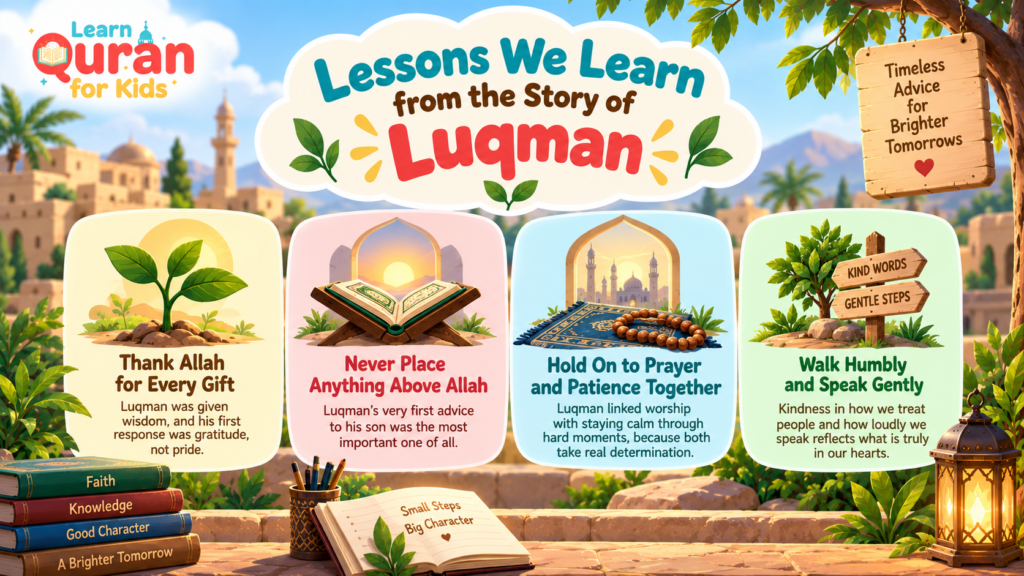
- Thank Allah for every gift: Luqman was given wisdom, and his first response was gratitude, not pride.
- Never place anything above Allah: Luqman’s very first advice to his son was the most important one of all.
- Hold on to prayer and patience together: Luqman linked worship with staying calm through hard moments, because both take real determination.
- Walk humbly and speak gently: Kindness in how we treat people and how loudly we speak reflects what is truly in our hearts.
Experience the Magic Firsthand
Watch these short clips from our live classes to see our interactive teaching tools, vibrant student-teacher interactions, and the fun, stress-free ways we make learning easy for kids!
Start Your Child’s Quran Learning Journey Today!
Join Kids Learning Quran Academy and help your child read the Quran with confidence through fun and guided lessons.
Book a Free Trial ClassHelp Your Child Discover More Quran Stories
The story of Luqman touches on prayer, patience, gratitude, and the deeper meaning behind some of the Quran’s most tender verses, themes that are best explored slowly, with guidance from a caring teacher.
Kids Learning Quran Academy designs lessons specifically for children, so verses like these become lifelong lessons rather than just words on a page.
Here is what our program offers:
- Certified tutors trained in child psychology and Quranic education
- 10+ years of experience teaching Muslim families across the UK, USA, Canada, and UAE
- Personalized learning plans tailored to your child’s age and pace
- Flexible, one-on-one live sessions that fit around school and family schedules
- Real-time progress reports so parents see growth after every lesson
- Interactive, gamified lessons that keep kids engaged and excited to learn
Our Courses Include:
- Tajweed Course for Kids
- Quran Memorization Course for Kids
- Quran Recitation Course for Kids
- Quran Classes for Toddlers
- Quran Tafseer Course for Kids
- Qaida Course for Kids
- Quran Reading Course for Kids
- Online Arabic Classes for Kids
- Quranic Arabic Course for Kids
- Islamic Studies Courses for Kids
- Islamic Studies Course for Kindergarten
- 5 Pillars of Islam Course for Kids
- Islamic Education Course for Kids
Book your free trial lesson today and help your child build a lasting, joyful connection with the Quran and its lessons.
Start a Free Trial With Kids Learning Quran Academy!

Conclusion
The Luqman story in the Quran for kids leaves behind a simple truth: real wisdom shows itself in gratitude, humility, and gentle words, not in wealth or status.
A father’s quiet advice to his son became a lesson preserved forever in the Quran, reminding every child that Allah sees every deed, however small.
Insha’Allah, every young reader who hears Luqman’s words grows up carrying the same gentle wisdom into their own life.
Frequently Asked Questions
Was Luqman a prophet?
Most scholars describe Luqman as a righteous, wise man rather than a prophet. The Quran honors him for the wisdom Allah gave him, not for prophethood.
Why did Luqman compare a bad voice to a donkey?
Luqman used this comparison so his son would clearly understand, simply and memorably, that a loud, harsh voice is unpleasant to hear.
What does the story of Luqman in the Quran teach children about honesty with Allah?
It teaches that nothing is ever hidden from Allah, not even something as tiny as a mustard seed, so children learn that good and bad actions both matter.
What lesson does this story teach about patience?
Luqman told his son that prayer, encouraging good, and patience through hardship all require real determination, teaching children that patience is an act of faith.
At what age can kids start learning stories like this one?
Many families begin sharing simple Prophet and Quran stories from around age five, gradually adding depth as the child grows older.
Related Articles
Quran Stories