Learn Quran
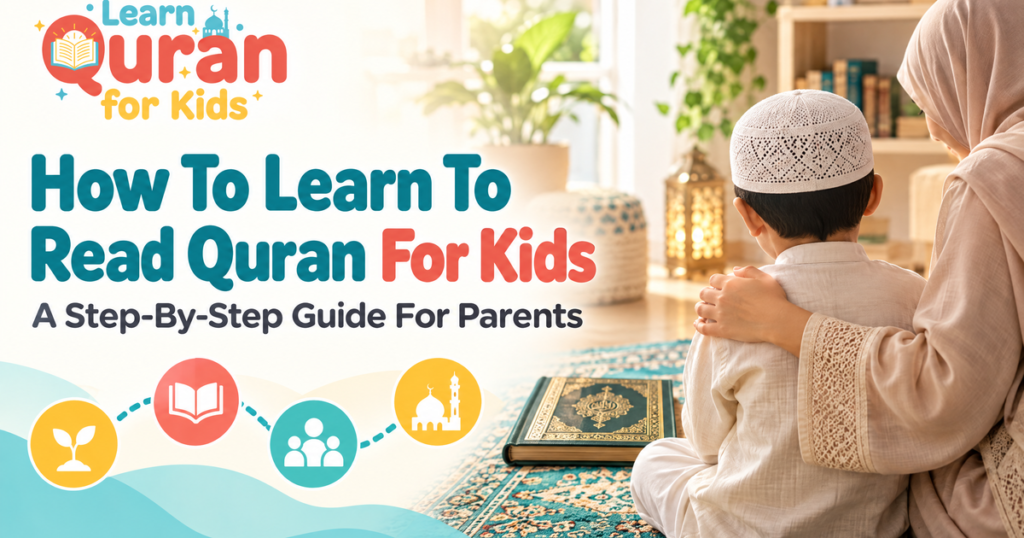
Every Muslim parent hopes to hear their child recite the words of Allah clearly and confidently. Learning to read Quran for kids can be a gentle and enjoyable journey when children progress step by step, without pressure or rushing.
This guide explains how children move from Arabic letters and vowel marks to reading simple words and short surahs with basic Tajweed, using established methods such as Talqeen, Noorani Qaida, and Juz’ ‘Amma.
It also offers practical guidance for parents who choose home learning, local Quran classes, or online lessons, helping children build accurate reading skills with patience and consistency.
1. Teach the Arabic Alphabet (Al-Huruf Al-Hija’iyyah)
The first step in learning to read Quran for kids is mastering the 28 Arabic letters, including their names, shapes, sounds, and correct Makharij. Children can gradually learn how letters change shape at the beginning, middle, and end of words while practicing their sounds.
Make this stage interactive with flashcards, puzzles, tracing sheets, and matching games. Pay special attention to similar sounds, such as ح and ه, ع and ء, ص and س, and ذ and ز. Let children listen to a skilled reciter and repeat each sound to develop accurate pronunciation.
A teacher who can listen and correct pronunciation immediately can make this foundation stronger. The Quran Reading Course for Kids at Kids Learning Quran Academy focuses on building these essential skills through personalized one-on-one lessons.
2. Practice the Vowel Marks – Harakat, Sukoon, Shaddah, and Tanween
Once the child knows the letters, the next step is learning the vowel marks, called Harakat. In Arabic, short vowels are written as small symbols above or below the letters, and they tell the reader how each letter should be pronounced.
The main Harakat are Fathah, Kasrah, and Dammah, and learning to recognize them helps children understand how letters change their sounds when they appear in different words. Without these vowel marks, a beginner may recognize the letters but still struggle to read Quranic words correctly.
For this reason, learning Harakat acts as an important bridge between recognizing the Arabic alphabet and beginning to read complete Quranic words with greater accuracy and confidence.
َ
| Mark | What It Does | Example |
|---|---|---|
| Fathah ( َ ) | Adds a short “a” sound | بَ (ba) |
| Kasrah ( ِ ) | Adds a short “i” sound | بِ (bi) |
| Dammah ( ُ ) | Adds a short “u” sound | بُ (bu) |
| Sukoon ( ْ ) | The letter has no vowel and stops | مِنْ (min) |
| Shaddah ( ّ ) | The letter is doubled | رَبِّ (rabbi) |
| Tanween ( ً ٍ ٌ ) | Adds an “n” sound at the end | بًا، بٍ، بٌ (ban, bin, bun) |
| Madd letters (ا و ي) | Lengthen the vowel, usually for two counts | بَا، بُو، بِي (baa, buu, bii) |
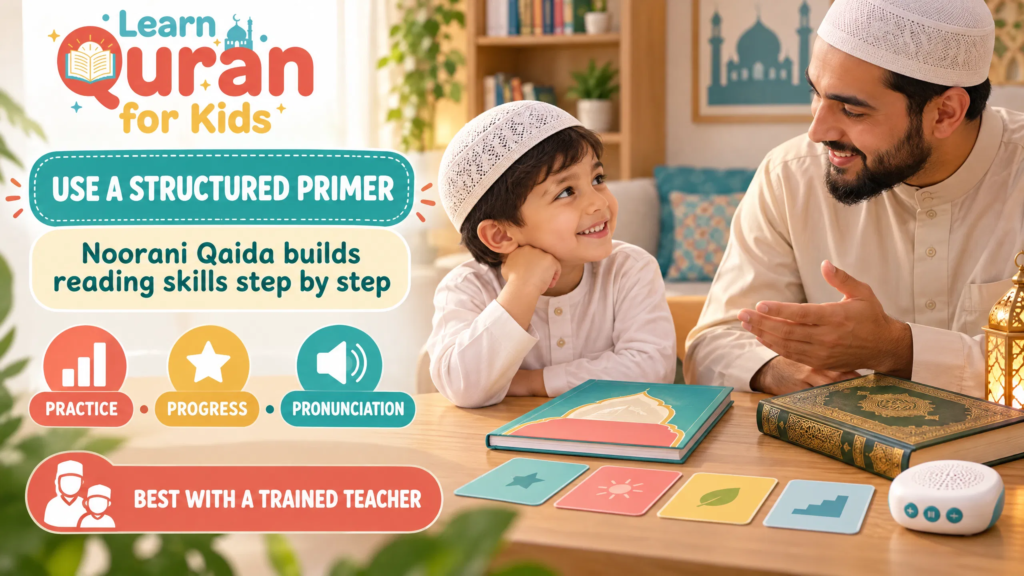
3. Use a Structured Primer Such as the Noorani Qaida
A structured primer gives Quran reading lessons a clear order and saves parents from guessing what to teach next. One of the most widely used primers in the English-speaking world is Al-Qa’idah An-Nuraniyyah, known as the Noorani Qaida, which moves from single letters to joined letters, vowel marks, and finally Quranic words and phrases. In many Arab countries, a similar primer called Al-Juz’ Al-Rashidi serves the same purpose.
The strength of a good primer is that every lesson builds on the one before it, and many practice lines are drawn from or modeled on Quranic words. Most modern editions include colors, illustrations, and audio that make lessons attractive to children.
Parents can use these books at home, but the best results usually come when a trained teacher guides the child through each page and corrects pronunciation along the way.
4. Learn Through Listening and Repetition (Talqeen)
Talqeen is the traditional method in which the teacher recites a word or verse slowly and clearly, and the child repeats it immediately afterward. This is how the Quran has been passed down for centuries, from teacher to student, and it remains the most reliable way to build correct pronunciation, because the child hears the right sound before trying to produce it.
In practice, read a short phrase aloud, ask the child to repeat it, correct gently if needed, and repeat the cycle several times until the pronunciation is steady. Then add the next phrase.
Alongside lessons, let your child listen regularly to a well-known reciter with clear, measured recitation. Hearing the same surahs every day trains the ear and makes correct reading feel natural.
Start Your Child’s Quran Learning Journey Today!
Join Kids Learning Quran Academy and help your child read the Quran with confidence through fun and guided lessons.
Book a Free Trial Class5. Start Reading Short Surahs From Juz’ ‘Amma
When the child can read simple words, it is time to move to real Quranic verses. Most teachers begin with the short surahs of Juz’ ‘Amma, the thirtieth and final part of the Quran, often starting from Surah An-Nas and moving backward, or reading from Surah Ad-Duha to Surah An-Nas. These surahs have short verses and familiar sounds, which give the child a quick and motivating sense of achievement.
Reading and memorizing naturally overlap at this stage, because children who repeat a short surah many times often learn it by heart.
Some teachers complete Juz’ ‘Amma and Juz’ Tabarak before moving to Surah Al-Fatihah and Surah Al-Baqarah, while others move to the beginning of the Mushaf directly. Both approaches are common, and children with a strong memory can build on this stage in the Quran Memorization Course for Kids.

6. Introduce Basic Tajweed Rules Gradually
Tajweed is the set of rules that governs how the Quran is pronounced, including how letters are articulated, when sounds are lengthened, and how certain letters merge or are hidden.
For young children, Tajweed should be taught gently and practically, through examples from surahs they already read, rather than through long theoretical explanations they cannot yet follow.
Good starting points include the natural madd (lengthening a vowel for two counts), ghunnah (the nasal sound on a doubled noon or meem), and simple rules of noon saakinah and tanween such as idgham (merging) and ikhfa (hiding the sound).
Point these rules out as they appear in familiar verses, then add more as the child reads longer surahs. The Tajweed Course for Kids introduces these rules in a child-friendly, practical way.

7. Connect Verses With Simple Meanings and Quran Stories
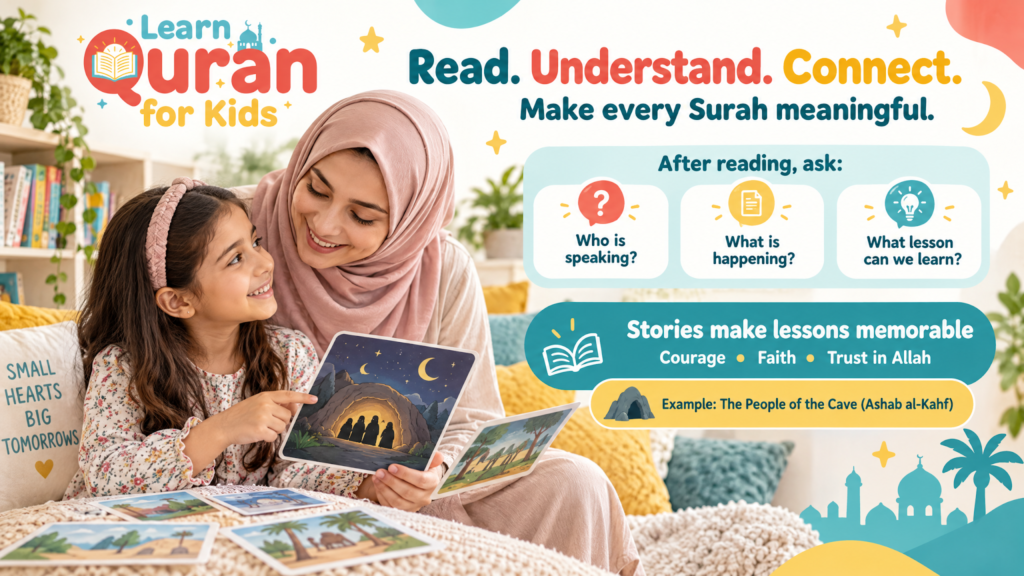
Children often develop a stronger connection with the Quran when they understand what they are reading. After a child reads a Surah correctly, explain its meaning in simple, age-appropriate language: who is speaking, what is being described, and what lesson the verses teach.
These short explanations can transform reading from simply producing sounds into understanding meaning and help children build a deeper connection with the words of Allah.
Quran stories can be especially engaging for young learners. For example, the story of the People of the Cave (Ashab al-Kahf) introduces children to themes such as courage, faith, and trust in Allah. When a child recognizes a story in the verses they are reading, the lesson can become more personal, memorable, and meaningful.
8. Build a Daily Routine With Organized Revision
Consistency matters more than long sessions when kids learn to read the Quran. Fifteen to twenty minutes of focused practice every day is far more effective for a young child than one long lesson a week.
Choose a fixed time when the child is fresh, such as after Fajr, after an afternoon snack, or before bed, and protect it so the routine becomes a natural part of family life.
Repetition also needs to be organized so it does not become boring. A practical pattern is to read a new verse several times on the first day, read it again the next day, and after a few days review it together w ith earlier verses.
Begin every session with a quick review of previous material before moving on to anything new, because regular revision is what turns new learning into lasting skill.
See Our Classes in Action!
Learning to read the Quran is a beautiful journey that helps children connect with the words of Allah and build confidence in their recitation.
Start Your Child’s Quran Learning Journey Today!
Join Kids Learning Quran Academy and help your child read the Quran with confidence through fun and guided lessons.
Book a Free Trial Class9. Make Learning Fun With Encouragement and Rewards
A child’s love for the Quran cannot be forced; it is built through positive experiences. Praise every bit of progress, avoid harsh criticism when mistakes happen, and celebrate milestones such as finishing a lesson in the primer or reading a full surah correctly.
Small rewards, like a sticker chart, a special outing, or a favorite treat, give children clear and exciting goals to work toward. Variety keeps motivation high as well. Mix reading practice with games, interactive apps, and stories.
For example, animal stories from the Quran for kids capture children’s imagination and make reading sessions something to look forward to. When the child is ready, taking part in children’s Quran competitions can also boost enthusiasm and connect them with other young learners.
A Tafseer Course for Kids can also make Quran learning more meaningful by helping children understand the verses in a simple, age-appropriate way.
10. Be Patient and Learn With a Qualified Teacher
Learning to read the Quran takes time, especially for children who do not speak Arabic at home. Some days a verse will not stick, and then, after a day or two of review, the child suddenly reads it with ease.
Avoid showing frustration, allow breaks for play and movement when the child is tired, and trust that steady effort brings results. Allah has made the Quran easy for those who turn to it:
وَلَقَدْ يَسَّرْنَا ٱلْقُرْءَانَ لِلذِّكْرِ فَهَلْ مِن مُّدَّكِرٍ
“And We have certainly made the Qur’an easy for remembrance, so is there any who will remember?”Surah Al-Qamar (54:17)
While parents play a vital role, a qualified Quran teacher adds what most parents cannot: trained ears that catch subtle pronunciation errors, a structured curriculum, and Tajweed expertise. Online one-on-one classes make this possible from home, letting children learn with a dedicated teacher at a convenient time while parents stay close to their progress.
Practical Tips for Parents Supporting a Child Learning to Read the Quran
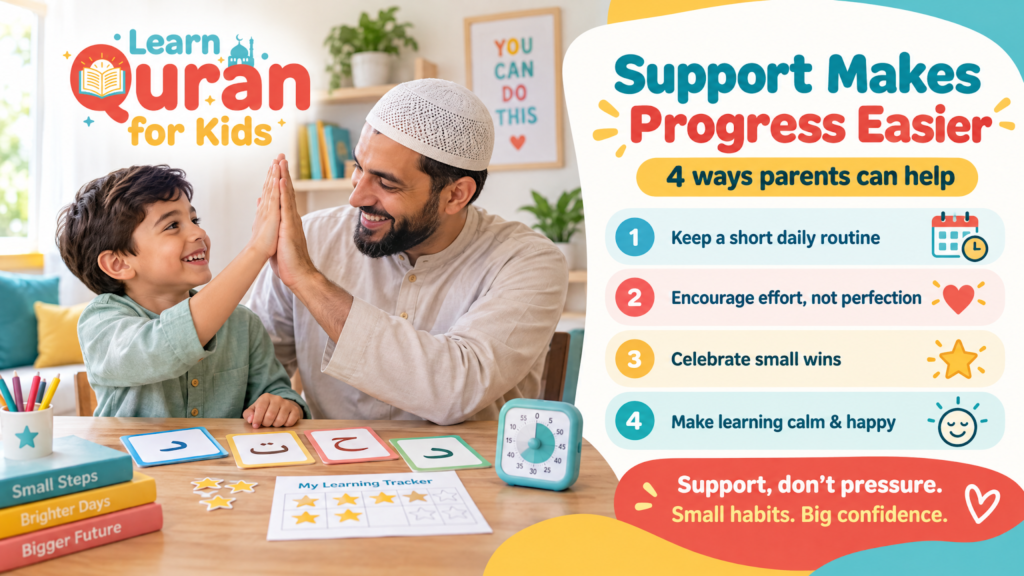
Even with an excellent teacher, the family remains a child’s main source of motivation when learning to read the Quran. Parents can reinforce what the child learns during lessons by creating a supportive routine at home, offering encouragement, and celebrating small improvements.
These simple habits can make a real difference in how quickly, confidently, and happily a child progresses. When children feel supported rather than pressured, they are more likely to stay engaged and develop a positive, lasting relationship with Quran learning.
1. Be a Role Model at Home
Children learn more from what they see every day than from instructions alone. When your child regularly sees you reading the Quran, they begin to understand that it is a valued and natural part of family life. Parents can also model patience, consistency, and respect for the Quran through their own daily habits.
The Quran presents Luqman gently advising his son with wisdom and love, offering a beautiful example of caring guidance that parents can reflect in their own approach. You can share the story of Luqman in the Quran with your child and use it as an opportunity to talk about good character and family guidance.
2. Listen to Your Child Recite Every Day
Set aside a few minutes each day to listen to your child read, even if they already study with a teacher. Ask them to recite a few lines from their lesson and encourage them to repeat difficult words without making them feel embarrassed about mistakes.
You can also invite them to recite in front of grandparents or siblings when they feel comfortable and celebrate each achievement, however small. This regular attention shows children that their efforts matter, while also helping parents stay aware of their progress and notice areas where they may need extra support.
3. Create a Calm, Pressure-Free Learning Space
A quiet, comfortable place with good lighting, a clear large-print Mushaf, and no distracting screens nearby can help children focus on Quran reading. Try to keep Quran time calm and positive, rather than turning every mistake into a source of pressure.
Keeping the experience positive can help children associate Quran learning with comfort, encouragement, and a sense of achievement. Parents can also make lessons more engaging by using simple Quran-related stories, such as the Quran creation story for kids, to connect reading practice with meaningful ideas.
Start Your Child’s Quran Learning Journey Today!
Join Kids Learning Quran Academy and help your child read the Quran with confidence through fun and guided lessons.
Book a Free Trial ClassHelp Your Child Learn to Read the Quran With Kids Learning Quran Academy
At Kids Learning Quran Academy, children learn to read the Quran step by step through fun, guided online lessons with dedicated teachers. The learning path follows the same proven order described in this guide, from the Arabic alphabet and the Noorani Qaida to fluent recitation with Tajweed, adapted to each child’s age, pace, and personality.
If you want your child to read the Quran correctly and confidently, now is a great time to begin. Book a free trial class and see how your child grows when lessons are structured, encouraging, and enjoyable.
Our Courses Include:
- Tajweed Course for Kids
- Quran Memorization Course for Kids
- Quran Recitation Course for Kids
- Quran Classes for Toddlers
- Quran Tafseer Course for Kids
- Qaida Course for Kids
- Quran Reading Course for Kids
- Online Arabic Classes for Kids
- Quranic Arabic Course for Kids
- Islamic Studies Courses for Kids
- Islamic Studies Course for Kindergarten
- 5 Pillars of Islam Course for Kids
- Islamic Education Course for Kids

Conclusion
Learning how to learn to read Quran for kids follows a clear, gradual sequence: master the Arabic letters, practise the vowel marks, follow a structured primer such as Noorani Qaida, and learn through listening, repetition, and correction. Once children build a basic reading foundation, they can begin with the short Surahs of Juz’ Amma and gradually add Tajweed as their skills improve.
Connecting verses with simple meanings and Quranic stories, maintaining a daily routine, and celebrating progress can turn Quran reading into a positive and enjoyable habit. Above all, parents should remain patient and keep their intention sincere.
The Prophet ﷺ taught that the best people are those who learn the Quran and teach it, and that those who struggle with recitation receive a double reward.
With steady practice, loving encouragement, and the right guidance, children can gradually learn to read the Quran with greater accuracy, confidence, and love. May Allah make the Quran easy for every child and bless every family on this journey.
Frequently Asked Questions About Kids Learning to Read the Quran
At what age should a child start learning to read the Quran?
There is no fixed age in the Quran or Sunnah for starting. Many teachers find children are ready for structured letter lessons around ages four to five, while some start at three. Younger children can benefit simply from listening to recitation at home.
How long does it take a child to learn to read the Quran?
It depends on the child’s age, practice time, and teaching method. With short daily practice, many children finish a beginner primer like the Noorani Qaida within several months, while fluent reading of the full Mushaf usually takes longer.
Can I teach my child to read the Quran if I am not fluent in Arabic?
Yes, parents can support their child by practicing letters, listening daily, and encouraging routine. However, a qualified Quran teacher is strongly recommended for correct pronunciation and Tajweed, since many letter sounds are hard to judge without training.
What is the Noorani Qaida?
The Noorani Qaida (Al-Qa’idah An-Nuraniyyah) is a beginner primer that teaches Arabic letters, joined letters, vowel marks, and Quranic words in a step-by-step order. It is one of the most popular starting books for children learning to read the Quran.
Should kids learn Tajweed from the beginning?
Kids should learn correct letter pronunciation from the very first lesson, which is the foundation of Tajweed. Named Tajweed rules, such as madd and ghunnah, are best introduced gradually through verses the child already reads.
Should kids learn to read the Quran or memorize it first?
Most teachers build reading foundations first, because accurate reading leads to accurate memorization. In practice, the two overlap: children often memorize the short surahs of Juz’ ‘Amma while learning to read them.