 Learn Islam
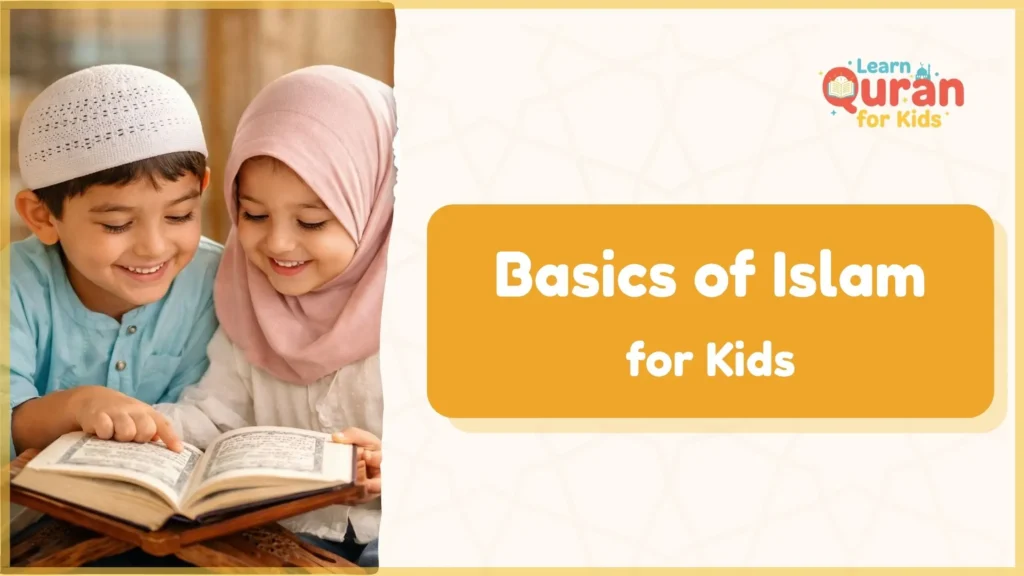
Building a child’s Islamic identity begins with small, meaningful lessons that shape how they see the world and their relationship with Allah. Faith becomes real for children through daily practices, stories, and values that gradually nurture belief, character, and spiritual awareness.
The basics of Islam for kids include understanding Tawhid, learning the Five Pillars and core beliefs, becoming familiar with the life of the Prophet ﷺ, connecting with the Quran, practicing daily duas, and developing strong Islamic character through kindness, honesty, and respect.
Tawhid Is the Most Essential Basic of Islam for Kids to Understand First
The first thing you should teach your children is that there is only one God.
Tawhid, the belief in Allah’s absolute oneness, is the foundation upon which every other Islamic teaching rests without exception.
Children understand Tawhid most naturally through observation of the world around them.
When a parent points to the sky, the trees, and the rain and explains that Allah created all of this, the concept of the Creator becomes immediate and real rather than abstract.
Introduce children to the 99 Names of Allah, emphasizing His Divine Mercy, Compassion, and Greatness through stories from the Quran and Hadith.
Children who know Allah as Al-Rahman and Al-Raheem develop a relationship with Allah built on love rather than fear, and that love becomes the engine of their entire Islamic identity.
Allah ﷻ states with absolute clarity the foundational truth every child deserves to know:
قُلْ هُوَ اللَّهُ أَحَدٌ {1}
Qul huwa Allahu ahad {1}
Say, “He is Allah, [who is] One, {1}
Surah Al-Ikhlas: 1
Beginning a child’s Islamic education with this Surah connects Tawhid directly to daily Salah from the very first lesson, making theology immediately practical and personally meaningful for young learners.
– Teaching Tawhid Through Nature Makes the Concept Tangible for Them
Young children think concretely, not abstractly. Discussions about mountains, rain, animals, and the human body as evidence of Allah’s creation are far more effective than theological explanations for children under 8.
– The Shahada Gives Children a Personal Declaration They Can Own and Understand
The Shahada is “La ilaha illallah, Muhammadur rasulullah.” In the first part, Muslims declare that there is no god but Allah, emphasizing the belief in the oneness of Allah.
In the second part, Muslims affirm that Muhammad is the Messenger of Allah.
Teaching children to understand what they are saying, not just memorize the words, gives the Shahada its full spiritual weight.
– Connecting Tawhid to Daily Gratitude Builds a Living and Breathing Faith
Children who are taught to say Alhamdulillah for food, for health, and for family are practicing Tawhid in its most practical form.
Gratitude is the daily lived expression of believing that every blessing comes from Allah alone.
Kids Learning Quran Academy’s Islamic Studies Courses for Kids introduces Tawhid through age-appropriate stories, activities, and discussions that make Allah’s oneness genuinely understood rather than merely memorized by young learners.
Book a Free Session for Your Child in the Best Islamic Studies Courses for Kids
The Five Pillars Represent the Core basics of Islam for Kids to Practice
There are many important things kids should know about Islam. They should learn about the basic concept and origin of Islam, why the Shahada is important as the first pillar, and the other pillars of Islam such as praying and giving to charity.
The Five Pillars give children a clear, structured framework for what being Muslim actually looks like in daily life.
Each Pillar introduced at the right age and in the right way becomes a natural part of a child’s identity rather than an external obligation.
The goal is not compliance, it is genuine belonging and willing practice from the heart.
– Salah Is the Pillar Children Should Begin Learning
Teaching children the significance of performing Salah, its steps, and the conditions for prayer instills discipline and spiritual awareness, and emphasizing the importance of Wudu reinforces the concept of purity in both body and soul.
Children who grow up watching their parents pray develop a felt sense of Salah’s importance long before they perform it themselves.
This approach is also supported by the guidance of the Prophet ﷺ, who instructed parents to begin teaching their children to pray at the age of seven and to discipline them if they neglect it by the age of ten.
Prophet ﷺ said:
“مُرُوا أَوْلادَكُمْ بِالصَّلاةِ وَهُمْ أَبْنَاءُ سَبْعِ سِنِينَ، وَاضْرِبُوهُمْ عَلَيْهَا وَهُمْ أَبْنَاءُ عَشْرٍ”
“Command your children to pray when they become seven years old, and beat them for it (prayer) when they become ten years old.”
Sunan Abi Dawud: 495
– Zakat Teaches Children That Generosity Is Worship and a Core Islamic Responsibility
Even young children can participate in Zakat through simple acts: setting aside a portion of Eid money for charity, helping parents sort items to donate, and understanding that helping others is not mere generosity but an act of worship with real spiritual weight.
– Sawm Builds Self-Control and Empathy in Children Long Before Obligation Arrives
Introducing children to the concept of fasting, its spiritual benefits, and the practice of abstaining during Ramadan helps them develop self-control, empathy for the less fortunate, and gratitude for blessings.
Partial fasts and full Ramadan participation prepare children for this Pillar years before it becomes obligatory.
– Hajj Introduces Children to the Global Unity of the Muslim Ummah
Teaching children about Hajj helps them understand one of the greatest symbols of unity in Islam.
Even if they are not yet able to perform the pilgrimage themselves, learning about the rituals of Hajj, the journey to Makkah, and the gathering of millions of Muslims from different cultures and backgrounds strengthens their sense of belonging to the global Muslim Ummah.
Explaining the story of Prophet Ibrahim (AS), the significance of the Kaaba, and the values of sacrifice, patience, and devotion allows children to appreciate the spiritual meaning of Hajj and prepares them for the day they may perform this sacred journey themselves.
Shots Videos from Our Courses
Start Your Child’s Quran Learning Journey Today!
Join Kids Learning Quran Academy and help your child read the Quran with confidence through fun and guided lessons.
Book a Free Trial ClassThe Six Pillars of Faith Build the basic knowledge of Islam for kids
Islam’s belief system extends beyond practice into a comprehensive worldview that shapes how a Muslim child understands existence, purpose, and their place in the universe.
Teaching children about faith involves introducing them to the core beliefs of Islam in a simple and engaging manner: belief in Allah, in angels as Allah’s special slaves who carry out His commands, in the prophets, in the Quran as Allah’s revealed message, a basic understanding of the Day of Judgment, and Belief in divine decree (Qadar), both its good and its bad.
These six articles give children the theological framework to understand why Muslims do what they do.
Practice without belief produces ritual. Belief without understanding produces confusion. Together, they build genuine, owned faith.
Kids Learning Quran Academy’s 5 Pillars of Islam for Kids course covers both practice and belief in age-appropriate formats, helping children understand not just what Muslims do but why, making their faith personally owned rather than inherited by default.
Read also: Prophets in Islam for Kids
Learning the Seerah Gives Children a Living Human Model of Every Islamic Value
No element of basic knowledge of Islam for kids is more practically powerful than the Prophet’s life story.
The Prophet ﷺ is not merely a historical figure to be studied, he is a living model to be followed, and children respond to his story with remarkable openness and love.
Teach about Prophet Muhammad ﷺ by sharing the Prophet’s life stories that highlight his kindness, honesty, and compassion.
Children who know that the Prophet ﷺ helped with housework, loved cats, and was gentle with children see Islamic values as accessible and human rather than impossibly demanding.
The Prophet ﷺ said:
“خَيْرُكُمْ خَيْرُكُمْ لِأَهْلِهِ وَأَنَا خَيْرُكُمْ لِأَهْلِي”
“The best of you is the one who is best to his family, and I am the best of you to my family.”
Sunan Ibn Majah: 1977
A child who knows this Hadith and connects it to how the Prophet ﷺ treated his own family has received a complete lesson in Islamic character, family values, and prophetic example in a single teaching, Masha’Allah.
– Seerah Stories Teach Courage, Patience, and Integrity Through Narrative Children Remember
Children absorb values most effectively through story. The Prophet’s patience at Taif, his forgiveness at the conquest of Makkah, and his kindness to those who wronged him are character education lessons that no worksheet or lecture can replicate.
– Knowing the Prophet ﷺ Personally Prevents Children from Seeing Islam as a Rulebook
Children who love the Prophet ﷺ follow his Sunnah willingly and with joy. Children who see Islam as a list of rules follow it reluctantly and without connection. The Seerah is the most powerful tool for building a child’s intrinsic motivation to live Islamically.
– Age-Appropriate Seerah Resources Make the Prophet’s Story Accessible at Every Stage
Picture books for ages 4 to 7, illustrated chapter books for ages 8 to 11, and full Seerah texts for ages 12 and above make the Prophet’s story genuinely accessible. Matching the resource to the child’s developmental level is essential for real engagement and retention.
The Quran Sits at the Heart of All Basics of Islam for Kids as Allah’s Direct Living Word
The Quran has everything children need to learn about their religion, so reading and explaining the Quran to them from a young age will teach them everything they need to learn about their religion and will help them grow to be well-rounded people.
A child’s relationship with the Quran is not just an educational matter. It is a spiritual relationship with Allah’s direct speech that shapes identity, character, and worldview across an entire lifetime.
Building this relationship early, and building it correctly, is one of the most important responsibilities Muslim parents carry.
The Prophet ﷺ said:
“خَيْرُكُمْ مَنْ تَعَلَّمَ الْقُرْآنَ وَعَلَّمَهُ”.
“The best among you are those who learn the Qur’an and teach it.”
Sahih al-Bukhari: 5027
Kids Learning Quran Academy’s Quran Recitation Course for Kids and Quran Tafseer Course for Kids give children both the recitation skills and the meaning comprehension they need to build a genuine, lasting relationship with the Quran, taught by certified instructors who specialize in child-centered Quranic education.
Book a Free Trial Class for Your Child in the Best Quran Recitation Course for Kids
Daily Duas and Islamic Etiquette Bring the basic knowledge of Islam for Kids into Every Moment
Teaching children simple daily Duas and Azkar can help them incorporate these prayers into their routines.
Examples include Duas for waking up, before eating, and before sleeping, enhancing their spiritual connection throughout the day.
These daily practices are where the basics of Islam for kids move from knowledge into lived identity.
A child who says Bismillah before eating, Alhamdulillah after finishing, and Astaghfirullah when they make a mistake is practicing Islam continuously throughout every ordinary day.
Teaching children to say Bismillah before meals and Alhamdulillah afterward promotes good manners and gratitude. These small consistent practices accumulate into a deeply rooted Islamic character over months and years of gentle reinforcement.
Our Students Reviews
Start Your Child’s Quran Learning Journey Today!
Join Kids Learning Quran Academy and help your child read the Quran with confidence through fun and guided lessons.
Book a Free Trial ClassIslamic Morals and Character Complete Every Child’s Foundation in Islamic Knowledge
The basics of Islam for kids are incomplete without the character teachings that bring all other knowledge to life.
Islam is not only a set of rituals and beliefs, it is a complete code of conduct that governs how Muslims treat every person and creature they encounter.
The essence of our faith is having good character, teaching our children empathy and compassion, teaching them to be well-mannered and emotionally aware.
A child who prays five times but treats siblings unkindly has not yet received a complete Islamic education.
Allah ﷻ describes the character of the true believer throughout the Quran:
إِنَّ اللَّهَ يَأْمُرُ بِالْعَدْلِ وَالْإِحْسَانِ
Inna Allaha ya-muru bialAAadli waal-ihsani
Indeed, Allah orders justice and good conduct.
Surah An-Nahl: 90
Teaching children that justice and kindness are direct commands from Allah gives Islamic character its full divine authority and makes good behavior genuinely meaningful rather than just socially expected.
Respect for Parents Is Among the Most Emphasized Values in Islamic Teachings for Children
Respect for parents holds a prominent position in Islam. Teaching children to treat their parents with kindness and obedience is vital, and sharing relevant stories and Hadiths can illustrate the importance of this virtue.
In the Quran, respect for parents is mentioned directly alongside Tawhid in multiple verses, demonstrating its profound importance.
Honesty, Kindness, and Sharing Are the Daily Expressions of Islamic Character in Children
Islam teaches kids to be kind to everybody, to speak nicely, to respect their parents, and always speak the truth. Smiling, sharing, and helping are some of the ways to seek Allah’s blessings.
These simple daily actions are the earliest expressions of a child’s Islamic identity in the world around them.
Islamic Holidays and Community Belonging Complete a Child’s Sense of Muslim Identity
Understanding important holidays in Islam is crucial because they commemorate significant events in the faith’s history and provide opportunities for Muslims to deepen their spirituality and connection with Allah.
Eid celebrations, Ramadan family traditions, and community mosque visits all build a child’s felt sense of belonging to the global Muslim Ummah.
Kids Learning Quran Academy’s Islamic Studies Courses for Kids weaves character building, daily Islamic practices, and community identity into every lesson, ensuring children receive a truly complete Islamic education that extends far beyond classroom knowledge.
Book a Free Session for Your Child in the Best Islamic Studies Courses for Kids
Enroll Your Child at Kids Learning Quran Academy and Build Their Islamic Foundation Today
Every topic in this guide comes to life most powerfully with a certified instructor who knows your child, tracks their progress, and teaches with patience and genuine expertise.
Kids Learning Quran Academy offers:
- Certified instructors experienced in teaching non-Arabic speaking children at every level
- Courses covering every foundation: Islamic Studies Courses for Kids, 5 Pillars of Islam for Kids, Quran Recitation Course for Kids, Quran Tafseer for Kids, and Online Arabic Classes for Kids
- One-on-one live sessions tailored to your child’s age and learning pace
- Safe, monitored online environment with fully verified instructors
- Flexible scheduling that fits your family’s daily routine
- Regular progress updates keeping parents fully informed at every stage
Check out our top courses for children in Hifz Quran, Arabic language skills, and Islamic studies:
- Online Arabic Classes for Kids
- Noorani Qaida for Kids
- Tajweed for kids
- Quran Reading Course for Kids
- Quran Memorization Course for Kids
- Quran Tafseer for Kids
- Islamic Studies Courses for Kids
Start Your Child’s Quran Learning Journey Today!
Join Kids Learning Quran Academy and help your child read the Quran with confidence through fun and guided lessons.
Book a Free Trial ClassConclusion
A strong Islamic foundation begins when children learn about Allah’s oneness, the pillars of worship, and the essential beliefs that shape a Muslim’s worldview. These teachings help young learners understand both the spiritual and practical aspects of living as a Muslim.
Teaching the basics of Islam for kids also involves nurturing love for the Quran, learning from the Seerah of the Prophet ﷺ, and practicing daily supplications and good manners. Together, these elements transform knowledge into lived faith and consistent Islamic behavior.
When parents introduce these principles early and reinforce them through daily practice, children develop a lasting connection to their religion. This foundation supports their spiritual growth, strengthens their character, and guides them throughout every stage of life.