 Learn Quran
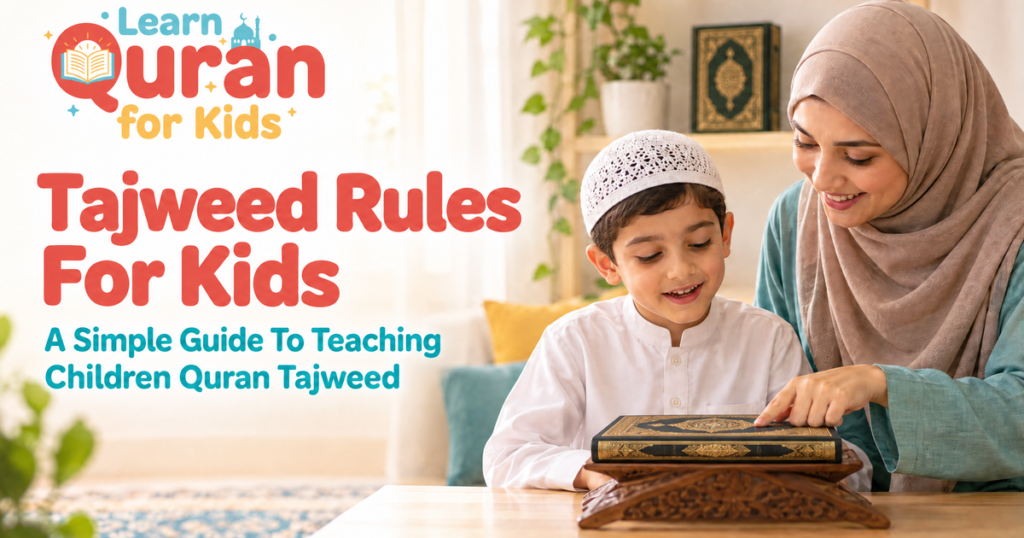
Tajweed rules for kids are the basic rules of Quran recitation, explained in a simple, gradual way so children can pronounce every Arabic letter correctly and read the Quran beautifully.
Young learners first listen and imitate, then learn the names of the rules they already apply. Many parents want their children to recite the Quran correctly but are not sure where to begin.
In this guide from Kids Learning Quran Academy, you will learn what tajweed means, why it matters, the main tajweed rules for kids with examples from short surahs, and practical ways to teach tajweed at home or online.
What You Will Learn
- What tajweed for kids means and how it is taught differently from adult tajweed study.
- Why learning tajweed early protects a child’s recitation and builds lasting confidence.
- The six main tajweed rules for kids, explained simply with verified Quranic examples.
- Practical, step-by-step methods parents can use to teach tajweed for kids at home.
- What happens in tajweed classes for kids and what else children learn in them.
What Is Tajweed for Kids?
Tajweed (تَجْوِيد) is the science of reciting the Quran correctly by pronouncing each letter from its proper point of articulation and giving it its due qualities, such as ghunnah (a nasal sound) or madd (lengthening).
The word comes from the Arabic root j-w-d, meaning to make something excellent. Tajweed for kids is the same science, taught simply and practically.
For a child, tajweed does not begin with definitions. A young learner listens to the teacher, repeats each word, and corrects mistakes by ear. This method, called talaqqi (receiving recitation directly from a teacher), is how the Quran has been passed down since the time of Prophet Muhammad ﷺ.
What Does the Quran Say About Reciting Carefully?
The Quran itself instructs believers to recite it in a careful and measured way. In Surah Al-Muzzammil, Allah commands the Prophet ﷺ to recite the Quran with Tarteel, emphasizing a clear and deliberate style of recitation.
Tajweed helps learners, including children, develop the pronunciation and recitation skills needed to apply this principle in practice.
أَوْ زِدْ عَلَيْهِ وَرَتِّلِ ٱلْقُرْءَانَ تَرْتِيلًا
“or a little more—and recite the Quran ˹properly˺ in a measured way.”
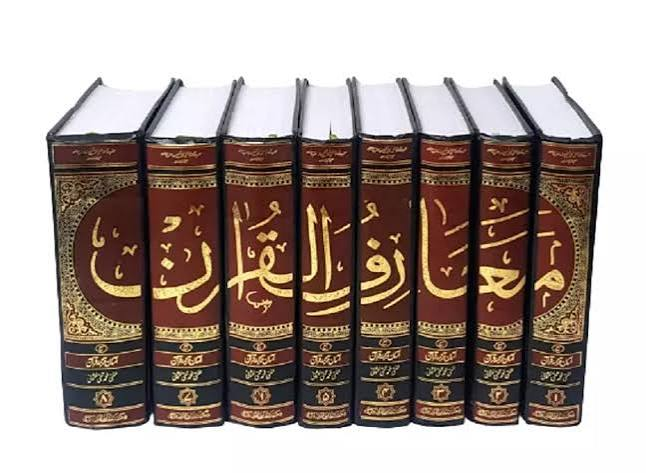
In works of tafsir such as Ma’arif al-Qur’an, tarteel in this verse is explained as reciting without haste so that every letter and word is clear. Tajweed rules are the practical tools that help children reach this measured recitation.
Importance of Learning Tajweed for Kids
Learning Tajweed in childhood is important because it helps shape how a child will recite the Quran for years to come. Pronunciation habits can develop early, and learning the correct sounds from the beginning can prevent mistakes from becoming difficult habits to change later in the teenage or adult years.
The Prophet ﷺ also highlighted the special status of those who learn and teach the Quran. This gives children a valuable opportunity to build correct recitation from an early age, while parents and teachers share in the responsibility of guiding them through patient and consistent learning.
خَيْرُكُمْ مَنْ تَعَلَّمَ الْقُرْآنَ وَعَلَّمَهُ
The best among you (Muslims) are those who learn the Qur’an and teach it.”

1. Tajweed Protects the Meaning of the Quran
Tajweed protects the meaning of Allah’s words by teaching children how to pronounce each Arabic letter correctly and observe the rules of Quranic recitation. In Arabic, changing one letter or vowel can completely change the meaning of a word, making accurate pronunciation essential when reading the Quran.
Scholars of recitation call obvious errors that alter letters or vowels al-lahn al-jali (clear mistakes) and emphasize the importance of avoiding them. These errors can affect both the accuracy and meaning of recitation, which is why early Tajweed training is so valuable for children.
Learning the basic rules from the beginning helps children develop correct pronunciation, build confidence, and establish a strong foundation for reciting the Quran properly as they grow.
2. Tajweed Builds Confidence and Love for the Quran
When a child recites a short surah correctly in front of family, they feel proud and motivated to continue. This confidence often grows into a lasting love for the Quran.
A patient, encouraging teacher plays a big role in this, which is why choosing the right Quran teachers for kids matters as much as choosing a good curriculum.
Children who find recitation difficult should never feel discouraged. The Prophet ﷺ promised a double reward to anyone who struggles while reading the Quran and keeps trying, which gives parents a gentle way to encourage kids who find tajweed hard:
الْمَاهِرُ بِالْقُرْآنِ مَعَ السَّفَرَةِ الْكِرَامِ الْبَرَرَةِ وَالَّذِي يَقْرَأُ الْقُرْآنَ وَيَتَتَعْتَعُ فِيهِ وَهُوَ عَلَيْهِ شَاقٌّ لَهُ أَجْرَانِ
One who is proficient in the Qur’an is associated with the noble, upright, recording angels; and he who falters in it, and finds it difficult for him, will have two rewards.”
3. Tajweed Creates Strong Recitation Habits
Learning Tajweed from an early age helps children develop correct recitation habits before inaccurate pronunciation becomes difficult to change. Regular practice teaches children to pay attention to letter sounds, Makharij, Madd, and other basic Tajweed rules as they read.
Over time, these skills become a natural part of their Quran recitation, making it easier for children to continue improving as they grow.
To explore a structured program, see the tajweed course for kids at Kids Learning Quran Academy.
See Our Classes in Action!
Learning the rules of Tajweed can make Quran recitation more accurate, clear, and meaningful.
Start Your Child’s Quran Learning Journey Today!
Join Kids Learning Quran Academy and help your child read the Quran with confidence through fun and guided lessons.
Book a Free Trial ClassMain Tajweed Rules for Kids
Children learn Tajweed rules gradually, one small step at a time, with each new rule building on the skills they have already learned.
The main Tajweed rules for kids include correct letter pronunciation, the rules of Noon Sakinah and Tanween, the rules of Meem Sakinah, Madd (lengthening), Qalqalah (echoing), and understanding heavy and light letters.
The examples below are taken from short Surahs that children may already know and recite, making each rule easier to understand, practise, and remember. Learning Tajweed through familiar verses also helps children connect the rule to actual Quranic recitation instead of memorizing it as a theory.
For extra exercises, examples, and practical practice ideas, you can also read our detailed guide to Tajweed rules for kids.

1. Makharij al-Huruf: Pronouncing Letters Correctly
Makharij al-huruf (مَخَارِج الحُرُوف) are the points of articulation from which Arabic letters are pronounced, such as the throat, the tongue, the lips, and the nasal passage. This is the first tajweed rule for kids, because every other rule depends on the child producing each letter correctly from its proper place.
Teachers usually start with letters children often confuse, such as ح and ه, ذ and ز, س and ص, or ق and ك, practicing two similar letters per session so the child hears the difference before saying it.
2. Rules of Noon Sakinah and Tanween
The rules of Noon Sakinah and Tanween are an important part of beginner Tajweed because they help children understand how the Noon sound is pronounced when it appears before different Arabic letters.
Learning these rules gradually makes Quran recitation clearer and helps children recognize why the same sound may be pronounced differently depending on what comes next.
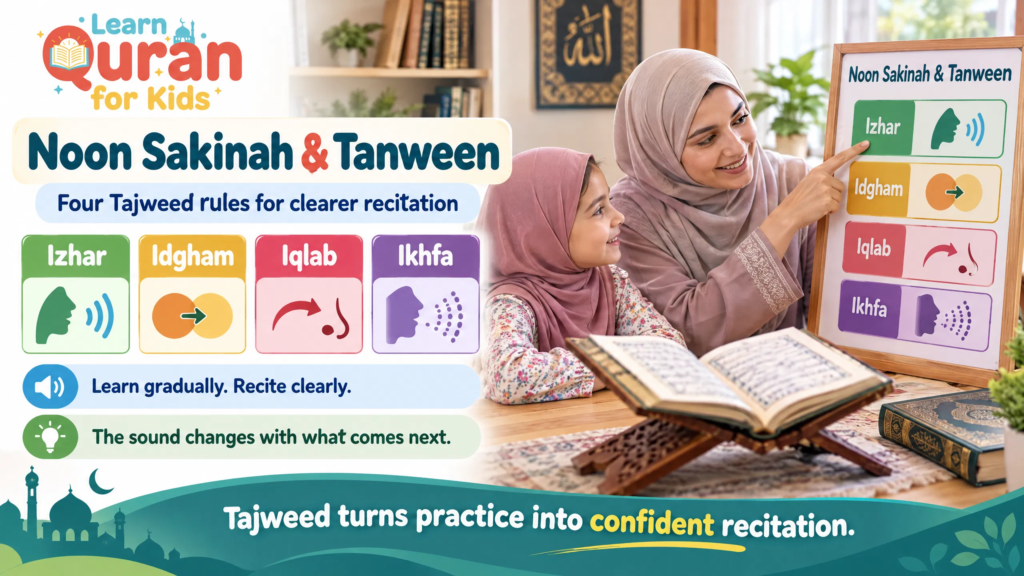
There are four main rules: Izhar, Idgham, Iqlab, and Ikhfa. Each rule applies to a specific group of letters and has its own way of pronunciation.
a. Izhar: Clear Pronunciation
Izhar (إظهار) means pronouncing noon sakinah or tanween clearly, without ghunnah, when it is followed by one of six throat letters: ء، هـ، ع، ح، غ، خ. Children remember this rule easily, because these letters come from the throat, far away from the nose where the ghunnah sound is made.
A clear example of izhar appears in the last verse of Surah Al-Ikhlas. The tanween on the word كُفُوًا is followed by the hamza at the start of أَحَدٌ, so the child pronounces the “n” sound clearly before the hamza, without any humming:
وَلَمْ يَكُن لَّهُۥ كُفُوًا أَحَدٌۢ
“And there is none comparable to Him.”
b. Idgham: Merging Two Sounds
Idgham (إدغام) means merging noon sakinah or tanween into the next letter so the two sound like one stressed letter. It happens between two words with six letters gathered in the word يَرْمَلُون. With ي، ن، م، و the merging includes ghunnah, while with ل and ر the noon is merged completely without ghunnah.
Surah Al-Ikhlas 112:4 also shows idgham without ghunnah: in يَكُن لَّهُۥ, the noon sakinah merges fully into the lam, so the child reads “yakul-lahu.” In Surah Al-Fil, the tanween at the end of بِحِجَارَةٍ merges into the meem of مِّن with a clear ghunnah, which is idgham with ghunnah:
تَرْمِيهِم بِحِجَارَةٍۢ مِّن سِجِّيلٍۢ
“that pelted them with stones of baked clay,”
c. Iqlab: Changing Noon into Meem
Iqlab (إقلاب) means changing noon sakinah or tanween into a hidden meem sound with ghunnah when it is followed by ب.
A small meem (ۢ) is usually written above the noon as a reminder. In لَيُنۢبَذَنَّ from Surah Al-Humazah, the child closes the lips gently and says a soft meem:
كَلَّا ۖ لَيُنۢبَذَنَّ فِى ٱلْحُطَمَةِ
“Not at all! Such a person will certainly be tossed into the Crusher.”
d. Ikhfa: Hiding the Noon Sound
Ikhfa (إخفاء) means pronouncing noon sakinah or tanween between izhar and idgham, without full clarity or stress, while keeping a ghunnah of about two counts.
It applies to the remaining fifteen letters: ت ث ج د ذ ز س ش ص ض ط ظ ف ق ك. In Surah Al-Fil 105:4, the noon in مِّن سِجِّيلٍ is hidden before س.
3. Rules of Meem Sakinah
Meem Sakinah (مْ) is a Meem without a vowel. Its three Shafawi rules depend on the letter that follows: Ikhfa Shafawi, Idgham Shafawi, and Izhar Shafawi.
Ikhfa Shafawi occurs before ب, with Ghunnah, as in تَرْمِيهِم بِحِجَارَةٍ (Surah Al-Fil 105:4). Idgham Shafawi occurs before another Meem, merging the two with Ghunnah. Izhar Shafawi occurs before all other letters, with the Meem pronounced clearly, as in أَلَمْ تَرَ.
أَلَمْ تَرَ كَيْفَ فَعَلَ رَبُّكَ بِأَصْحَـٰبِ ٱلْفِيلِ
“Have you not seen ˹O Prophet˺ how your Lord dealt with the Army of the Elephant?”
4. Madd: Lengthening Vowel Sounds
Madd (مَدّ) means lengthening the sound of a vowel letter during recitation. The three madd letters are alif (ا) after a fatha, waw (و) after a damma, and ya (ي) after a kasra. Children begin with madd tabee’i, the natural madd, which is held for two counts and appears in almost every verse of the Quran.
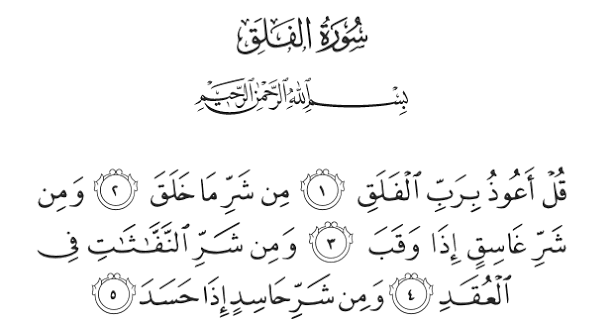
In Surah Al-Falaq, the word مَا contains a natural madd. The alif comes after a fatha, so the child stretches the sound for two counts, no more and no less, before moving to the next word:
مِن شَرِّ مَا خَلَقَ
“from the evil of whatever He has created,”
5. Qalqalah: The Echoing Sound
Qalqalah (قَلْقَلَة) is a slight bouncing or echoing sound made when one of five letters carries a sukoon. The qalqalah letters are ق، ط، ب، ج، د, gathered in the phrase قُطْبُ جَدٍّ (Qutbu Jadd). Children usually enjoy this rule, because the bouncing sound is easy to hear and fun to practice aloud.
Qalqalah is strongest when stopping at the end of a verse. When a child stops on خَلَقَ in Surah Al-Falaq 113:2, the final qaf becomes sakin and is read “khalaq” with a clear bounce.
6. Tafkheem and Tarqeeq: Heavy and Light Letters
Tafkheem (تفخيم) means pronouncing a letter with a full, heavy sound, while tarqeeq (ترقيق) means pronouncing it with a thin, light sound. Seven letters are always heavy: خ، ص، ض، غ، ط، ق، ظ, gathered in the phrase خُصَّ ضَغْطٍ قِظْ. Most other Arabic letters are always pronounced light.
Kids feel the difference by comparing pairs such as ص and س, or ق and ك. In خَلَقَ from Surah Al-Falaq 113:2, the خ and ق are heavy. The letter ر and the lam in the name Allah can be heavy or light, depending on the surrounding vowels.
Start Your Child’s Quran Learning Journey Today!Join Kids Learning Quran Academy and help your child read the Quran with confidence through fun and guided lessons.
How to Teach Tajweed for Kids
Teaching Tajweed to kids works best when practice comes before theory. Children learn naturally by listening, imitating, and repeating, so they benefit from hearing correct recitation and applying the rules before learning their technical names.
This helps Tajweed feel like a practical reading skill rather than a list of difficult rules to memorize.
With short lessons, repetition, and positive encouragement, parents and teachers can make Tajweed easier and more enjoyable for young learners. The following methods can help make Tajweed simple, engaging, and appropriate for children at different learning levels.
For parents exploring online options, free online Quran classes for kids explains what to look for in a quality online class.

1. Start with Listening and Repetition
Let the child listen to a teacher or a well-known reciter read a short verse slowly, then encourage them to repeat it word by word.
This listen-and-repeat method, based on Talaqqi, helps train the ear and tongue together and allows children to hear the correct pronunciation before trying to reproduce it. Even ten focused minutes of daily practice can gradually build stronger pronunciation and recitation habits.
2. Teach the Most Important Rules First
Follow a clear order when teaching Tajweed for kids: start with correct letter pronunciation, then introduce natural Madd, followed by Noon Sakinah and Tanween, Meem Sakinah, Qalqalah, and heavy and light letters.
Rules of stopping and starting (Waqf and Ibtida) can come later, as they require more awareness of the meaning and structure of verses. Teaching rules gradually prevents children from feeling overwhelmed and gives them time to practise each skill before adding a new one.
3. Use Games, Colors, and Familiar Surahs
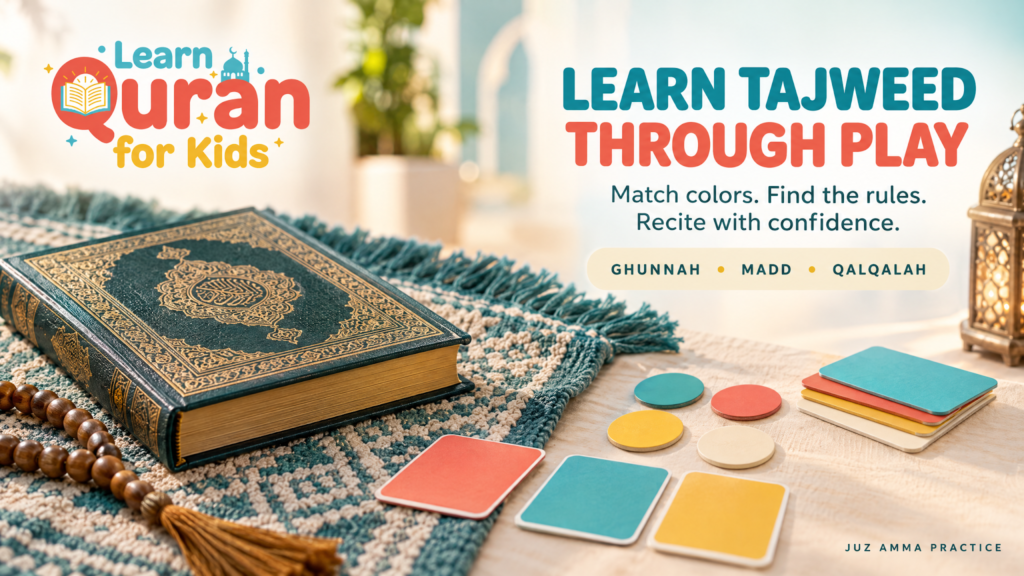
Color-coded cards can make Tajweed easier and more enjoyable for children. For example, one color can represent Ghunnah, another Madd, and another Qalqalah. Children can then search for these rules in Juz Amma, using Surahs they already know to connect the rule with actual Quranic reading.
Simple games, matching activities, and interactive learning tools can also make practice more engaging. Our review of Quran learning apps for kids can help parents choose suitable digital resources to support this practice.
4. Correct One Mistake at a Time
Correcting every mistake at once can overwhelm or frustrate a young learner. Instead, focus on one specific pronunciation or Tajweed mistake during each lesson, give the child enough time to practise it, and praise their improvement.
Once the child becomes more confident with that skill, gradually introduce the next correction. Small rewards, such as stickers, choosing a favourite Surah, or having a family recitation evening, can also make progress feel rewarding and keep children motivated.
Start Your Child’s Quran Learning Journey Today!
Join Kids Learning Quran Academy and help your child read the Quran with confidence through fun and guided lessons.
Book a Free Trial ClassBook a Free Tajweed Trial Class for Your Child
Give your child a confident start in reading the Quran correctly. At Kids Learning Quran Academy, children learn Tajweed step by step through friendly, interactive online lessons designed around their age, level, and learning pace.
Book a free trial class today and discover how enjoyable and rewarding learning Tajweed for kids can be when it is taught with patience, encouragement, and care.
Our Courses Include:
- Tajweed Course for Kids
- Quran Memorization Course for Kids
- Quran Recitation Course for Kids
- Quran Classes for Toddlers
- Quran Tafseer Course for Kids
- Qaida Course for Kids
- Quran Reading Course for Kids
- Online Arabic Classes for Kids
- Quranic Arabic Course for Kids
- Islamic Studies Courses for Kids
- Islamic Studies Course for Kindergarten
- 5 Pillars of Islam Course for Kids
- Islamic Education Course for Kids
Don’t wait to invest in your child’s Akhirah and future. Enroll today and watch your child grow with confidence, knowledge, and love for the Quran.
Join Kids Learning Quran Academy now and start your child’s learning journey today!

Conclusion
Tajweed rules for kids help children learn to recite the Quran clearly and correctly, following the guidance to recite with measured recitation in Surah Al-Muzzammil.
The learning journey can begin with correct letter pronunciation and gradually move through Noon Sakinah and Tanween, Meem Sakinah, Madd, Qalqalah, and heavy and light letters, using familiar verses from Juz Amma to make practice easier and more meaningful.
With regular listening, repetition, and consistent recitation to a qualified teacher, children can develop their Tajweed skills gradually at a pace that suits their age and ability.
Mistakes are a natural part of learning, and with patience and encouragement, each child can become a more confident Quran reciter. Every sincere effort made to learn and recite the Quran is valuable and rewarding.
Frequently Asked Questions About Tajweed for Kids
What is tajweed for kids in simple words?
Tajweed for kids means learning to read the Quran correctly by saying each Arabic letter from its right place and following simple recitation rules such as ghunnah, madd, and qalqalah. Children learn it mainly by listening to a teacher and repeating each word.
Which tajweed rule should kids learn first?
Kids should usually start with makharij al-huruf, the correct pronunciation of letters, followed by natural madd and the rules of noon sakinah and tanween. These basics appear in almost every verse and prepare children for the more advanced tajweed rules.
How long does it take a child to learn tajweed?
The time it takes a child to learn tajweed depends on age, practice, and reading level. Children who already read the Qaida often learn the main beginner rules within several months of regular lessons, while mastery develops over years of recitation.
Can parents teach tajweed for kids at home?
Parents can support tajweed at home through listening, repetition, and short daily practice. However, Quran recitation is traditionally learned through talaqqi with a qualified teacher, so combining home practice with a teacher who can correct mistakes is the most reliable approach.
Is it necessary for children to learn tajweed?
Learning basic tajweed helps children avoid clear mistakes that change letters or meanings in the Quran, which scholars strongly emphasize for every reciter. Scholars discuss the exact level of obligation in detail, so families can consult a trusted scholar for specific rulings.
Related Articles
Learn Quran