 Quran Stories
Children naturally connect with Islamic stories for kids, especially those that reflect real struggles and meaningful choices. Within the Quran, these narratives go far beyond entertainment, offering young minds a powerful lens to understand faith, character, and the consequences of human decisions.
From the courage of the youths in the cave to the wisdom of Luqman and the downfall of Qarun, these Quranic stories present real events filled with lessons on patience, humility, and trust in Allah, shaping a child’s moral and spiritual foundation.
Why Are Stories of the Prophets the Most Important Islamic Stories for Kids?
The stories of the prophets are the most important islamic stories for kids because they show children what real faith looks like under real pressure.
Every prophet faced doubt, danger, or disbelief — and chose Allah. These accounts give children living examples of courage, patience, and complete trust in Allah across every stage of human history.
The Quran mentions 25 prophets by name. Their stories are not told for historical curiosity. They are told so that every generation of Muslim children can look at a real human being, see what he faced, and understand what the right choice looks like.
In our instructors’ experience at Kids Learning Quran Academy, children who learn about the prophets through structured Quranic storytelling develop a far more confident Islamic identity than those who only learn names and timelines without narrative context.
| Age Group | Recommended Story Format | Session Length | Core Focus |
| Ages 4 to 6 | Oral storytelling with simple visuals | 10 to 15 minutes | Simple values: kindness, trust in Allah |
| Ages 7 to 10 | Interactive narration with discussion questions | 15 to 20 minutes | Character, patience, and consequence |
| Ages 11 to 15 | Story with Quranic text and personal reflection | 20 to 30 minutes | Moral reasoning, identity, and purpose |
Kids Learning Quran Academy’s Islamic Studies Courses for Kids introduce children to Quranic stories in structured, age-appropriate sessions guided by certified instructors.
Each prophet’s story is taught with proper context, meaningful discussion, and direct connection to the child’s real daily experiences. Insha’Allah, your child will leave each session not just knowing a story but carrying its lesson.
Book a Free Session for Your Child in the Best Islamic Studies Courses for Kids

1. Ashab al-Kahf Story for Children
The story of Ashab al-Kahf, found in Surah Al-Kahf (18:9 to 26), tells of a group of young men who refused to worship idols under a tyrannical ruler. They fled to a cave, and Allah caused them to sleep for approximately 309 years.
When they awoke, the world around them had changed and their faith had been preserved completely.
These were not elderly scholars. They were young men, likely in their late teens or early twenties, who stood firm while their entire society bowed to a tyrant.
That detail matters deeply for children. This islam story for kids shows that young people are fully capable of choosing Allah over social pressure.
“إِذْ أَوَى الْفِتْيَةُ إِلَى الْكَهْفِ فَقَالُوا رَبَّنَا آتِنَا مِن لَّدُنكَ رَحْمَةً وَهَيِّئْ لَنَا مِنْ أَمْرِنَا رَشَدًا” {10}
Idh awā al-fityatu ilā al-kahfi faqālū rabbanā ātinā min ladunka raḥmatan wahayyi’ lanā min amrinā rashadā.
[Mention] when the youths retreated to the cave and said, “Our Lord, grant us from Yourself mercy and prepare for us from our affair right guidance.” {10}
At Kids Learning Quran Academy, we use this story specifically with children aged 10 to 15 who are navigating peer pressure about their Islamic identity.
The young men of the cave chose a dark, unknown cave over a comfortable life of compromise. Children who understand this story are far better equipped to say no when it matters most.
2. Ashab al-Sabt Story Shows Children That Clever Tricks Cannot Fool Allah
The story of Ashab al-Sabt, mentioned in Surah Al-A’raf (7:163 to 166), tells of a community from Bani Israel who were commanded to rest on Saturday and avoid fishing.
Allah tested them by making fish appear abundantly only on Saturdays. A group devised a trick, placing nets on Friday to collect fish on Saturday. Allah punished them by transforming them.
The trick seemed clever. The nets were set on Friday. The fish were collected Sunday. They technically did not fish on Saturday. But they violated the spirit of Allah’s command completely.
“وَاسْأَلْهُمْ عَنِ الْقَرْيَةِ الَّتِي كَانَتْ حَاضِرَةَ الْبَحْرِ إِذْ يَعْدُونَ فِي السَّبْتِ إِذْ تَأْتِيهِمْ حِيتَانُهُمْ يَوْمَ سَبْتِهِمْ شُرَّعًا وَيَوْمَ لَا يَسْبِتُونَ ۙ لَا تَأْتِيهِمْ ۚ كَذَٰلِكَ نَبْلُوهُم بِمَا كَانُوا يَفْسُقُونَ” {163}
Was’alhum ‘ani al-qaryati allatī kānat ḥāḍirata al-baḥri idh ya’dūna fī as-sabti idh ta’tīhim ḥītānuhum yawma sabtihim shurra’an wayawma lā yasbitūna lā ta’tīhim; kadhālika nablūhum bimā kānū yafsuqūn.
And ask them about the town that was by the sea – when they transgressed in [the matter of] the Sabbath – when their fish came to them openly on their Sabbath day, and the day they had no Sabbath they did not come to them. Thus did We give them trial because they were defiantly disobedient. {163}
This verse provides a detailed historical account of the trial faced by the People of the Sabbath, illustrating how Allah tests the sincerity of believers through the presentation of worldly temptations during times of sacred prohibition.
This islamic story for kids teaches one of the most practical lessons in Islamic character: sincerity in obedience matters, not just surface compliance.
Children today face similar temptations. Finding loopholes in what parents or teachers say, bending rules while keeping the letter.
Ashab al-Sabt shows, in vivid and memorable terms, that Allah is not concerned with the cleverness of the excuse. He is concerned with the sincerity of the heart.
Shots Videos from Our Courses
Start Your Child’s Quran Learning Journey Today!
Join Kids Learning Quran Academy and help your child read the Quran with confidence through fun and guided lessons.
Book a Free Trial Class3. Ashab al-Ukhdud Story Teaches Children That Faith Is More Valuable Than Safety
The story of Ashab al-Ukhdud, found in Surah Al-Burooj (85:4 to 10), tells of a tyrant king who burned believers alive in fire-filled trenches for refusing to abandon their faith in Allah. The believers chose the fire over disbelief. Allah declared them among the people of great success.
This islam story for kids is remarkable because it involves a child at its center. A young boy who learned true faith from a monk chose Allah over the king’s power. He guided people to belief through Allah’s permission, healing the blind and the sick. When the king had him executed, his death only spread faith further.
“وَمَا نَقَمُوا مِنْهُمْ إِلَّا أَن يُؤْمِنُوا بِاللَّهِ الْعَزِيزِ الْحَمِيدِ” {8}
Wa mā naqamū minhum illā an yu’minū billāhi al-‘azīzi al-ḥamīd.
And they resented them not except because they believed in Allah, the Exalted in Might, the Praiseworthy, {8}
For Muslim children growing up in the West, this story carries a direct and powerful message. Being different because of your faith is not a weakness. The people of the trench were different. Allah called them the people of great success.
4. The Story of Qarun for Children
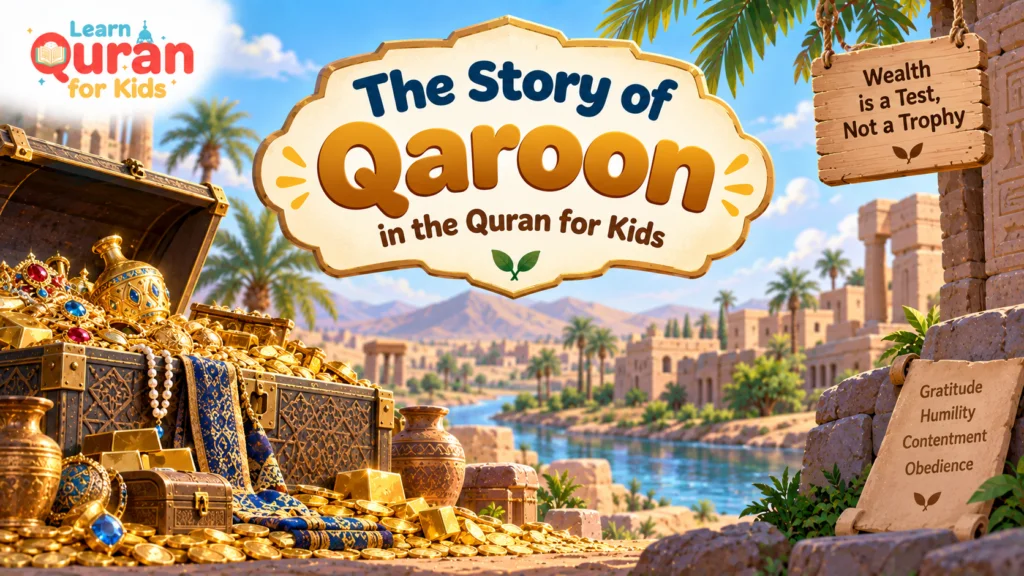
Qarun was a man from the people of Musa (AS) whom Allah blessed with extraordinary wealth. He became arrogant, claiming his wealth came from his own intelligence and skill. He refused to acknowledge Allah’s blessing and oppressed his people. Allah caused the earth to swallow him and everything he owned.
His story is in Surah Al-Qasas. Qarun’s treasuries were so vast that it reportedly took a group of strong men just to carry the keys. Yet none of it protected him when Allah’s judgment came.
“إِنَّ قَارُونَ كَانَ مِن قَوْمِ مُوسَىٰ فَبَغَىٰ عَلَيْهِمْ ۖ وَآتَيْنَاهُ مِنَ الْكُنُوزِ مَا إِنَّ مَفَاتِحَهُ لَتَنُوءُ بِالْعُصْبَةِ أُولِي الْقُوَّةِ إِذْ قَالَ لَهُ قَوْمُهُ لَا تَفْرَحْ ۖ إِنَّ اللَّهَ لَا يُحِبُّ الْفَرِحِينَ” {76}
Inna Qārūna kāna min qawmi Mūsā fabaghā ‘alayhim, wa-ātaynāhu mina al-kunūzi mā inna mafātiḥahu latanū’u bil-‘uṣbati ulī al-quwwati idh qāla lahu qawmuhu lā tafraḥ inna Allāha lā yuḥibbu al-fariḥīn.
Indeed, Qarun was from the people of Moses, but he tyrannized them. And We gave him of treasures it whose keys would burden a band of strong men, then his people said to him, “Do not exult. Indeed, Allah does not like the exultant.” {76}
This verse introduces the cautionary tale of Qarun, serving as a profound theological warning against the spiritual peril of material arrogance and the delusion that wealth is a result of personal merit rather than a divine trial.
This islamic story for kids is especially effective for older children and teenagers who are beginning to see success, status, and talent as personal achievements. The lesson of Qarun is not that wealth is bad. It is that wealth without gratitude and humility leads to destruction. Everything belongs to Allah, and those who forget this are reminded eventually.
Kids Learning Quran Academy’s Quran Tafseer for Kids course explores stories like Qarun in depth, helping children understand not just what happened but why Allah included these narratives in His Book.
Certified instructors guide children through the deeper meanings in age-appropriate language that makes Tafseer genuinely engaging.
Book a Free Trial for Your Child in Quran Tafseer Course for Kids

Read also: Prophet Yunus Story for Kids
5. Luqman and His Son’s Story for Children
Luqman was a wise man whom Allah blessed with profound wisdom. The Quran preserves his advice to his son in Surah Luqman (31:12 to 19). His first instruction was to never associate partners with Allah. He then taught his son gratitude, prayer, humility, and how to walk and speak with dignity.
Luqman was not a prophet. He was a wise man, and Allah considered his parental advice worthy of preservation in the Quran forever. That detail alone tells children something important. Wisdom and righteous character are gifts Allah gives to those who are sincere and humble, regardless of their status or background.
“يَا بُنَيَّ إِنَّهَا إِن تَكُ مِثْقَالَ حَبَّةٍ مِّنْ خَرْدَلٍ فَتَكُن فِي صَخْرَةٍ أَوْ فِي السَّمَاوَاتِ أَوْ فِي الْأَرْضِ يَأْتِ بِهَا اللَّهُ ۚ إِنَّ اللَّهَ لَطِيفٌ خَبِيرٌ” {16}
Yā bunayya innahā in taku mithqāla ḥabbatin min khardalin fatakun fī ṣakhratin aw fī as-samāwāti aw fī al-arḍi ya’ti bihā Allāhu, inna Allāha laṭīfun khabīr.
[And Luqman said], “O my son, indeed if wrong should be the weight of a mustard seed and should be within a rock or [anywhere] in the heavens or in the earth, Allah will bring it forth. Indeed, Allah is Subtle and Acquainted.” {16}
For children, this verse is one of the most powerful pieces of Islamic education in the entire Quran. Allah sees everything. Every small good deed. Every hidden bad deed. Every secret kindness. This understanding, when instilled early, shapes a child’s character from the inside out.
Start Your Child’s Quran Learning Journey Today!
Join Kids Learning Quran Academy and help your child read the Quran with confidence through fun and guided lessons.
Book a Free Trial Class6. Ashab al-Fil Story for Children
The story of Ashab al-Fil, told in Surah Al-Fil (105:1 to 5), describes the army of Abraha, a Yemeni ruler who marched toward Makkah with war elephants intending to destroy the Kaaba.
Allah sent flocks of birds called Ababil carrying stones of baked clay. The army was destroyed completely before reaching the Kaaba.
This event occurred in the year of the Prophet’s birth ﷺ, approximately 570 CE. Abd al-Muttalib, the Prophet’s grandfather, told his people to flee to the mountains and leave the Kaaba in Allah’s protection. That trust was fully honored.
For children who have already memorized Surah Al-Fil, this story makes those five short verses come alive. They are not just sounds. They are a historical record of how Allah defended His House when the most powerful army of its time came against it.
“أَلَمْ تَرَ كَيْفَ فَعَلَ رَبُّكَ بِأَصْحَابِ الْفِيلِ {1} أَلَمْ يَجْعَلْ كَيْدَهُمْ فِي تَضْلِيلٍ {2} وَأَرْسَلَ عَلَيْهِمْ طَيْرًا أَبَابِيلَ {3} تَرْمِيهِم بِحِجَارَةٍ مِّن سِجِّيلٍ {4} فَجَعَلَهُمْ كَعَصْفٍ مَّأْكُولٍ {5}”
Alam tara kayfa fa‘ala Rabbuka bi-aṣḥābi al-fīl. 2. Alam yaj‘al kaydahum fī taḍlīl. 3. Wa-arsala ‘alayhim ṭayran abābīl. 4. Tarmīhim bi-ḥijāratin min sijjīl. 5. Fa-ja‘alahum ka-‘aṣfin ma’kūl.
Have you not considered, [O Muhammad], how your Lord dealt with the companions of the elephant? 2. Did He not make their plan into misguidance? 3. And He sent against them birds in flocks, 4. Striking them with stones of hard clay, 5. And He made them like eaten straw. {1-5}
This short yet powerful Meccan Surah serves as a historical and theological testament to Allah’s absolute protection of the Kaaba, demonstrating that even the most formidable human military might is inconsequential when confronted by the precise and unconventional execution of divine will.
This islam story for kids teaches that reliance on Allah is not passive. It is the most powerful stance a person can take.
Kids Learning Quran Academy’s Quran Memorization for Kids program helps children memorize surahs like Al-Fil with proper Tajweed and full understanding of the story behind each revelation.
When children know why a surah was revealed, they memorize it with stronger retention and deeper love for the Quran.
Begin your child’s memorization with Quran Memorization for Kids at Kids Learning Quran Academy with a free trial session today.
Book a Free Trial for Your Child in the Best Hifz Course for Kids

7. Ashab al-Jannah Story for Children
The story of Ashab al-Jannah, found in Surah Al-Qalam (68:17 to 33), tells of the owners of a garden whose righteous father always shared the harvest with the poor.
After his death, his sons decided to harvest early in the morning in secret to avoid giving anything to the poor. Allah destroyed their garden overnight before they arrived.
When they reached their garden and found it completely ruined, they initially blamed each other. Then the most balanced among them reminded them of what they had done. They acknowledged their wrongdoing and turned to Allah in repentance.
This islamic story for kids is powerful precisely because it involves family, inheritance, and collective decision-making. The sons did not commit a dramatic sin.
They simply decided to keep more for themselves and give nothing away. Yet that decision, driven by greed and selfishness, cost them everything.
Read also: Prophet Stories for Kids
8. The Story of the Two Garden Owners Teaches Children That Arrogance Blinds the Heart
The story of the two men in Surah Al-Kahf (18:32 to 44) tells of two men, one wealthy with two lush gardens and one of modest means. The wealthy man became arrogant, doubting the Day of Judgment and attributing his success entirely to himself. His companion warned him sincerely. Allah destroyed the wealthy man’s gardens, and he was left with nothing.
.”وَلَوْلَا إِذْ دَخَلْتَ جَنَّتَكَ قُلْتَ مَا شَاءَ اللَّهُ لَا قُوَّةَ إِلَّا بِاللَّهِ ۚ إِن تَرَنِ أَنَا أَقَلَّ مِنكَ مَالًا وَوَلَدًا” {39}
Walawlā idh dakhalta jannataka qulta mā shā’a Allāhu lā quwwata illā billāh, in tarani ana aqalla minka mālan wa-waladā.
And why did you, when you entered your garden, not say, ‘What Allah willed [has occurred]; there is no power except in Allah ‘? Although you see me less than you in wealth and children. {39}
This islam story for kids gives children a direct, practical phrase to say when they see something beautiful or achieve something good. “Ma sha’Allah” is not just a cultural expression. It is a protection against the arrogance that destroyed the garden owner’s blessings completely.
Our Students Reviews
Start Your Child’s Quran Learning Journey Today!
Join Kids Learning Quran Academy and help your child read the Quran with confidence through fun and guided lessons.
Book a Free Trial Class9. The Story of Bilqis and Sulaiman for Children
The story of Bilqis, the Queen of Sheba, and Prophet Sulaiman (AS) is found in Surah An-Naml (27:22 to 44). A hoopoe bird brought Sulaiman news of a queen who ruled a great kingdom but worshipped the sun.
Sulaiman sent her a letter inviting her to Islam. After witnessing Sulaiman’s miraculous court, Bilqis embraced the truth and submitted to Allah.
This islamic story for kids teaches several distinct lessons in one narrative. It shows that guidance can come from unexpected sources, a small bird carried news that changed a queen’s eternal destiny.
It shows that power and intelligence do not prevent a person from recognizing truth when it is presented with wisdom and clarity.
Kids Learning Quran Academy’s Online Arabic Classes for Kids course help children engage directly with Quranic Arabic so that stories like Sulaiman and Bilqis become accessible in their original language.
Understanding even basic Arabic vocabulary allows children to hear the rhythm and beauty of these stories as Allah revealed them.
Start your kid’s Arabic journey with a free lesson

Enroll Your Child at Our Academy and Begin Their Quranic Education Today
Every islamic story for kids in this article carries a lesson that shapes character, strengthens faith, and prepares children for real life. Structured learning ensures these stories are taught accurately, deeply, and in ways children genuinely remember.
Kids Learning Quran Academy offers:
- Interactive sessions that make Quranic stories meaningful and memorable.
- 1-on-1 personalized attention tailored to each child’s pace and level.
- Certified instructors specialized in teaching children Quranic stories with full context.
- Safe, monitored online learning environment for peace of mind.
- Flexible scheduling to suit busy families across all time zones.
- Age-appropriate, engaging teaching methods designed for every learning stage.
- Progress tracking so parents stay fully informed of their child’s development.
- Free trial session with no commitment required.
Check out our top courses for children in Hifz Quran, Arabic language skills, and Islamic studies:
- Online Arabic Classes for Kids
- Noorani Qaida for Kids
- Tajweed for kids
- Quran Reading Course for Kids
- Quran Memorization Course for Kids
- Quran Tafseer for Kids
- Islamic Studies Courses for Kids
Start Your Child’s Quran Learning Journey Today!
Join Kids Learning Quran Academy and help your child read the Quran with confidence through fun and guided lessons.
Book a Free Trial ClassFrequently Asked Questions About Islamic Stories for Kids
At What Age Can a Child Start Learning Islamic Stories From the Quran?
Children as young as 4 can begin learning simple islamic stories for kids through oral storytelling. Stories like Ashab al-Fil and Luqman’s advice to his son are naturally accessible at this age.
Deeper narratives like Ashab al-Kahf and Ashab al-Sabt are best introduced between ages 8 and 12, when children can understand consequence and moral complexity.
How Can Parents Make Islam Stories for Kids More Effective at Home?
The most effective approach is storytelling followed by a single discussion question. Ask your child: “What would you have done if you were one of the young men in the cave?” This narrative engagement activates personal reflection.
Revisiting the same islam story for kids at different ages reveals new layers as the child matures. Consistency matters more than duration.
Are There Quranic Stories Specifically Suitable for Very Young Children?
Yes. Surah Al-Fil and the story of Luqman’s advice are both naturally suited for young children. Al-Fil involves a dramatic, visual narrative with birds and elephants that children aged 4 to 7 grasp immediately.
Luqman’s advice uses a parent speaking to a child, a dynamic young learners understand instinctively. Both are excellent starting points for islamic stories for kids at home.
Why Do Islam Stories for Kids Include Communities and Not Just Prophets?
Allah includes stories of communities precisely because they show how ordinary people, not prophets, respond to faith, temptation, and divine commands. Ashab al-Sabt were ordinary fishermen. Ashab al-Jannah were brothers managing an inheritance.
These are situations children encounter parallels to every day. That relatability makes these islam stories for kids uniquely powerful for character development.
How Does Quran Tafseer Help Children Understand These Stories More Deeply?
Tafseer reveals the context, background, and scholarly interpretation behind each Quranic narrative. Without Tafseer, a child knows that Qarun was swallowed by the earth.
With Tafseer, they understand what made him fall, why his people warned him, and what specific form his arrogance took. That depth transforms a story into a lifelong lesson.
Related Articles
Quran Stories