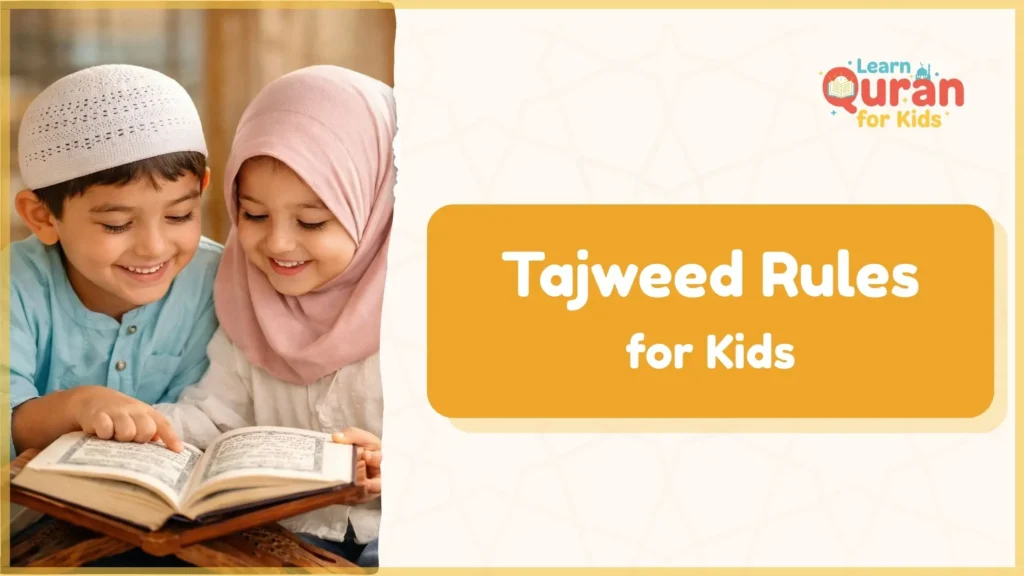
Teaching children the beauty of Quran recitation starts with making Tajweed accessible and enjoyable. When young Muslims learn proper pronunciation rules early, they develop a lifelong connection with Allah’s words that shapes their spiritual foundation.
Tajweed for kids involves simplified pronunciation rules that help children recite the Quran correctly and beautifully. It teaches young learners how to pronounce each Arabic letter properly, apply elongation rules, and understand when to pause—all through age-appropriate methods that make learning engaging and memorable for non-Arabic speaking Muslim children.
What Is Tajweed for Kids?
Tajweed means “to make better” or “to improve” in Arabic. For children, it’s the set of rules that teaches them how to pronounce Quranic words exactly as the Prophet Muhammad ﷺ recited them.
Learning Tajweed for children ensures they don’t just read Arabic letters—they recite with beauty and accuracy. This protects them from mispronouncing Allah’s words and helps them understand the deeper meanings behind correct recitation.
Young students who master these rules early develop confidence in their Quranic reading. They participate more actively in prayers and feel proud when reciting in front of family and community.
At Kids Learning Quran Academy, our Tajweed for Kids course breaks down complex rules into child-friendly lessons. Certified instructors use games, colorful charts, and interactive activities that match children’s natural learning styles and short attention spans.
Enroll your child in Tajweed for kids with a free trial class

Importance of Learning Tajweed for Kids at an Early Age
Starting Tajweed education during childhood creates lasting benefits. Young minds absorb pronunciation patterns faster than adults, making elementary years the ideal window for mastering Quranic recitation skills.
Children who learn Quran Tajweed for kids early develop muscle memory for correct Arabic pronunciation. Their tongues adapt naturally to sounds that don’t exist in English or other languages, preventing bad habits from forming.
This foundation prepares them for lifelong Quran memorization success. When students know how words should sound, memorizing becomes easier and more enjoyable.
Early Tajweed training also builds Islamic identity. Children feel connected to Muslims worldwide who recite the same way, creating a sense of belonging to the global Ummah.
Main Tajweed Rules for Kids Simplified for Easy Understanding
Breaking down Tajweed rules for kids into digestible concepts makes learning manageable. Young students need clear, concrete explanations that connect to their everyday experiences and natural learning patterns.
The fundamental rules form building blocks that stack upon each other. When children master basic concepts first, advanced applications become accessible and logical rather than overwhelming.
Here are the essential Tajweed principles every young Muslim should understand and practice regularly with proper guidance.
1. Makharij Rules for Proper Letter Pronunciation Points for Children
Makharij teaches children where each Arabic letter originates in the mouth and throat. This foundational skill determines whether students pronounce words correctly or develop habits that distort Quranic meanings.
Some letters come from the lips, others from the tongue tip, and some from deep in the throat. Each articulation point creates distinct sounds that don’t exist in English or most other languages.
For example, the letter ع (Ayn) comes from the middle of the throat, while ق (Qaf) originates deeper. The letter ح (Ha) requires a breathy sound from the upper throat, different from regular H.
Children practice these distinct sounds through repetition and mirror exercises. Watching their mouth positions while producing sounds helps them self-correct and develop muscle memory naturally.
Certified instructors use fun techniques like animal sounds, robot voices, and silly face exercises to make articulation practice enjoyable rather than tedious for young learners.
2. Noon Sakinah and Tanween Rules Made Simple for Kids
When a Noon has no vowel (Sakinah) or when words end in double vowels (Tanween), four specific rules apply. These rules determine how children should pronounce or modify the sound.
Idgham (merging) combines the Noon sound with the following letter from the group يرملون. The Noon disappears completely, merging into the next letter with a smooth, natural flow.
Iqlab (conversion) changes Noon Sakinah or Tanween into a Meem sound before the letter ب (Ba). Children practice this transformation using hand gestures that show the sound conversion visually.
Ikhfa (hiding) softens the Noon sound before fifteen specific letters. The Noon becomes nasal and gentle, neither fully pronounced nor completely hidden—a middle ground children learn through careful listening.
Izhar (clear pronunciation) keeps the Noon sound crisp and clear before throat letters: ء ه ع ح غ خ. Students pronounce the Noon fully without any modification or nasal quality.
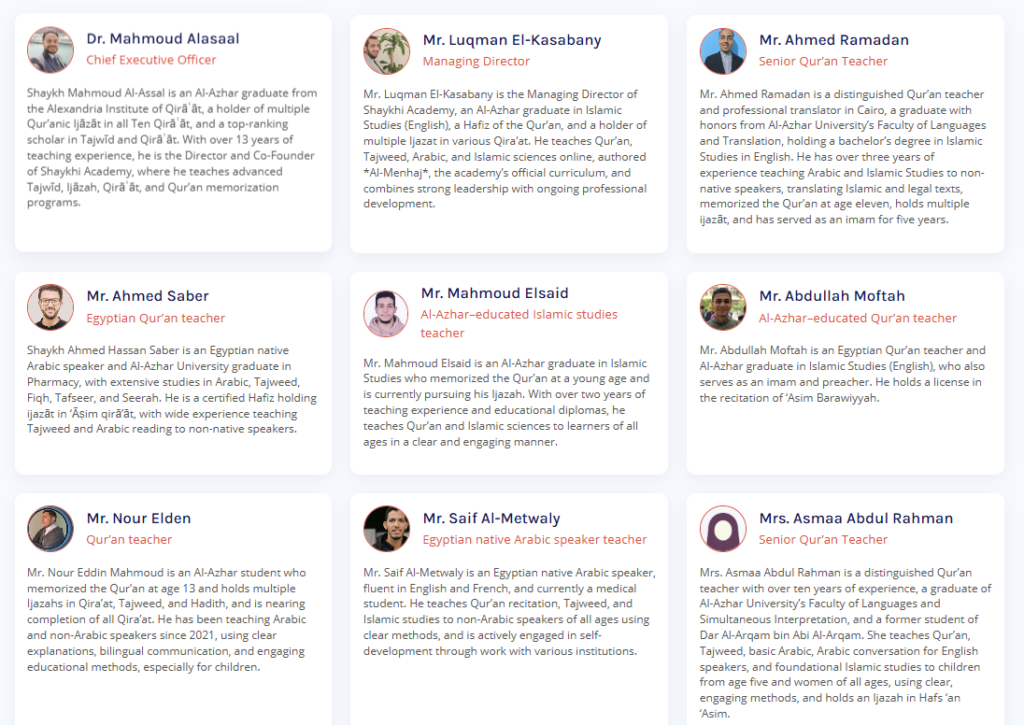
Certified tutors at Kids Learning Quran Academy teach these through color-coded Qurans and hand signals that children love using during practice sessions. Each rule gets a unique color and gesture for easy recognition.
Book a FREE Trial for Your Kid with One of Our Certified Teachers
3. Meem Sakinah Rules Explained for Young Learners
The silent Meem (Meem Sakinah) follows three straightforward rules that children grasp quickly through consistent practice. These rules appear frequently in Quran recitation, making them essential knowledge.
Ikhfa Shafawi (labial hiding) happens before the letter ب (Ba). The Meem sound becomes soft and nasal, similar to humming with closed lips while air flows through the nose.
Idgham Shafawi (labial merging) occurs before another Meem. The two Meems merge into one longer sound lasting two counts, creating a smooth, connected pronunciation.
Izhar Shafawi (clear pronunciation) applies before all remaining letters. Children pronounce the Meem clearly and fully without hiding, merging, or nasalization—just pure, distinct Meem sound.
Children remember these easily when teachers use stories and visual aids that connect abstract rules to concrete examples. Character stories featuring the letters as personalities make rules memorable.
4. Elongation Rules Simplified for Kids
Mad rules tell children how long to hold certain vowels, creating the melodious flow that distinguishes proper Quranic recitation. Mastering elongation timing separates mechanical reading from beautiful recitation.
Natural Mad (Madd Tabee’i) lasts two counts—the baseline elongation for any long vowel. Children practice counting “one, two” internally while maintaining steady rhythm and consistent length.
Connected Mad (Madd Muttasil) extends to four or five counts when a long vowel meets a Hamza in the same word. This longer hold emphasizes important Quranic words naturally.
Separate Mad (Madd Munfasil) also lasts four or five counts but occurs when a long vowel ends a word and Hamza begins the next. Students learn to connect words smoothly while maintaining proper elongation.
The essential Mad (Madd Lazim) requires six counts—the longest elongation rule. This appears when specific letter combinations occur, demanding sustained breath control and steady pronunciation from young reciters.
5. Qalqalah: The Echoing Letters Children Love
Five letters (ق ط ب ج د) create a slight bounce or echo when they appear with no vowel. This dynamic sound adds energy and rhythm that children naturally enjoy producing.
The echoing effect happens whether these letters appear in the middle of words or at the end. Students create a small rebound sound from the articulation point, making recitation lively.
Children love this rule because it adds rhythm to their recitation and feels playful compared to other technical rules. The bounce creates natural musicality without singing or melody.
Teachers use the phrase “قطب جد” (Qutb Jad) to help students memorize these special letters. This mnemonic combines all five letters into two memorable words children can recall instantly.
Practice involves exaggerating the bounce initially, then refining it gradually. Starting with obvious echoes helps students feel the mechanism before developing subtle, proper application.
Start Your Child’s Quran Learning Journey Today!
Join Kids Learning Quran Academy and help your child read the Quran with confidence through fun and guided lessons.
Book a Free Trial Class6. Ghunnah is The Nasal Sound Rule in Tajweed for Kids
Ghunnah creates a nasal sound lasting two counts that appears with certain Noon and Meem situations. This soft, humming quality adds gentleness and beauty to Quranic recitation.
The sound comes through the nose while the mouth position stays closed or set for the letter. Children practice by placing fingers on their nose bridge to feel the vibration during proper Ghunnah.
Ghunnah appears in Idgham (with certain letters), Ikhfa, Iqlab, and when Meem or Noon carry Shaddah (double letter mark). Recognizing these situations becomes second nature with regular practice.
Students at Kids Learning Quran Academy learn Ghunnah through sensory exercises that make the abstract concept tangible, helping them distinguish proper nasal sound from regular pronunciation.
7. IQlab is The Conversion Rule for Perfect Flow
Qalb specifically refers to converting Noon Sakinah or Tanween into a Meem sound before the letter ب (Ba). This rule creates smooth transitions that prevent awkward sound combinations.
The conversion happens automatically once children recognize the pattern. When they see Noon Sakinah or Tanween followed by Ba, their recitation naturally flows into Meem pronunciation.
Students practice Qalb using example words from the Quran repeatedly until the conversion becomes instinctive. Muscle memory develops through consistent, focused repetition under teacher guidance.
8. Letters of Heavy and Light Pronunciation (Ra Rules)
The letter ر (Ra) changes between heavy and light pronunciation depending on surrounding vowels and letter conditions. This dynamic rule requires attention and practice for proper application.
When Ra carries Fatha or Damma (opening or closing vowel), it sounds heavy and emphatic. Children produce thick, rolling R sounds from deeper in the mouth using back tongue position.
When Ra carries Kasra (closing vowel), it generally sounds light and delicate. Students create thinner R sounds from the front of the mouth with tongue tip and forward placement.
Special cases occur when Ra appears with no vowel—then students check preceding letters and vowels to determine heaviness or lightness. Certified instructors guide children through these conditional situations systematically.
9. Putting All Tajweed Rules for Kids Together
After learning individual Tajweed rules for kids, students practice applying multiple rules within single verses. This integration phase develops fluency and automatic rule recognition during real recitation.
Children begin with simple, familiar Surahs like Al-Fatihah and Al-Ikhlas. These short chapters contain most common Tajweed applications, providing perfect practice ground for consolidating separate rules.
Gradual progression moves students toward longer, more complex passages. Teachers select verses that introduce new rule combinations incrementally, preventing overwhelm while building comprehensive skill mastery.
Regular review prevents forgetting. Our Quran Reading Course for Kids incorporates Tajweed review throughout all reading instruction, ensuring rules remain fresh and applicable across all learning stages.
Book a Free Session for Your Child in the Quran Reading Course
What Are the Tajweed Classes for Kids at Kids Learning Quran Academy?
Tajweed classes for kids at Kids Learning Quran Academy provide structured, age-appropriate instruction designed specifically for young learners. Each session combines traditional Islamic teaching methods with modern educational technology.
Classes operate on a one-on-one basis, allowing certified instructors to customize lessons for each child’s pace and learning style. This personalized attention ensures no student falls behind or feels overwhelmed.
Sessions typically last 30-45 minutes—the optimal length for maintaining children’s focus and enthusiasm. Teachers incorporate breaks, games, and rewards to keep energy levels high throughout instruction.
The curriculum progresses systematically from basic letter pronunciation to advanced rules. Students master foundational concepts before moving forward, ensuring solid understanding at every stage.
Enroll your child in Tajweed for kids with a free trial class

How to Teach Tajweed for Kids?
Parents and educators can support children’s Tajweed education even without advanced Arabic knowledge. Creating the right environment and using effective strategies makes home practice productive and enjoyable.
Start with consistent short practice sessions. Fifteen minutes daily outperforms hour-long weekly sessions because regular exposure builds retention and prevents overwhelm.
Use technology wisely. Tajweed apps with child-friendly interfaces, Quran recitation videos featuring kids’ voices, and interactive games reinforce classroom learning between formal lessons.
Celebrate small victories. When your child pronounces a difficult letter correctly or remembers a rule independently, acknowledge their progress enthusiastically to build confidence.
Partner with qualified teachers. While home support matters greatly, certified instructors at Kids Learning Quran Academy provide the expert guidance children need for accurate Tajweed mastery through our Quran Recitation Course for Kids.
Book a FREE Trial for You Child in Our Quran Recitation Course for Kids
Do Kids Only Learn Tajweed in the Tajweed Classes?
No, comprehensive Tajweed for children programs teach far more than pronunciation rules alone. Holistic Islamic education integrates multiple learning dimensions that support overall spiritual and linguistic development.
Children simultaneously develop Arabic reading fluency. As they practice Tajweed, their ability to recognize and read Arabic script naturally improves, creating synergy between skills.
Islamic character building happens throughout lessons. Teachers model patience, respect for the Quran, and proper adab (etiquette) during handling and recitation of Allah’s words.
Memorization strategies often accompany Tajweed instruction. Students learn how to memorize verses correctly the first time, using proper pronunciation as their foundation through programs like Quran Memorization for Kids.
Book a Free Trial for Your Child in the Best Hifz Course for Kids
Understanding basic word meanings enriches learning. When children know what they’re reciting, the Quran becomes meaningful rather than merely phonetic practice, which our Quran Tafseer for Kids course addresses beautifully.
Book a Free Trial for Your Child in Quran Tafseer Course for Kids

Read Also: Quran Learning Tools for Kids
Learn Quran Online with Tajweed for Kids from Home
Learning Quran online with Tajweed for kids offers flexibility and quality that traditional settings sometimes cannot match. Virtual classrooms eliminate geographic barriers while maintaining educational excellence.
Children access certified instructors worldwide regardless of local availability. Families in areas without qualified children’s Quran teachers gain the same opportunities as those in major Islamic centers.
Flexible scheduling accommodates busy family routines. Morning, afternoon, or evening sessions fit around school, extracurricular activities, and family commitments without stress.
The comfortable home environment reduces anxiety for shy children. Many young students participate more actively during online sessions than in traditional classroom settings.
Parents monitor progress directly. Sitting nearby during lessons helps families understand what children learn and how to support practice between sessions effectively.
Read Also: The Best Online Quran Teacher for Kids
Start Your Child’s Quran Learning Journey Today!
Join Kids Learning Quran Academy and help your child read the Quran with confidence through fun and guided lessons.
Book a Free Trial ClassRead Also: Quran Learning Apps for Kids
Enroll Your Child at Kids Learning Quran Academy Today
Your child deserves Tajweed education that combines Islamic authenticity with child-centered teaching excellence. Kids Learning Quran Academy specializes in making Quran recitation beautiful, accurate, and deeply meaningful for young Muslims.
Our platform offers:
- Certified instructors trained specifically in children’s Islamic education
- Personalized one-on-one attention matching each child’s learning pace
- Engaging, age-appropriate methods that transform Tajweed into an enjoyable experience
- Flexible scheduling that respects your family’s unique routine
- Safe, monitored online environment with parent-approved content
- Progress tracking that keeps families informed and involved
- Comprehensive programs from Tajweed for Kids to Islamic Studies Courses for Kids
Watch them discover the joy of reciting Allah’s words correctly while building confidence, spiritual connection, and lifelong Islamic knowledge under expert guidance.
Check out our top courses for children in Hifz Quran, Arabic language skills, and Islamic studies:
- Online Arabic Classes for Kids
- Noorani Qaida for Kids
- Tajweed for kids
- Quran Reading Course for Kids
- Quran Memorization Course for Kids
- Quran Tafseer for Kids
- Islamic Studies Courses for Kids
Book your child’s free trial session today.
Conclusion
Tajweed education transforms children’s relationship with the Quran from simple reading into beautiful, meaningful recitation. When young Muslims learn proper pronunciation rules through engaging, age-appropriate methods, they develop skills that serve their Islamic practice throughout life while building confidence and spiritual connection.
Starting early gives children the advantage of natural language acquisition during their most receptive years. Combined with qualified instruction and consistent practice, Tajweed becomes an enjoyable journey rather than an overwhelming academic burden for families.
Quality online platforms now make expert Tajweed instruction accessible regardless of location. With certified teachers, flexible scheduling, and child-centered curricula, families can provide their children with authentic Quranic education that fits modern lifestyles while maintaining traditional Islamic teaching standards.


Leave a Reply