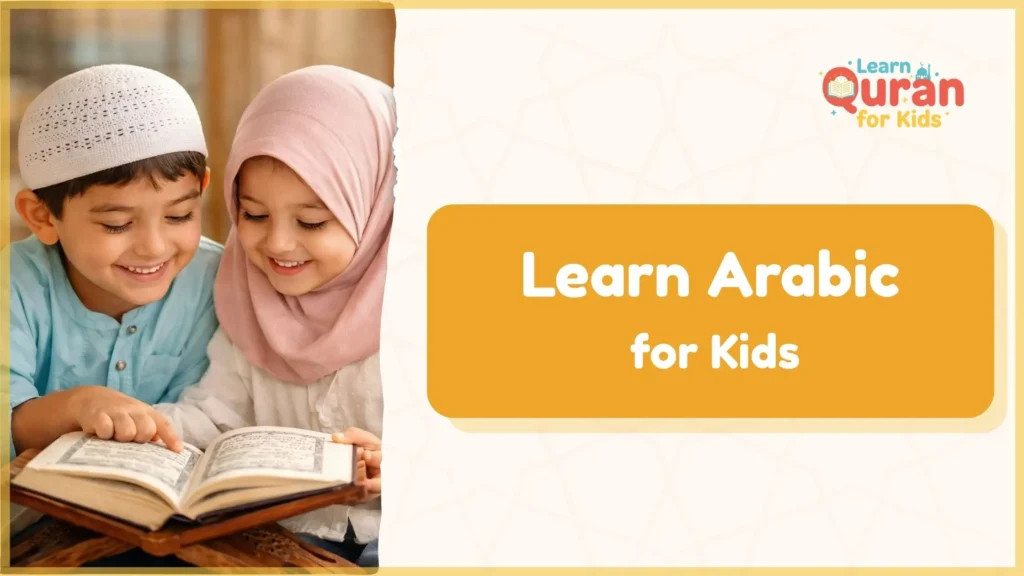
 Learn Arabic
In many Muslim homes, a child’s first Arabic words are more than sounds—they are prayers, greetings, and tiny bridges to faith. When children speak full sentences instead of scattered vocabulary, Arabic becomes alive, personal, and woven into daily routines.
Structured Arabic sentences help young learners grasp grammar naturally, build conversational confidence, and strengthen Quran readiness. From essential greetings and Islamic phrases to family expressions, daily activities, numbers, and progressive structures, children develop fluency step by step through meaningful, real-life language practice.
Why Arabic Sentences for Kids Matter for Early Language Development?
Learning complete Arabic sentences helps children grasp language structure naturally, unlike isolated vocabulary words. Young minds absorb grammar patterns through repetition of meaningful phrases.
Children who learn Arabic sentences early develop stronger reading comprehension when they begin Quran studies. The sentence context makes memorization easier and more enjoyable for kids.
Complete sentences also build conversational confidence. Your child feels accomplished when they can express complete thoughts in Arabic, not just single words.
At Kids Learning Quran Academy, our Online Arabic Classes for Kids introduce sentence structures through interactive games and visual storytelling. Certified instructors use age-appropriate methods that keep young learners engaged.
Start your kid’s Arabic journey with a free lesson

Essential Greeting Arabic Sentences for Kids to Practice Daily
Greetings form the foundation of conversational Arabic. These phrases are perfect starting points for beginners aged 4-8.
السَّلَامُ عَلَيْكُمْ
As-salāmu ʿalaykum
“Peace be upon you.”
This universal Islamic greeting teaches respect and connection. Encourage your child to use it daily at home.
صَبَاحُ الْخَيْرِ
Ṣabāḥul-khayr
“Good morning.”
مَسَاءُ الْخَيْرِ
Masā’ul-khayr
“Good evening.”
These time-specific greetings help children understand Arabic’s natural rhythm. Practice them during corresponding parts of the day.
كَيْفَ حَالُكَ؟
Kayfa ḥāluk?
“How are you?”
أَنَا بِخَيْرٍ، الْحَمْدُ لِلَّهِ
Anā bi-khayr, alḥamdu lillāh
“I am fine, praise be to Allah.”
These conversational pairs teach question-and-response patterns. Role-play these exchanges with your child weekly.
Simple Islamic Arabic Sentence to Memorize First
Islamic phrases carry spiritual significance while teaching essential vocabulary. Start with these fundamental expressions.
بِسْمِ اللَّهِ الرَّحْمَٰنِ الرَّحِيمِ
Bismillāhir-Raḥmānir-Raḥīm
“In the name of Allah, the Entirely Merciful, the Especially Merciful.” (Al-Fatihah 1:1)
This opening phrase appears in daily prayers and before meals. Children as young as three can learn it.
الْحَمْدُ لِلَّهِ
Alḥamdu lillāh
“Praise be to Allah.”
Use this after eating, receiving good news, or completing tasks. It builds gratitude consciousness naturally.
اللَّهُ أَكْبَرُ
Allāhu Akbar
“Allah is the Greatest.”
Children hear this during Adhan and prayers. Learning it early creates familiarity with Islamic rituals.
أَسْتَغْفِرُ اللَّهَ
Astaghfirullāh
“I seek forgiveness from Allah.”
This teaches accountability and spiritual awareness age-appropriately. Encourage its use after mistakes.
Our Islamic Studies Courses for Kids at Kids Learning Quran Academy integrate these phrases with character development lessons. Young students learn meanings alongside practical applications.
Book a Free Session for Your Child in the Best Islamic Studies Courses for Kids

Basic Family-Related Arabic Sentences to Use at Home
Family vocabulary makes Arabic personally relevant. These sentences help children describe their world.
هَذَا أَبِي
Hādhā abī
“This is my father.”
هَذِهِ أُمِّي
Hādhihi ummī
“This is my mother.”
أُحِبُّ عَائِلَتِي
Uḥibbu ʿā’ilatī
“I love my family.”
These declarative sentences build confidence through personal connection. Practice them while looking at family photos.
أَخِي يَلْعَبُ
Akhī yalʿabu
“My brother plays.”
أُخْتِي تَقْرَأُ
Ukhtī taqra’u
“My sister reads.”
These subject-verb constructions introduce basic grammar patterns. Children absorb verb conjugation without explicit instruction.
Start Your Child’s Quran Learning Journey Today!
Join Kids Learning Quran Academy and help your child read the Quran with confidence through fun and guided lessons.
Book a Free Trial ClassEveryday Activity Sentences for Kids Learning Language Basics
Action-oriented sentences teach verbs through daily routines. These phrases describe common childhood activities.
أَنَا أَلْعَبُ
Anā alʿabu
“I play.”
أَنَا آكُلُ
Anā ākulu
“I eat.”
أَنَا أَشْرَبُ
Anā ashrabu
“I drink.”
These first-person constructions help children describe their actions. Use them during actual activities for contextual learning.
أَذْهَبُ إِلَى الْمَدْرَسَةِ
Adh’habu ilal-madrasah
“I go to school.”
أُصَلِّي خَمْسَ مَرَّاتٍ
Uṣallī khamsa marrāt
“I pray five times.”
These sentences connect Arabic with daily Islamic practices. They reinforce routine vocabulary naturally.
أَقْرَأُ الْقُرْآنَ
Aqra’ul-Qur’ān
“I read the Quran.”
This phrase combines language learning with spiritual identity. Children feel proud using Arabic for religious activities.
Read Also: Arabic Kids Books
Color and Number Sentences for Kids Building Vocabulary
Descriptive sentences teach adjectives through concrete concepts. Colors and numbers create visual learning opportunities.
السَّمَاءُ زَرْقَاءُ
As-samā’u zarqā’u
“The sky is blue.”
الشَّجَرَةُ خَضْرَاءُ
Ash-shajaratu khaḍrā’u
“The tree is green.”
These noun-adjective combinations demonstrate gender agreement naturally. Point to objects while practicing these sentences.
عِنْدِي ثَلَاثَةُ كُتُبٍ
ʿIndī thalāthatu kutub
“I have three books.”
أَرَى خَمْسَةَ طُيُورٍ
Arā khamsata ṭuyūr
“I see five birds.”
Number sentences teach counting in meaningful contexts. Use them during everyday observations with your child.
Read Also: Arabic Games for Kids
| Arabic Number | Transliteration | English |
| وَاحِد | Wāḥid | One |
| اثْنَان | Ithnān | Two |
| ثَلَاثَة | Thalāthah | Three |
| أَرْبَعَة | Arbaʿah | Four |
| خَمْسَة | Khamsah | Five |
These foundational numbers appear frequently in Quranic contexts. Early familiarity helps with later Tajweed studies.
Read Also: Arabic Words for Kids
Question-Based Arabic Sentences for Kids to Develop Communication
Question sentences teach critical thinking alongside language structure. These interrogatives build conversational skills.
مَا اسْمُكَ؟
Mā ismuk?
“What is your name?”
كَمْ عُمْرُكَ؟
Kam ʿumruk?
“How old are you?”
These personal questions encourage self-expression in Arabic. Practice question-answer pairs during family time.
أَيْنَ الْكِتَابُ؟
Ayna al-kitāb?
“Where is the book?”
مَتَى نَذْهَبُ؟
Matā nadh’habu?
“When do we go?”
Location and time questions develop spatial and temporal vocabulary. Use them during daily transitions.
لِمَاذَا تَبْكِي؟
Limādhā tabkī?
“Why are you crying?”
This empathy question teaches emotional vocabulary. It demonstrates Arabic’s expressive capacity beautifully.
Read Also: Learning Arabic Numbers for Kids
Start Your Child’s Quran Learning Journey Today!
Join Kids Learning Quran Academy and help your child read the Quran with confidence through fun and guided lessons.
Book a Free Trial ClassRead Also: Arabic Alphabet Learning for Kids
Progressive Arabic Sentences Advancing Beyond Basics
Once children master simple sentences, introduce more complex structures. These phrases build linguistic sophistication.
أُرِيدُ أَنْ أَتَعَلَّمَ الْعَرَبِيَّةَ
Urīdu an ataʿallama al-ʿarabiyyah
“I want to learn Arabic.”
This compound sentence expresses desire and intention. It teaches the infinitive structure naturally.
أُحِبُّ الْقُرْآنَ لِأَنَّهُ كَلَامُ اللَّهِ
Uḥibbu al-Qur’āna li’annahu kalāmullāh
“I love the Quran because it is Allah’s word.”
This causal sentence develops reasoning expression. Children learn to connect ideas logically.
عِنْدَمَا أَسْتَيْقِظُ، أَقُولُ الْحَمْدُ لِلَّهِ
ʿIndamā astayqiẓu, aqūlu alḥamdu lillāh
“When I wake up, I say Alhamdulillah.”
Temporal clauses teach sequencing and routine description. These structures prepare children for Quranic grammar.
Kids Learning Quran Academy’s Quran Memorization for Kids program offers proven, child-friendly techniques that make memorization enjoyable. Students aged 5-15 build strong retention through interactive methods.
Book a Free Trial for Your Child in the Best Hifz Course for Kids
Read Also: How to Learn Arabic for Kids?
Start Your Child’s Arabic Language Journey at Kids Learning Quran Academy Today
Teaching Arabic sentences gives your child linguistic tools for lifelong Islamic learning. These simple phrases build confidence, vocabulary, and spiritual connection simultaneously.
Kids Learning Quran Academy offers specialized programs designed specifically for young non-Arabic speakers:
- Certified instructors experienced in teaching children ages 4-15
- Age-appropriate, engaging methods that make Arabic fun
- 1-on-1 personalized attention adapting to each child’s pace
- Flexible scheduling accommodating busy family routines
- Safe, monitored online learning environment with progress tracking
- Interactive, gamified experiences keeping young learners motivated
- Free trial session to experience our child-centered approach
Our Online Arabic Classes for Kids transform sentence learning into exciting adventures. Children develop fluency through stories, games, and meaningful conversations.
Check out our top courses for children in Hifz Quran, Arabic language skills, and Islamic studies:
- Online Arabic Classes for Kids
- Noorani Qaida for Kids
- Tajweed for kids
- Quran Reading Course for Kids
- Quran Memorization Course for Kids
- Quran Tafseer for Kids
- Islamic Studies Courses for Kids
Enroll your child now for a free trial class to start his Quran and Arabic Path.
Conclusion
Complete Arabic sentences give children more than linguistic skills—they offer clarity, confidence, and connection. Through greetings, question forms, and daily expressions, young learners internalize grammar patterns without pressure, building a strong foundation for reading and Quran studies.
Islamic phrases such as Bismillah, Alhamdulillah, and simple prayer-related sentences nurture spiritual awareness alongside vocabulary growth. Language becomes tied to gratitude, responsibility, and routine worship, shaping both communication skills and character development.
With structured guidance, interactive learning, and age-appropriate progression, children can move from basic greetings to compound sentences with ease. Consistent sentence practice transforms Arabic from a subject into a living language that supports lifelong Quranic understanding and Islamic identity.
Related Articles
Learn Arabic

Leave a Reply