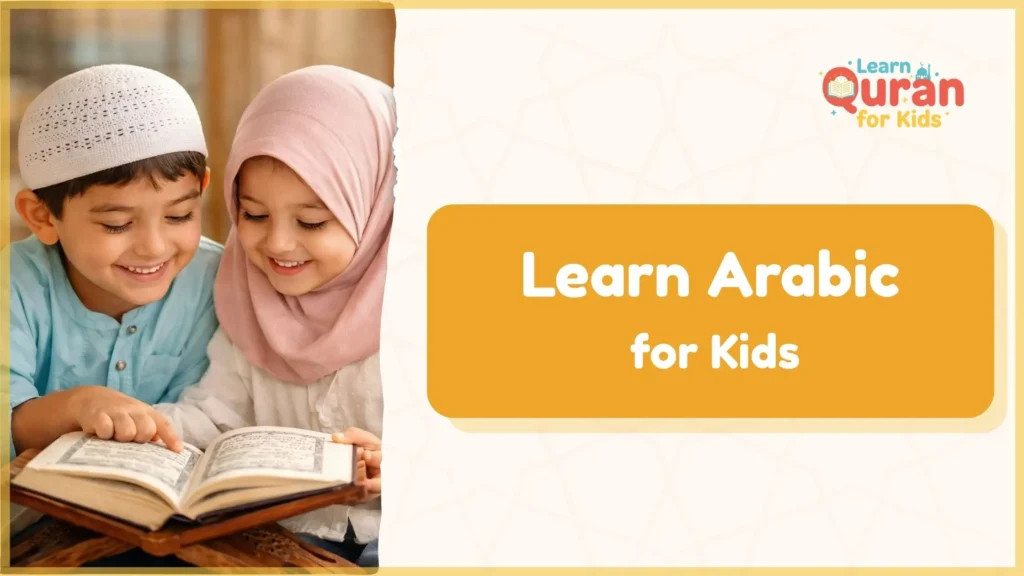
 Learn Arabic
From Alif to Hamza, kids learn each letter through visual cues, dot patterns, and hands-on writing—then level up by spotting letter families (like Baa–Taa–Thaa) and practicing real words.
Along the way, Arabic pronunciation skills grow with articulation games, emphatic-letter training, and gradual reading connections.
1. Alif (ا) is The First Letter in Arabic Alphabet Learning for Kids
Alif is the foundation of Arabic alphabet learning for kids. This tall, straight letter appears in numerous Quran words and is the easiest starting point for young learners.
Children should practice Alif through visual association. Draw a standing stick or tall tree to help them remember its shape. The letter produces three sounds depending on its vowel mark: “a” (fatha), “i” (kasra), or “u” (damma).
Teaching Alif to Young Learners
Start with the standing form of Alif. Show children how it appears at the beginning, middle, and end of words. Use common Quranic words like “Allah” (الله) to demonstrate practical application.
| Alif Form | Position | Example Word | Meaning |
| ا | Beginning | الله (Allah) | Allah |
| ـا | Middle | نَار (naar) | Fire |
| ـا | End | دُنْيَا (dunya) | World |
Practice writing Alif from top to bottom in one smooth stroke. Children aged 4-6 benefit from large-format tracing, while older students can work in standard notebooks.
At Kids Learning Quran Academy, our Online Arabic Classes for Kids introduce Alif through interactive games where children trace the letter in sand boxes or air writing, making muscle memory development natural and fun.
Start your kid’s Arabic journey with a free lesson

2. Arabic Alphabet Learning for Kids Continues with Baa (ب)
Baa introduces children to the concept of dots in Arabic letters. This boat-shaped letter with one dot underneath teaches kids that dots distinguish similar letter shapes.
The Baa sound resembles the English “b” sound. Children easily connect this familiar sound to the new Arabic letter, building confidence in their Arabic alphabet learning for kids experience.
Differentiating Baa from Similar Letters
Baa, Taa, and Thaa share identical base shapes but differ in dot placement. Teach children the “dot counting game” where they identify letters by counting dots: one dot below (Baa), two dots above (Taa), three dots above (Thaa).
| Letter | Dots | Sound | Memory Tip for Kids |
| ب (Baa) | 1 below | “b” | One dot at the bottom like a boat anchor |
| ت (Taa) | 2 above | “t” | Two eyes looking up |
| ث (Thaa) | 3 above | “th” | Three dots like a crown |
This systematic approach prevents confusion and strengthens letter recognition skills essential for Quran reading.
3. Taa (ت) – Building Arabic Letter Recognition for Kids
Taa features the same boat shape as Baa but carries two dots above. Young learners appreciate the pattern emerging in Arabic alphabet structure.
The Taa sound matches the English “t” sound. Connect it to familiar words children know, making Arabic alphabet for kids learning relatable and memorable.
Letter Connection Practice with Taa
Introduce simple words containing Taa. Show children how Taa connects to other letters, changing its form based on position within words.
Practice writing connected Taa versus isolated Taa. This fundamental skill prepares children for fluent Arabic reading and Quranic text recognition.
Start Your Child’s Quran Learning Journey Today!
Join Kids Learning Quran Academy and help your child read the Quran with confidence through fun and guided lessons.
Book a Free Trial Class4. The Arabic Letter Thaa (ث)
Thaa completes the Baa-Taa-Thaa family with three dots positioned above the base shape. This letter introduces the “th” sound as in “think.”
Children find Thaa challenging initially because the “th” sound doesn’t exist in all languages. Extra practice time ensures proper pronunciation development.
Pronunciation Practice for Thaa
Use mirror practice for Thaa pronunciation. Children watch their tongue placement between teeth while producing the sound.
Incorporate Thaa-containing words from daily Arabic vocabulary. Repetition through meaningful words accelerates Arabic alphabet learning for kids more effectively than isolated letter drills.
Working with qualified certified instructors at Kids Learning Quran Academy through our Qaida for Kids course provides the patient, age-appropriate instruction needed to master letter variations like Thaa, with flexible scheduling that fits family routines.
Enroll your child in Noorani Qaida for kids with a free trial class
5. Jeem (ج) – The Hook-Shaped Letter in Arabic
Jeem introduces a new letter shape resembling a hook or smile with one dot inside. This unique form excites young learners exploring Arabic alphabet diversity.
The Jeem sound resembles the “j” in “jump.” Children readily connect this familiar sound to the distinctive letter shape.
Visual Memory Techniques for Jeem
Create Jeem crafts using curved pipe cleaners or playdough. Hands-on activities strengthen letter shape memory in young children.
Show Jeem in Quranic context. The word “Jannah” (جنة) provides meaningful motivation for Arabic alphabet for kids mastery.
6. Haa (ح) – The Breathed Letter in Arabic
Haa appears similar to Jeem but without the dot. This letter teaches children the strong “h” sound produced from the chest.
Distinguishing Haa from regular “h” develops proper Tajweed foundations. Children learn that Arabic contains sounds requiring specific articulation points.
| Letter Pair | Visual Difference | Sound Difference | Articulation Point |
| ج (Jeem) | One dot inside | “j” sound | Tongue middle |
| ح (Haa) | No dot | Strong “h” from chest | Chest/throat |
| خ (Khaa) | One dot above | “kh” throaty sound | Upper throat |
Articulation Point Teaching
Guide children to place their hand on their chest while pronouncing Haa. They feel the vibration from the correct articulation point.
This physical awareness builds Tajweed consciousness from the earliest stages of Arabic alphabet learning for kids.
Kids Learning Quran Academy’s Tajweed for Kids course offers proven, child-friendly techniques that make pronunciation mastery enjoyable for students who are beginning their Quranic studies, ensuring strong articulation skills through interactive methods.
Enroll your child in Tajweed for kids with a free trial class

7. Khaa (خ) – The Throaty Sound in Arabic
Khaa resembles Haa and Jeem in shape but carries one dot above. This letter produces the throaty “kh” sound unfamiliar to English speakers.
Children practice Khaa by mimicking the sound of gentle gargling. This playful approach removes pronunciation anxiety.
Making Khaa Fun for Children
Use words children find amusing. “Khubz” (bread) in Arabic becomes a fun practice word that connects language learning with daily life.
Regular practice prevents letter confusion within the Jeem-Haa-Khaa family. Consistent review sessions strengthen retention.
Start Your Child’s Quran Learning Journey Today!
Join Kids Learning Quran Academy and help your child read the Quran with confidence through fun and guided lessons.
Book a Free Trial Class8. Daal (د) – The Simple Standing Letter in Arabic
Daal appears as a small standing line with a curve at the top. Its simplicity appeals to young learners progressing through Arabic alphabet for kids.
The Daal sound matches the English “d” sound perfectly. This familiar connection accelerates learning and builds student confidence.
9. Dhaal (ذ) is a Daal with a Dot
Introduce Dhaal (ذ) alongside Daal. The single dot above distinguishes Dhaal’s “th” sound (as in “that”) from Daal’s “d” sound.
| Letter | Shape | Sound | English Example |
| د (Daal) | Standing curve | “d” | Door |
| ذ (Dhaal) | Standing curve + dot | “th” | That |
Practice minimal pairs containing Daal and Dhaal. This comparative approach sharpens children’s listening and pronunciation skills.
10. Raa (ر) – The Rolling Letter in Arabic
Raa features a distinctive curve that children often describe as a “little nose.” This letter introduces the rolled “r” sound.
Rolling the Raa requires tongue tip vibration against the upper palate. Children master this through consistent, patient practice.
Developing the Rolled R Sound
Start with short vibration attempts. Children gradually extend the rolling duration as tongue muscles strengthen.
Use Arabic names containing Raa. “Rahman” (الرحمن) from Surah Al-Fatihah provides meaningful practice context.
بِسْمِ ٱللَّهِ ٱلرَّحْمَـٰنِ ٱلرَّحِيمِ
Bismillahir-Rahmanir-Raheem
“In the name of Allah, the Entirely Merciful, the Especially Merciful.” (Al-Fatihah 1:1)
For families teaching Quran reading at home, the Al-Menhaj Book by Luqman ElKasabany offers a systematic learn-to-read-Quran curriculum specifically designed for non-Arabic speakers, covering Arabic alphabet and reading fundamentals step-by-step including proper Raa pronunciation.
11. Zaa (ز) – Adding the Dot to Raa
Zaa shares Raa’s shape but includes one dot above. This letter produces the “z” sound as in “zebra.”
Children appreciate the pattern: Raa and Zaa follow the same relationship as Daal and Dhaal—base shape plus dot creates sound variation.
Pattern Recognition in Arabic Letters
Highlight letter families during Arabic alphabet learning for kids. Pattern awareness accelerates memorization and reduces confusion.
| Letter Family | Base Letter | With Dot | Pattern |
| Daal Family | د (d) | ذ (th) | Add dot above |
| Raa Family | ر (r) | ز (z) | Add dot above |
| Seen Family | س (s) | ش (sh) | Add 3 dots above |
Create family charts showing letter groups. Visual organization supports children’s natural pattern-seeking cognitive abilities.
12. Seen (س) – The Three-Tooth Letter
Seen features three distinctive peaks resembling small teeth. This unique shape makes Seen highly memorable for young learners.
The Seen sound matches the English “s” sound. Children connect it easily to familiar words.
Seen versus Sheen Practice
Introduce Sheen (ش) immediately after Seen. The three dots above Sheen create the “sh” sound, differentiating it from Seen’s “s” sound.
Practice writing both letters consecutively. Side-by-side comparison strengthens differentiation skills essential for Arabic reading fluency.
13. Saad (ص) – The Emphatic Letter in Arabic
Saad resembles Seen but features a closed, oval loop. This letter introduces children to emphatic Arabic sounds.
The emphatic Saad requires deeper throat resonance than regular “s.” Children develop this through guided practice with certified instructors.
Kids Learning Quran Academy’s Quran Recitation Course for Kids provides expert guidance in mastering emphatic letters like Saad, ensuring children develop proper Tajweed from the foundational stage.
Understanding Emphatic Letters
Explain that some Arabic letters sound “heavier” than their lighter counterparts. Saad versus Seen demonstrates this concept clearly.
| Regular Letter | Emphatic Letter | How Kids Feel It |
| س (Seen – s) | ص (Saad – emphatic s) | Heavier, deeper sound |
| د (Daal – d) | ض (Daad – emphatic d) | Tongue pressed down |
| ت (Taa – t) | ط (Taa – emphatic t) | Stronger, fuller sound |
Use body percussion alongside pronunciation. Stomping feet while saying Saad helps children feel the emphatic quality.
Start Your Child’s Quran Learning Journey Today!
Join Kids Learning Quran Academy and help your child read the Quran with confidence through fun and guided lessons.
Book a Free Trial Class14. Daad (ض) – The Unique Arabic Letter
Daad holds special significance as the letter unique to Arabic language. Its shape resembles Saad but includes one dot above.
The emphatic Daad sound requires specific tongue placement. Children master this distinctive pronunciation through patient, consistent practice.
Celebrating Daad’s Uniqueness
Share that Arabic is sometimes called “the language of Daad” because no other language contains this exact sound.
This cultural insight motivates children in their Arabic alphabet for kids studies. They appreciate learning something truly special.
15. Taa (ط) – The Emphatic T in Arabic
Taa (emphatic) produces a stronger, fuller “t” sound than regular Taa (ت). This letter introduces children to another emphatic pronunciation.
Understanding the difference between light and heavy letters develops children’s phonetic awareness essential for proper Quran recitation.
Emphatic Taa Practice Techniques
Guide children to press their tongue firmly while pronouncing emphatic Taa. This physical action creates the distinctive heavy sound.
Compare words with regular versus emphatic Taa. This direct comparison clarifies the pronunciation distinction for young learners.
16. Thaa (ظ) – The Emphatic TH in The Arabic Alphabet
Thaa (emphatic) resembles emphatic Taa but includes one dot above. This letter produces an emphatic “th” sound rare in world languages.
Children find emphatic Thaa challenging. Extra practice time and patience ensure successful mastery during Arabic alphabet learning for kids.
| Light Letter | Heavy/Emphatic Letter | Dot Difference |
| ت (Taa – t) | ط (Taa emphatic) | No dots vs no dots (shape differs) |
| ث (Thaa – th) | ظ (Thaa emphatic) | 3 dots above vs 1 dot above |
Emphatic Letter Mastery
Practice emphatic letters consistently throughout Arabic learning journey. Regular exposure develops natural pronunciation habits.
Celebrate pronunciation improvements enthusiastically. Positive reinforcement maintains children’s motivation through challenging learning phases.
17. Ain (ع) – The Deep Throat Letter in The Arabic
Ain features a distinctive circular shape. This letter produces a deep, guttural sound challenging for non-Arabic speakers.
Children learn Ain by imagining they’re swallowing while speaking. This visualization helps them find the correct articulation point.
Working with qualified certified instructors at Kids Learning Quran Academy through our Tajweed for Kids course provides the patient, age-appropriate instruction needed to master challenging letters like Ain, with flexible scheduling that fits family routines.
Read Also: Arabic Games for Kids
Ain Articulation Games
Create fun “Ain challenges” where children try to produce the sound correctly. Celebrating small improvements maintains motivation.
Use mirror practice so children observe their throat and mouth position. Visual feedback enhances learning effectiveness.
Read Also: Arabic Sentences for Kids
18. Ghain (غ) – Ain with a Dot
Ghain resembles Ain but carries one dot above. This letter produces the “gh” sound similar to French “r.”
The dot changes Ain’s deep sound to Ghain’s rolling, throaty sound. Children appreciate how one small dot creates significant sound differences.
Comparing Ain and Ghain
Practice alternating between Ain and Ghain pronunciation. This direct comparison clarifies the distinction and prevents confusion.
Use Arabic words containing both letters. This real-world application makes Arabic alphabet learning for kids practically relevant.
19. Faa (ف) – The Dotted Circle
Faa features a circular shape with one dot above. This letter produces the “f” sound identical to English.
The familiar Faa sound provides children a comfortable moment in their Arabic alphabet for kids progression.
Faa versus Qaaf Distinction
Introduce Qaaf (ق) alongside Faa. Despite similar appearance, Qaaf carries two dots above and produces a deep “q” sound from the throat.
| Letter | Dots | Sound | Articulation |
| ف (Faa) | 1 dot above | “f” | Lips and teeth |
| ق (Qaaf) | 2 dots above | Deep “q” | Deep throat |
Practice distinguishing these letters develops careful observation skills essential for Arabic literacy.
20. Qaaf (ق) – The Deep Q Sound
Qaaf’s two dots above its circular base create the deep, emphatic “q” sound. This letter originates from deep in the throat.
Children find Qaaf challenging initially. Consistent practice with proper guidance ensures eventual mastery.
Qaaf Pronunciation Development
Guide children to say “k” then push the sound deeper into their throat. This progression helps them locate Qaaf’s articulation point.
Celebrate pronunciation improvements enthusiastically. Positive reinforcement maintains children’s motivation through challenging learning phases.
Start Your Child’s Quran Learning Journey Today!
Join Kids Learning Quran Academy and help your child read the Quran with confidence through fun and guided lessons.
Book a Free Trial Class21. Kaaf (ك) – The Regular K Sound
Kaaf produces the standard “k” sound. Its distinctive shape resembles a small cup or container.
Understanding Kaaf versus Qaaf distinction teaches children that Arabic contains both regular and emphatic sound versions.
Writing Kaaf Correctly
Show children how Kaaf’s shape changes based on position within words. Initial, medial, and final forms require separate practice.
| Kaaf Position | Form | Example Word |
| Isolated | ك | (Standalone letter) |
| Initial | كـ | كِتَاب (kitaab – book) |
| Medial | ـكـ | مَكْتَب (maktab – office) |
| Final | ـك | مَلِك (malik – king) |
This shape-shifting characteristic of Arabic letters prepares children for connected reading fluency.
22. Laam (ل) – The Standing Letter
Laam stands tall like Alif but includes a distinctive curve at the top. This letter produces the “l” sound.
Laam frequently appears in Quranic text, making it essential for Arabic alphabet for kids mastery.
Special Laam-Alif Combination
Teach children that Laam and Alif together create a special combined form (لا). This unique ligature appears frequently in Arabic writing.
The word “Laa” (لا) meaning “no” provides practical practice context children understand easily.
23. Meem (م) – The Complete Circle with a Small Tail
Meem features a perfectly round circle with a small tail. This letter produces the “m” sound.
Children enjoy Meem’s simple, symmetrical shape. It provides a confidence-building success in letter mastery.
Meem in Important Words
Practice Meem through meaningful Islamic words. “Muhammad” (محمد), “Muslim” (مسلم), and “Mu’min” (مؤمن) connect letter learning with faith identity.
This meaningful practice motivates children more effectively than abstract letter drills.
24. Noon (ن) – The Bowl with Dot
Noon resembles a bowl shape with one dot above. This letter produces the “n” sound.
Understanding Noon prepares children for important Tajweed rules related to Noon Saakin and Tanween.
Noon Tajweed Introduction
Introduce basic Noon rules age-appropriately. Children learn that Noon’s pronunciation changes based on the following letter.
| Noon Rule | When It Happens | Child-Friendly Explanation |
| Idghaam | Before certain letters | Noon merges with next letter |
| Ikhfaa | Before most letters | Noon becomes soft and nasal |
| Iqlaab | Before ب | Noon sounds like Meem |
| Idhaar | Before throat letters | Noon pronounced clearly |
This foundational awareness prepares them for advanced Tajweed study as they mature.
25. Haa (ه) – The Gentle H
Haa (different from the earlier Haa ح) produces a soft “h” sound. Its shape varies significantly based on word position.
Children practice all Haa forms: initial, medial, final, and isolated. Each requires separate recognition practice.
Haa Shape Recognition
Create matching games where children connect different Haa forms. This playful approach strengthens shape recognition skills.
Show Haa in the name “Allah” (الله). This meaningful context emphasizes the letter’s importance.
26. Waaw (و) – The Standing Comma
Waaw resembles a standing comma or number nine. This letter produces “w” sound or functions as a long vowel.
Understanding Waaw’s dual function as consonant and vowel develops children’s Arabic grammar awareness.
Waaw as Long Vowel
Teach children that Waaw extends the “oo” sound. Practice with words like “Noor” (نور) meaning light.
| Waaw Function | Sound | Example Word | Meaning |
| Consonant | “w” | وَلَد (walad) | Boy |
| Long Vowel | “oo” | نُور (noor) | Light |
This vowel function understanding prepares children for proper Quran recitation rhythm and flow.
27. Yaa (ي) – The Two-Dot Letter
Yaa features two dots beneath its curved base. This letter produces “y” sound or functions as a long vowel.
Like Waaw, Yaa serves dual purposes. Children learn to identify its function through context.
Yaa Recognition Practice
Practice words where Yaa functions as consonant (“yawm” – day) versus vowel (“Kareem” – generous).
This contextual understanding develops reading comprehension alongside letter recognition during Arabic alphabet learning for kids.
Read Also: Arabic Kids Books
28. Hamza (ء) – The Glottal Stop
Hamza represents a glottal stop—a sound made by briefly closing the throat. It sits on different “seats” (Alif, Waaw, Yaa, or alone).
Children understand Hamza through the pause in “uh-oh.” This familiar example clarifies the concept.
Read Also: Learning Arabic Numbers for Kids
Hamza Seat Rules
Introduce simple Hamza rules age-appropriately. Children learn that Hamza’s seat depends on surrounding vowels.
| Hamza Seat | Example | When Used |
| On Alif | أ / إ | Beginning of words, certain vowel patterns |
| On Waaw | ؤ | After or before “oo” sound |
| On Yaa | ئ | After or before “ee” sound |
| Alone | ء | Specific positions |
Advanced understanding develops gradually. Initial exposure plants seeds for future detailed study.
Read Also: How to Learn Arabic for Kids?
Start Your Child’s Quran Learning Journey Today!
Join Kids Learning Quran Academy and help your child read the Quran with confidence through fun and guided lessons.
Book a Free Trial ClassRead Also: Learn Arabic for Kids
Start Your Child’s Arabic Alphabet Learning Journey Today
Mastering the Arabic alphabet opens Quranic literacy for your child. These 28 letters form the foundation for meaningful Islamic knowledge and spiritual connection.
Kids Learning Quran Academy offers comprehensive Arabic education designed specifically for young non-Arabic speaking Muslims:
- Certified instructors specialized in teaching children aged 4-15
- Age-appropriate, engaging teaching methods that make learning enjoyable
- 1-on-1 personalized attention ensuring your child’s unique needs are met
- Flexible scheduling that accommodates your family’s routine
- Interactive, gamified learning experiences that maintain children’s interest
- Safe, monitored online environment with progress tracking for parents
- Free trial session to experience our child-centered approach
Check out our top courses for children in Hifz Quran, Arabic language skills, and Islamic studies:
- Online Arabic Classes for Kids
- Noorani Qaida for Kids
- Tajweed for kids
- Quran Reading Course for Kids
- Quran Memorization Course for Kids
- Quran Tafseer for Kids
- Islamic Studies Courses for Kids
Enroll your child now for a free trial class to start his Quran and Arabic Path.

Conclusion
Step-by-step letter mastery starts with shape recognition and writing practice, then expands through smart comparisons: dots above or below, similar bases, and special pairs like Daal/Dhaal or Raa/Zaa. This pattern-first approach reduces confusion and speeds up Arabic reading readiness.
Pronunciation matters just as much as memorization. Letters like Haa, Khaa, Ain, and Qaaf build strong Tajweed foundations when children learn where sounds “live” in the mouth and throat, using simple body cues, mirrors, and playful repetition with meaningful vocabulary.
With consistent review and supportive instruction, the 28 letters become a clear pathway to Quranic literacy, stronger recitation, and deeper Islamic learning. A structured program—interactive, age-appropriate, and guided by certified teachers—helps children stay motivated and progress with confidence.
Related Articles
Learn Arabic

Leave a Reply